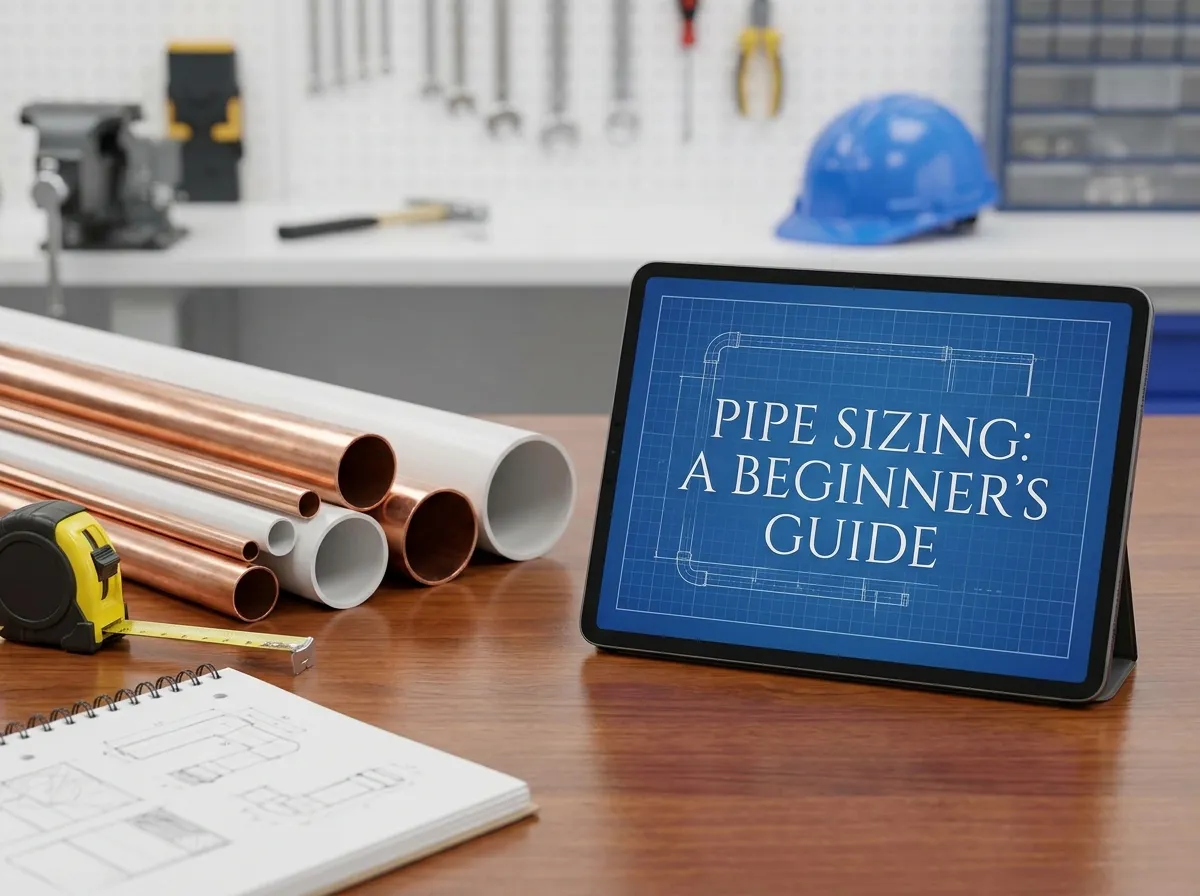

A ½-inch pipe sounds small, but get the size wrong, and you'll end up with a bathroom tap that dribbles instead of flows. Pipe sizing is one of the most misunderstood parts of any home plumbing project, and it trips up beginners and experienced DIYers alike. The good news? Once you understand a few core rules, choosing the right pipe size becomes straightforward.
This guide walks you through everything you need to know: what "pipe size" actually means (hint: it's not what the label says), how diameter affects water flow, standard sizes for supply and drain lines, and worked examples using both metric and imperial measurements.
Quick Reference: Pipe Sizing at a Glance
| Application | Recommended Size (Imperial) | Recommended Size (Metric) |
|---|---|---|
| Main water supply line | ¾ inch – 1 inch | 19 mm – 25 mm |
| Branch supply lines | ½ inch | 15 mm |
| Bathroom basin drain | 1¼ inch – 1½ inch | 32 mm – 40 mm |
| Shower/bath drain | 2 inch | 50 mm |
| Toilet drain | 3 inch – 4 inch | 75 mm – 100 mm |
| Kitchen sink drain | 1½ inch | 40 mm |
| Soil/sewer main | 4 inch | 100 mm |
Key formula for pipe internal volume: V = π × r² × h (where r = internal radius, h = length)
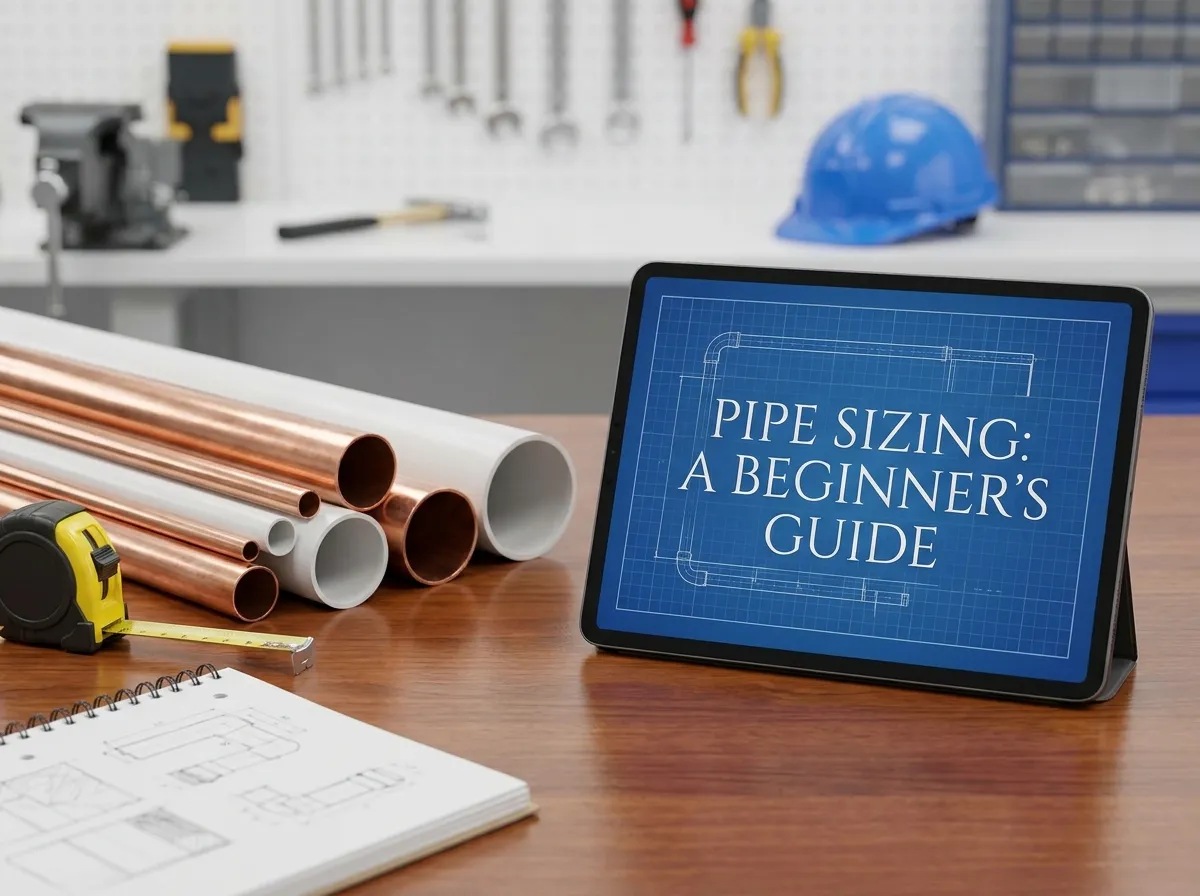
A Beginner's Guide to Pipe Sizing for Plumbing Projects
What Is Pipe Sizing — and Why Does It Matter?
Pipe sizing refers to selecting the correct diameter for a pipe so it delivers the right volume of water (or removes waste) at the right pressure. Choose too small, and you restrict flow — resulting in weak pressure, slow drains, or overloaded systems. Choose too large, and you waste money on materials and may actually reduce flow velocity in drain lines, which causes solids to settle and block.
For anyone setting up or upgrading their home's water infrastructure, pipe sizing is foundational. It affects how well water reaches every fixture, how efficiently waste drains away, and whether your project passes a building inspection. If you want your home to have truly efficient home plumbing systems, sizing is the place to start.
Understanding Pipe Size Terminology (NPS, OD, ID)
This is where most beginners get confused, and understandably so. Plumbing pipe labels are counterintuitive.
Nominal Pipe Size (NPS) vs. Actual Diameter
A "½-inch pipe" does not have a ½-inch outer diameter. Instead, it uses a system called Nominal Pipe Size (NPS) — a standardized labeling convention inherited from iron pipe manufacturing in the 19th century. The nominal size is loosely related to the pipe's internal flow capacity, not its actual measurement.
Here's what the numbers actually look like:
| Nominal Size | Actual OD (Outside Diameter) |
|---|---|
| ½ inch | 0.840 inch (21.3 mm) |
| ¾ inch | 1.050 inch (26.7 mm) |
| 1 inch | 1.315 inch (33.4 mm) |
| 1½ inch | 1.900 inch (48.3 mm) |
| 2 inch | 2.375 inch (60.3 mm) |
Practical tip: Always measure the outside diameter when identifying a pipe you already have, then use an NPS chart to confirm the nominal size. Don't guess based on what "looks like" ¾ inch.
Inside Diameter (ID) vs. Outside Diameter (OD)
The inside diameter (ID) is what actually determines flow capacity. It varies based on the pipe's schedule (wall thickness):
- Schedule 40 (standard residential): thinner walls, larger ID, lower pressure rating
- Schedule 80: thicker walls, smaller ID, higher pressure rating — used in commercial or high-pressure settings
For a nominal ½-inch PVC pipe:
- Schedule 40 ID = 0.622 inch (15.8 mm)
- Schedule 80 ID = 0.546 inch (13.9 mm)
That difference matters when calculating flow. Always confirm the schedule before ordering.
How Pipe Diameter Affects Water Flow — The Math Explained
Here's something that surprises most people: doubling a pipe's diameter doesn't double its flow capacity — it quadruples it. This is because flow capacity depends on the pipe's cross-sectional area, which follows the formula for a circle:
Area = π × r²
If you increase the radius (r) by a factor of 2, the area increases by a factor of 4 (since you square the radius). This is why stepping up just one pipe size makes a significant difference.
Pipe Internal Volume: The Cylinder Connection
A pipe is, geometrically, a hollow cylinder. Its internal volume over any given length equals:
V = π × r² × h
Where:
- π ≈ 3.14159
- r = internal radius (ID ÷ 2)
- h = pipe length
This formula tells you how much water a pipe holds and — combined with flow velocity — how much it can deliver per second. For quick checks during planning, a free tool to calculate cylinder volume makes it easy to compare pipe sizes before you buy anything.
Worked Example: Comparing ½-inch vs. ¾-inch Supply Line
Let's compare the cross-sectional area (flow capacity) of two common supply line sizes using Schedule 40 PVC:
½-inch pipe (ID = 0.622 in = 1.580 cm):
- Radius = 0.311 in (0.790 cm)
- Area = π × (0.311)² = π × 0.0967 = 0.304 in²
¾-inch pipe (ID = 0.824 in = 2.094 cm):
- Radius = 0.412 in (1.047 cm)
- Area = π × (0.412)² = π × 0.1697 = 0.533 in²
Result: The ¾-inch pipe has 75% more flow area than the ½-inch pipe. For a main supply line serving multiple fixtures, this isn't a small upgrade — it's the difference between adequate water pressure and a household that can't run a shower and a dishwasher at the same time.
Standard Pipe Sizes for Residential Plumbing
Water Supply Lines
Supply lines bring pressurized water to fixtures. Sizing is based on the number of fixtures served and the required flow rate.
- Main supply line entering the house: ¾ inch to 1 inch (19–25 mm). Homes with 3+ bathrooms should use 1 inch minimum.
- Branch lines running to individual fixtures: ½ inch (15 mm) for most taps, toilets, and appliances.
- Hose bibs / outdoor spigots: ½ inch is standard; use ¾ inch if running long distances to maintain pressure.
A good rule of thumb: run a larger main line (¾ inch or 1 inch) to a central manifold, then branch out at ½ inch to individual fixtures. This maintains pressure throughout the home even during peak usage.
Drain, Waste, and Vent (DWV) Pipes
Drain pipes work differently from supply lines — gravity does the work, not pressure. The goal here is to move water and waste quickly enough to prevent clogs, which means larger diameters and correct slope (typically ¼ inch drop per foot of run).
- Kitchen sink drain: 1½ inch (40 mm)
- Bathroom basin drain: 1¼ inch to 1½ inch (32–40 mm)
- Shower and bathtub drain: 2 inch (50 mm)
- Toilet: 3 inch minimum, 4 inch preferred (75–100 mm)
- Main soil stack / sewer line: 4 inch (100 mm)
- Vent pipes: 1½ inch to 2 inch (40–50 mm) typically
Never undersize a toilet drain. A 3-inch pipe is the absolute minimum; most professional plumbers use 4 inch to prevent blockages and comply with local codes.
Step-by-Step: How to Choose the Right Pipe Size for Your Project
Follow these five steps before purchasing any pipe:
Step 1 — Identify the pipe's function. Is it a supply line (pressurized), a drain line (gravity), or a vent line? Each has different sizing rules.
Step 2 — Count the fixtures served. A branch line serving one bathroom sink can be ½ inch. A main line serving 2 bathrooms, a kitchen, and a laundry room needs ¾ inch or larger.
Step 3 — Measure the run length. Longer pipe runs have more friction, which reduces pressure. For runs over 40 feet, size up one nominal size to compensate for pressure loss.
Step 4 — Check local building codes. Minimum sizes vary by region. In most US jurisdictions, the IPC (International Plumbing Code) sets minimums, but your local authority may differ. Always check before starting.
Step 5 — Confirm the material and schedule. PVC Schedule 40 is standard for residential drain lines. CPVC or PEX is common for supply lines. Each material has slightly different actual dimensions for the same nominal size.
Having the essential tools for DIY projects on hand — including pipe cutters, deburring tools, and a reliable tape measure — makes this process much easier when you get to the installation stage.
Worked Examples in Metric and Imperial
Example 1 — Bathroom Sink Supply Line (Imperial)
Scenario: You're installing a new bathroom vanity. The branch line runs 12 feet from a ¾-inch main supply.
- Single fixture: ½-inch branch line is correct
- ID of ½-inch Schedule 40 PVC = 0.622 inch
- Cross-sectional area = π × (0.311)² = 0.304 in²
- Internal volume over 12 feet (144 inches): V = 0.304 × 144 = 43.8 in³ (about 0.75 US pints)
Verdict: ½-inch branch line is the right choice. No need to oversize for a single basin tap.
Example 2 — Garden Water Tank Fill Line (Metric)
Scenario: You're running a supply line to fill a 500-liter garden water tank. The run is 15 meters. You want it to fill in under 30 minutes.
Required flow rate: 500 L ÷ 30 min = 16.7 L/min
A 25 mm (nominal 1-inch) pipe at normal household pressure (~3 bar / 43 psi) can deliver approximately 25–35 L/min. A 20 mm (nominal ¾-inch) pipe delivers around 12–18 L/min.
To verify using internal volume (cylinder formula):
- 20 mm pipe: ID ≈ 16.1 mm, radius = 8.05 mm = 0.805 cm
- Volume per meter of pipe: V = π × (0.805)² × 100 cm = π × 0.648 × 100 = 203.6 cm³ per meter (0.204 L/m)
- Over 15 meters: 0.204 × 15 = 3.06 liters of water held in the pipe at any moment — useful to know for purging and priming.
A free tool to calculate cylinder volume lets you run these comparisons instantly for any pipe dimension.
Verdict: 20 mm (¾-inch equivalent) will just barely meet the 16.7 L/min target at normal household pressure. Use 25 mm (1-inch) for a comfortable margin.
Pipe Sizing Comparison Table
| Nominal Size | OD (inch) | Sch 40 ID (inch) | Sch 40 ID (mm) | Flow Area (in²) | Typical Use |
|---|---|---|---|---|---|
| ½ inch | 0.840 | 0.622 | 15.8 | 0.304 | Branch supply lines, hose bibs |
| ¾ inch | 1.050 | 0.824 | 20.9 | 0.533 | Main supply (small homes), outdoor lines |
| 1 inch | 1.315 | 1.049 | 26.6 | 0.864 | Main supply (larger homes), manifold lines |
| 1½ inch | 1.900 | 1.610 | 40.9 | 2.036 | Kitchen/laundry drains, vent lines |
| 2 inch | 2.375 | 2.067 | 52.5 | 3.355 | Shower drains, vent stacks |
| 3 inch | 3.500 | 3.068 | 77.9 | 7.393 | Toilet drains, branch drain lines |
| 4 inch | 4.500 | 4.026 | 102.3 | 12.73 | Main soil stack, sewer line |
FAQs
What size pipe is used for most home water supply lines? The standard is ¾ inch for main supply lines and ½ inch for branch lines to individual fixtures. Larger homes with 3+ bathrooms benefit from a 1-inch main line to maintain consistent pressure across all fixtures simultaneously.
Why doesn't a ½-inch pipe measure ½ inch? Plumbing uses Nominal Pipe Size (NPS), a historical labeling system where the number loosely reflects internal flow capacity rather than any actual measurement. A nominal ½-inch pipe has an outside diameter of 0.840 inches (21.3 mm). Always check an NPS chart when shopping for fittings.
What's the minimum pipe size for a toilet? The absolute minimum is 3 inches (75 mm), but 4 inches (100 mm) is standard practice and often required by local building codes. Undersizing a toilet drain is a leading cause of repeat blockages.
Does pipe length affect what size I should use? Yes. Longer pipe runs create friction losses that reduce pressure at the tap end. As a general rule, size up one nominal size for supply runs exceeding 30–40 feet (9–12 meters) to compensate for pressure drop.
What is the difference between Schedule 40 and Schedule 80 pipe? Both have the same outside diameter for a given nominal size, but Schedule 80 has thicker walls, resulting in a smaller inside diameter and lower flow capacity. Schedule 80 is rated for higher pressures and is typically used in commercial or industrial applications. Residential plumbing almost exclusively uses Schedule 40.
How do I calculate how much water a pipe can hold? A pipe is a cylinder, so its internal volume = π × r² × h, where r is the internal radius and h is the pipe length. For a 1-inch Schedule 40 pipe (ID = 1.049 in) running 10 feet (120 inches): V = π × (0.5245)² × 120 = π × 0.2751 × 120 = 103.7 in³ (about 0.45 US gallons).
What pipe size do I need for a shower drain? A 2-inch (50 mm) drain pipe is standard for showers. Walk-in showers or wet rooms with high-flow showerheads should use 2-inch minimum; some high-flow designs use 3-inch drains to prevent pooling.
Can I mix metric and imperial pipes in the same system? Not directly — the dimensions don't match. You need proper metric-to-imperial transition fittings (also called adaptors) when connecting different standards. This is common in older homes where original pipes are imperial copper and new additions are metric PVC.




























Sign in to leave a comment.