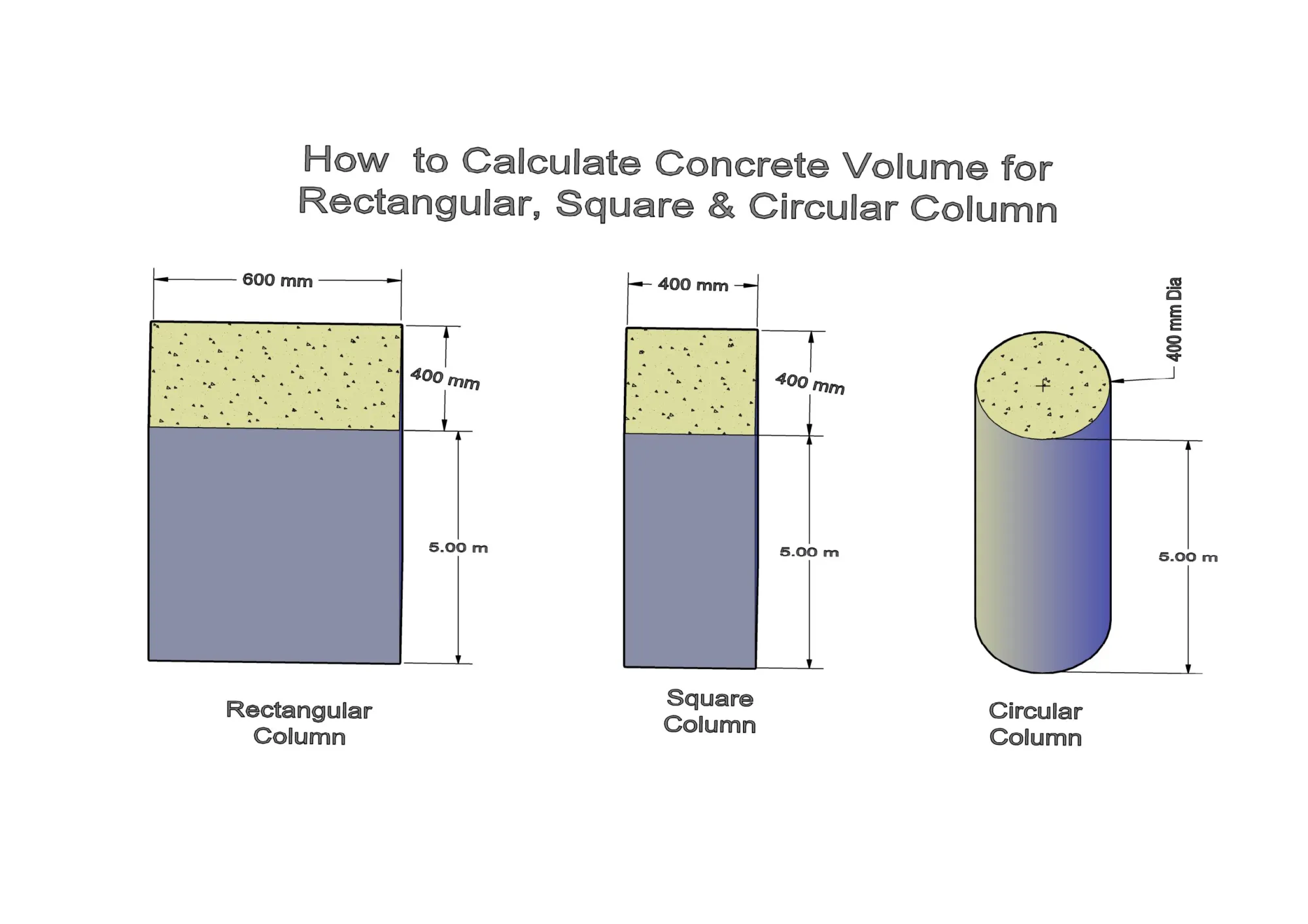

To calculate the concrete needed for a cylindrical column, use the formula V = π × r² × h — where r is the radius (half the diameter) and h is the height. For a column 10 inches in diameter and 4 feet tall, that works out to 0.091 cubic yards, or roughly 4 bags of 80 lb premix. Get that number wrong and you're either stopping mid-pour or ordering a second delivery. Neither is fun.
This guide walks you through the full calculation in both imperial and metric units, with three complete worked examples, a bag-count reference table, and the mistakes that trip up even experienced DIYers.
The Formula at a Glance
| Variable | Meaning | Unit |
|---|---|---|
| V | Volume of concrete | ft³, yd³, or m³ |
| π | Pi (constant) | ≈ 3.14159 |
| r | Radius of column (= diameter ÷ 2) | feet, inches, or meters |
| h | Height (length) of column | same unit as r |
Formula: V = π × r² × h
If you know the diameter instead of the radius: V = π × (d/2)² × h or equivalently V = (π × d² × h) ÷ 4
Both are identical — the second form just skips the halving step.
What You Need Before You Start
Before punching numbers, gather:
- Diameter of the column form (the outside diameter, not inside if using a tube form with thick walls — though for cardboard sonotubes the wall thickness is negligible)
- Height (or depth, for footings) of the pour
- Number of columns in the project
- Rebar count (optional — see the "hollow vs. solid" note below)
- A tape measure, pencil, and either a phone calculator or a reliable Cylinder Volume Calculator for quick double-checking
All measurements must be in the same unit before you apply the formula. Mixing feet and inches in the same calculation is the number-one cause of ordering errors.
Step-by-Step: How to Calculate Concrete for One Cylindrical Column
Step 1 — Measure the Diameter and Convert to Radius
Measure the inside diameter of your column form. Divide by 2 to get the radius.
Example: 12-inch diameter → r = 6 inches = 0.5 feet
Always convert to feet (for imperial) or meters (for metric) before continuing. Working in inches all the way through produces cubic inches, which then requires an extra conversion step (÷ 1,728 for ft³).
Step 2 — Square the Radius
Multiply r by itself.
r² = 0.5 × 0.5 = 0.25 ft²
This is the step people rush through. Squaring doubles the impact of any measurement error — a radius off by 10% creates a volume error of about 21%.
Step 3 — Multiply by π and Height
V = 3.14159 × 0.25 ft² × h (in feet)
For a 4-foot column: V = 3.14159 × 0.25 × 4 = 3.14 ft³
Step 4 — Convert to Cubic Yards (or Cubic Meters)
Concrete in the US is ordered by the cubic yard. There are 27 cubic feet in one cubic yard.
3.14 ft³ ÷ 27 = 0.116 cubic yards
For metric projects, the formula produces cubic meters directly when r and h are in meters.
Step 5 — Add a Waste Factor
Always add 5–10% to your calculated volume. Concrete expands slightly during pouring, forms aren't perfectly cylindrical, and some mix sticks to the wheelbarrow or mixer drum.
0.116 yd³ × 1.10 = 0.128 yd³ (with 10% waste)
For structural columns or deep footings where re-ordering is disruptive, use 10%. For small decorative posts, 5% is fine.
Step 6 — Calculate Bags or Order Ready-Mix
Premix bag yields (approximate):
| Bag size | Yield per bag |
|---|---|
| 40 lb | 0.30 ft³ |
| 60 lb | 0.45 ft³ |
| 80 lb | 0.60 ft³ |
For the 12-inch × 4-foot column above (3.14 ft³ with waste = ~3.46 ft³):
- 40 lb bags: 3.46 ÷ 0.30 = 12 bags
- 60 lb bags: 3.46 ÷ 0.45 = 8 bags
- 80 lb bags: 3.46 ÷ 0.60 = 6 bags
For volumes over 1 cubic yard, ordering ready-mix is usually cheaper and far less labor-intensive than mixing bags.
Worked Example 1 — Imperial (Deck Post, Sonotube Form)
Scenario: You're building a backyard deck with 4 posts, each using a 10-inch diameter sonotube sunk 42 inches (3.5 feet) into the ground.
Step 1: Diameter = 10 in → Radius = 5 in = 0.417 ft
Step 2: r² = 0.417 × 0.417 = 0.174 ft²
Step 3: V = π × 0.174 × 3.5 = 3.14159 × 0.174 × 3.5 = 1.912 ft³ per column
Step 4: 1.912 ÷ 27 = 0.0708 yd³ per column
Step 5: × 4 columns × 1.10 waste = 0.312 yd³ total
Step 6 (80 lb bags): 0.312 yd³ × 27 = 8.42 ft³ ÷ 0.60 = 14 bags of 80 lb (round up from 14.0)
For a project like this, two 80 lb bags per hole with a couple of spares in reserve keeps you covered without over-buying.
Worked Example 2 — Metric (Structural Concrete Column)
Scenario: A residential carport calls for a single cylindrical concrete column 300 mm (0.30 m) in diameter and 3 meters tall.
Step 1: Diameter = 0.30 m → Radius = 0.15 m
Step 2: r² = 0.15 × 0.15 = 0.0225 m²
Step 3: V = 3.14159 × 0.0225 × 3.0 = 0.2121 m³
Step 4: No conversion needed — already in m³. That equals 212.1 liters or 0.277 yd³.
Step 5 (10% waste): 0.2121 × 1.10 = 0.233 m³
Ready-mix order: Round up to 0.25 m³ (the minimum delivery quantity from most suppliers, so this fits perfectly).
Worked Example 3 — Multiple Columns at Once
Scenario: A pergola project requires 6 cylindrical concrete footings, each 8 inches (0.667 ft) in diameter and 30 inches (2.5 ft) deep.
Volume per footing:
- r = 0.333 ft
- r² = 0.111 ft²
- V = 3.14159 × 0.111 × 2.5 = 0.873 ft³ each
Total for 6 footings:
- 0.873 × 6 = 5.24 ft³
- ÷ 27 = 0.194 yd³
- 10% waste = 0.213 yd³
Bag count (80 lb): 5.24 × 1.10 = 5.76 ft³ ÷ 0.60 = 10 bags of 80 lb (round to 10)
Ten bags is a manageable DIY job in an afternoon — this is a perfect scale for bag mixing rather than ordering ready-mix. If you want to compare scenarios quickly as you plan, a Cylinder Volume Calculator can help you iterate through different diameters and depths before committing to forms.
Quick Reference: Bags Needed by Column Size
Based on 80 lb bags (0.60 ft³ yield each). Includes 10% waste.
| Diameter | 2 ft deep | 3 ft deep | 4 ft deep | 5 ft deep |
|---|---|---|---|---|
| 6 inches | 1 bag | 1 bag | 2 bags | 2 bags |
| 8 inches | 1 bag | 2 bags | 3 bags | 4 bags |
| 10 inches | 2 bags | 3 bags | 4 bags | 5 bags |
| 12 inches | 3 bags | 4 bags | 6 bags | 7 bags |
| 16 inches | 5 bags | 7 bags | 10 bags | 12 bags |
Round up to the nearest whole bag. Always buy one extra for your first project.
Unit Conversion Reference
| From | To | Multiply by |
|---|---|---|
| Cubic feet (ft³) | Cubic yards (yd³) | ÷ 27 |
| Cubic yards (yd³) | Cubic feet (ft³) | × 27 |
| Cubic meters (m³) | Cubic yards (yd³) | × 1.308 |
| Cubic meters (m³) | Liters | × 1,000 |
| Cubic feet (ft³) | Liters | × 28.317 |
| Cubic inches (in³) | Cubic feet (ft³) | ÷ 1,728 |
Common Mistakes That Waste Concrete (or Leave You Short)
1. Using the diameter instead of the radius This is the most common error by far. The formula requires r (radius = diameter ÷ 2). Using the full diameter in place of r produces a volume 4× too large — you'd order way too much concrete and wonder why the math didn't add up.
2. Mixing units mid-calculation If your radius is in inches but your height is in feet, you'll get a nonsense number. Convert everything to the same unit before you start calculating.
3. Skipping the waste factor Concrete poured into an uneven hole, a slightly bowed tube form, or a hole with loose soil at the bottom will consume more than the geometric volume. Leaving out the 5–10% buffer is how projects end up one bag short.
4. Confusing inside vs. outside diameter of the form For thick-walled metal pipe forms, the inside diameter is what matters (that's the concrete space). For standard cardboard sonotubes, the difference is negligible, but always measure the inside face for accuracy.
5. Forgetting to account for rebar displacement on small columns In most residential columns (under 12-inch diameter), rebar displaces less than 1–2% of the volume — usually ignorable. For heavily reinforced structural columns, an engineer's plan will specify adjusted volumes.
These are exactly the kinds of pitfalls that come up in construction estimating guides and in exterior home improvement projects that involve structural pours.
Final Tips Before You Pour
Planning residential building projects with cylindrical columns is one of those tasks where five minutes of calculation prevents a half-day of problems on site.
A few things worth writing on your work order before you pick up materials:
- Round up bag counts — a leftover bag costs a few dollars; a short pour mid-column can mean starting over
- Check your form diameter twice — this is the measurement that, if wrong, cascades through every step
- Pre-soak dry sonotubes in humid climates — a cardboard form that's absorbed moisture can swell and change your effective diameter
- Set up on level ground and brace forms plumb before mixing — concrete doesn't care that the form shifted while you were distracted
For home improvement planning that involves structural pours, the math is only one part of the job. Knowing exactly how much to order — and ordering a little more than you calculated — is the habit that separates confident builders from stressed ones. The formula is simple: V = π × r² × h. The discipline is in applying it carefully, every single time.
FAQs
How do I calculate concrete for a cylindrical column? Use V = π × r² × h. Divide the diameter by 2 to get r, then multiply pi (3.14159) by the radius squared, then by the height. The result is in cubic feet (if measurements are in feet). Divide by 27 for cubic yards. For a 12-inch diameter, 4-foot column: V = 3.14159 × 0.25 × 4 = 3.14 ft³ = 0.116 yd³.
How many bags of concrete do I need for a round post? Divide the column's volume in cubic feet by the yield per bag: 0.60 ft³ for an 80 lb bag, 0.45 ft³ for a 60 lb bag. Add 10% for waste before dividing. A 10-inch diameter, 3.5-foot deep footing needs roughly 3–4 bags of 80 lb mix.
What is a sonotube and does the same formula apply? A sonotube is a cylindrical cardboard tube used as a concrete form for posts and piers. The same V = π × r² × h formula applies — measure the inside diameter of the tube for r. Standard residential sonotube diameters run 8 inches to 14 inches.
Should I use cubic yards or cubic feet to order concrete? Ready-mix concrete is ordered in cubic yards in the US. Premix bags are sold by weight but their coverage is listed in cubic feet. Always convert your final volume to cubic yards before calling a ready-mix supplier, and to cubic feet before counting bags.
What's the minimum order for ready-mix concrete? Most ready-mix suppliers have a minimum order of 1 cubic yard (sometimes 0.5 yd³ with a short-load surcharge). If your cylindrical column project totals less than half a cubic yard, bagged premix is almost always more economical.
How much does one yard of concrete cover in cylindrical columns? One cubic yard (27 ft³) fills: approximately 27 columns that are 8 inches wide and 2 feet deep, or 10 columns that are 12 inches wide and 3 feet deep, or 7 columns that are 12 inches wide and 4 feet deep.
Does the formula change for tapered or battered columns? Yes. True tapered columns require the frustum-of-cone formula: V = (π × h ÷ 3) × (r₁² + r₁r₂ + r₂²), where r₁ and r₂ are the top and bottom radii. For residential projects, most cylindrical forms have parallel walls, so the standard formula applies. See cylinder geometry for visual references on shape variations.
Can I calculate this for hollow columns (pipe sleeves)? Yes — subtract the hollow core volume from the total. Calculate the outer cylinder volume, then calculate the inner void as a second cylinder, and subtract. This is common when concrete is poured around a pipe sleeve or conduit. The standard units (NIST) guide is useful if you're working with mixed measurement systems on imported forms.
What PSI concrete mix should I use for structural columns? For residential deck posts and fence post footings: 3,000 PSI mix is standard. For load-bearing structural columns in a carport, garage, or commercial application, consult a structural engineer — 4,000–5,000 PSI is commonly specified. Mix strength does not change the volume calculation but does affect which premix bag product you purchase.
Is the calculation different for slanted (oblique) columns? If the column's axis is not vertical, the height in the formula is the perpendicular height, not the slant length along the axis. For most construction columns, this distinction is irrelevant since columns are installed plumb. The cylinder (Britannica) entry covers oblique cylinder geometry for reference.





























Sign in to leave a comment.