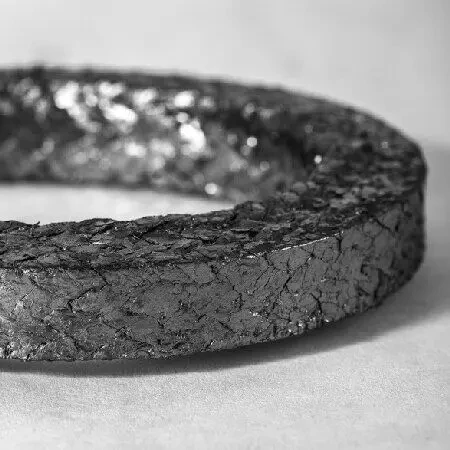

In industrial production, equipment sealing plays a vital role in ensuring safety and operational reliability. Poor sealing can cause malfunctions and even lead to serious hazards. Among the many sealing materials available, graphite packing stands out for its superior performance. It is primarily produced by weaving graphite yarn with various reinforcing fibers and metal wires, such as steel, copper, nickel, carbon fiber, pre-oxidized fiber, and glass yarn. The result is a material capable of maintaining exceptional sealing performance under extreme conditions—high temperatures, high pressures, and corrosive environments—making it one of the most versatile sealing solutions in industry.
Raw Materials and Manufacturing of Graphite Packing
Graphite packing is made from a combination of graphite yarn and reinforcing materials such as carbon fiber, pre-oxidized fiber, glass yarn, and metal wires (steel, copper, or nickel). These materials are intricately braided to produce packing that is both durable and resilient. This precise manufacturing process gives graphite packing outstanding mechanical and chemical stability, allowing it to perform reliably in harsh industrial environments where high temperatures, high pressures, and corrosive media are common.
Types of Graphite Packing
Graphite packing can be classified based on the crystalline form and structural characteristics of the graphite used. The main types include:
1. Dense Crystalline Graphite Packing
Also known as lump graphite, dense crystalline graphite features large, visible crystalline particles greater than 0.1 mm. It typically contains 60%–98% carbon and forms a compact, granular structure. Though it offers slightly lower lubricity and plasticity than flake graphite, its high carbon content makes it valuable in specialized applications requiring superior purity and density.
2. Flake Graphite Packing
Flake graphite packing consists of flake-shaped crystals formed through metamorphic processes under high pressure. It is available in both large and fine flake varieties. Despite its relatively low natural grade (2%–25%), flake graphite is highly floatable and easily refined into high-grade concentrate. With excellent lubricity, plasticity, and floatability, it is widely used not only in sealing applications but also in lubricants and other industrial products.
3. Cryptocrystalline Graphite Packing
Also referred to as amorphous or earthy graphite, cryptocrystalline graphite has microscopic crystals less than 1 micron in size and a specific surface area of 1–5 m²/g. Although its lubricity is weaker, it has a high carbon content (60%–90%) and a fine, uniform texture. Despite the challenges in refining and processing it, this type of graphite is ideal for certain specialized sealing applications.
Applications of Graphite Packing
Graphite packing is used extensively across industries due to its adaptability and resilience. Common applications include:
1. High-Temperature and High-Pressure Sealing
Graphite packing is a preferred choice for sealing valves, pumps, and reactors exposed to hot water, superheated steam, heat transfer fluids, hydrocarbons, ammonia, or cryogenic media. Its ability to maintain reliable sealing under extreme conditions makes it indispensable in power generation, petrochemical, and refining industries.
2. Corrosive Media Sealing
With excellent resistance to most chemicals—except strong oxidizing agents—graphite packing is widely used in chemical, pharmaceutical, and process industries to seal equipment that handles corrosive fluids, preventing leaks and ensuring operational safety.
3. Replacement for Traditional Materials
As environmental and performance standards rise, graphite packing has increasingly replaced traditional sealing materials such as asbestos. For example, aramid-based graphite packings offer high strength, heat resistance, and wear resistance, making them ideal for applications involving abrasive or high-temperature media like superheated steam, solvents, and liquefied gases.
4. Special Industrial Uses
In specialized applications, such as marine and water treatment industries, high-water-content graphite packing made from ramie fiber coated with graphite and lubricating oil provides superior corrosion resistance and low friction. It is suitable for sealing water, seawater, oils, and mild acids or bases, operating efficiently at temperatures up to 140°C and linear speeds up to 10 m/s.
Performance Advantages of Graphite Packing
1. Excellent Thermal Stability
Graphite packing remains stable and effective even at extremely high temperatures. At around 2200°C, structural transformations improve density and sealing capability, ensuring long-term performance in thermal cycling environments.
2. Chemical Resistance
It resists attack from most acids, bases, and salts, making it ideal for chemical and process equipment handling aggressive media.
3. Superior Lubrication
Graphite’s inherent lubricity minimizes friction and wear, improving equipment lifespan and efficiency—especially in high-speed or continuous-operation machinery.
4. High Strength and Dimensional Stability
The integration of metal wires and high-strength fibers gives graphite packing exceptional mechanical strength and pressure resistance, ensuring reliable sealing without deformation under load.
Conclusion
Graphite packing is a high-performance sealing solution designed for demanding industrial applications. Combining advanced materials with precise manufacturing, it offers exceptional resistance to heat, pressure, and corrosion, along with superior lubrication and strength. Available in multiple forms—dense crystalline, flake, and cryptocrystalline—it serves a wide range of industries and applications, ensuring safety, reliability, and efficiency in equipment operation.
To learn more about graphite packing and sealing technologies, follow our professional insights column for regular updates on industry knowledge and technical innovations.It's important to know about Google SEO to help your website rank higher in search results.

























Sign in to leave a comment.