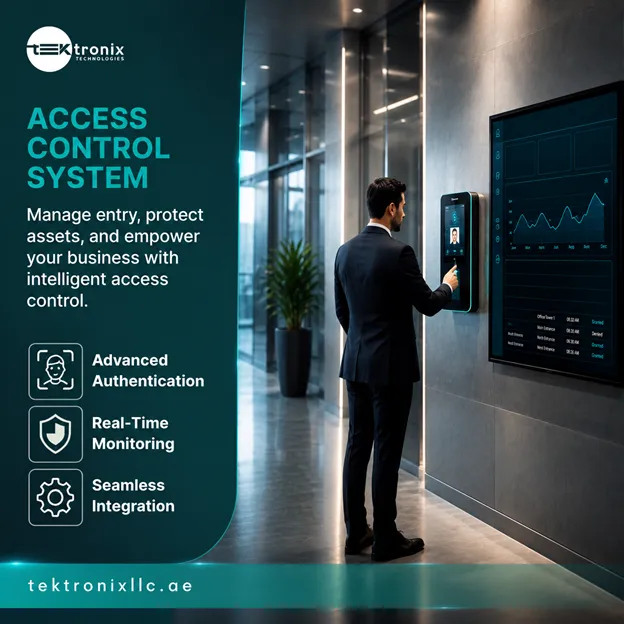

Walk into any modern office tower in DIFC or a data centre in Masdar City and you'll notice something: nobody is fumbling with keys. A badge tap, a half-second glance at a camera, and the door simply opens. That quiet moment is the payoff of years of engineering behind the humble access control system — and it's exactly the kind of security infrastructure that UAE organisations are racing to upgrade in 2026.
Among the companies building that infrastructure, Tektronix Technology Systems LLC has become one of the more visible names across Dubai, Abu Dhabi and the wider Emirates. As a certified HID partner delivering biometric, card-based and facial recognition systems, the company positions itself less as a hardware reseller and more as an end-to-end security integrator. So what does its Access Control system actually do, how does it work under the hood, and does it genuinely stand apart from the crowded field of security vendors operating in the region? Let's break it down.
What an access control system is actually replacing
Traditional locks-and-keys security has an obvious flaw: keys get copied, lost, or handed to the wrong person, and nobody can prove who opened a door at 2am. An electronic access control system solves this by tying every entry point to a verifiable identity — a card, a PIN, a fingerprint, or a face — and logging every attempt, successful or not. For a single office door, that might feel like overkill. But scale it across a 40-storey tower, a hospital campus, or a logistics hub with a dozen loading bays, and the case for centralised, auditable access becomes obvious fast.
This is where Tektronix's platform, branded TEKACCESS, is built to operate. It's described as an AI-driven system that enforces identity-based policies across doors, gates, elevators and restricted zones, rather than treating each door as an isolated lock. That distinction matters in the UAE specifically, where a growing share of security requirements are tied to compliance frameworks — UAE PDPL, ISO 27001, and integration with UAE Pass and Emirates ID — that demand tamper-proof audit trails, not just a working door.
How the system functions, door by door
Strip away the marketing language and the mechanics are fairly logical once you see the sequence:
1. Credential enrolment. Staff, contractors and visitors are registered with a biometric scan, a card, or a mobile credential. Identity is captured once and verified at enrolment.
2. Policy definition. An administrator sets who can go where, and when — by person, group, floor, zone, or time window. A cleaning contractor might get access only between 6 and 9am; a server room might be restricted to three named engineers.
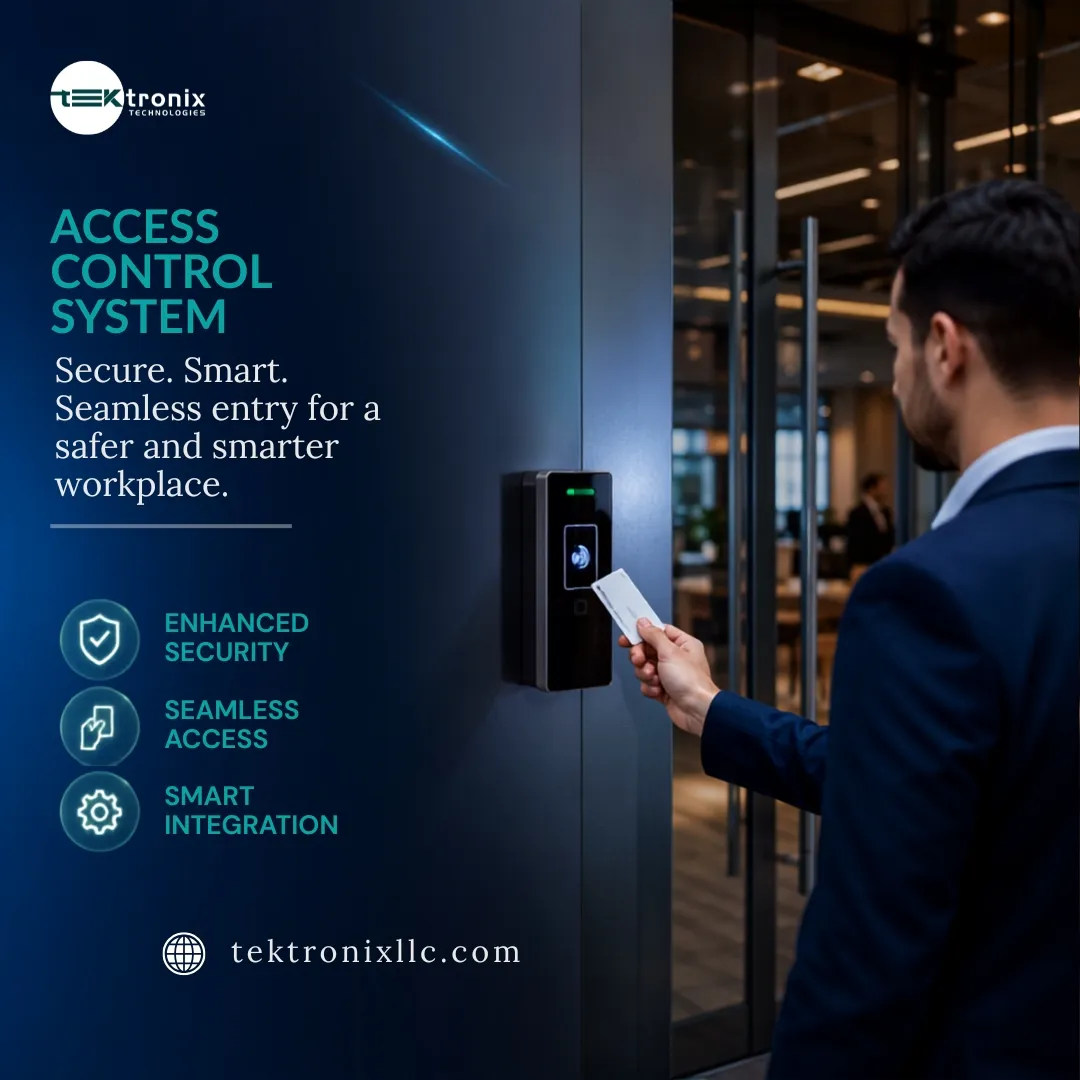
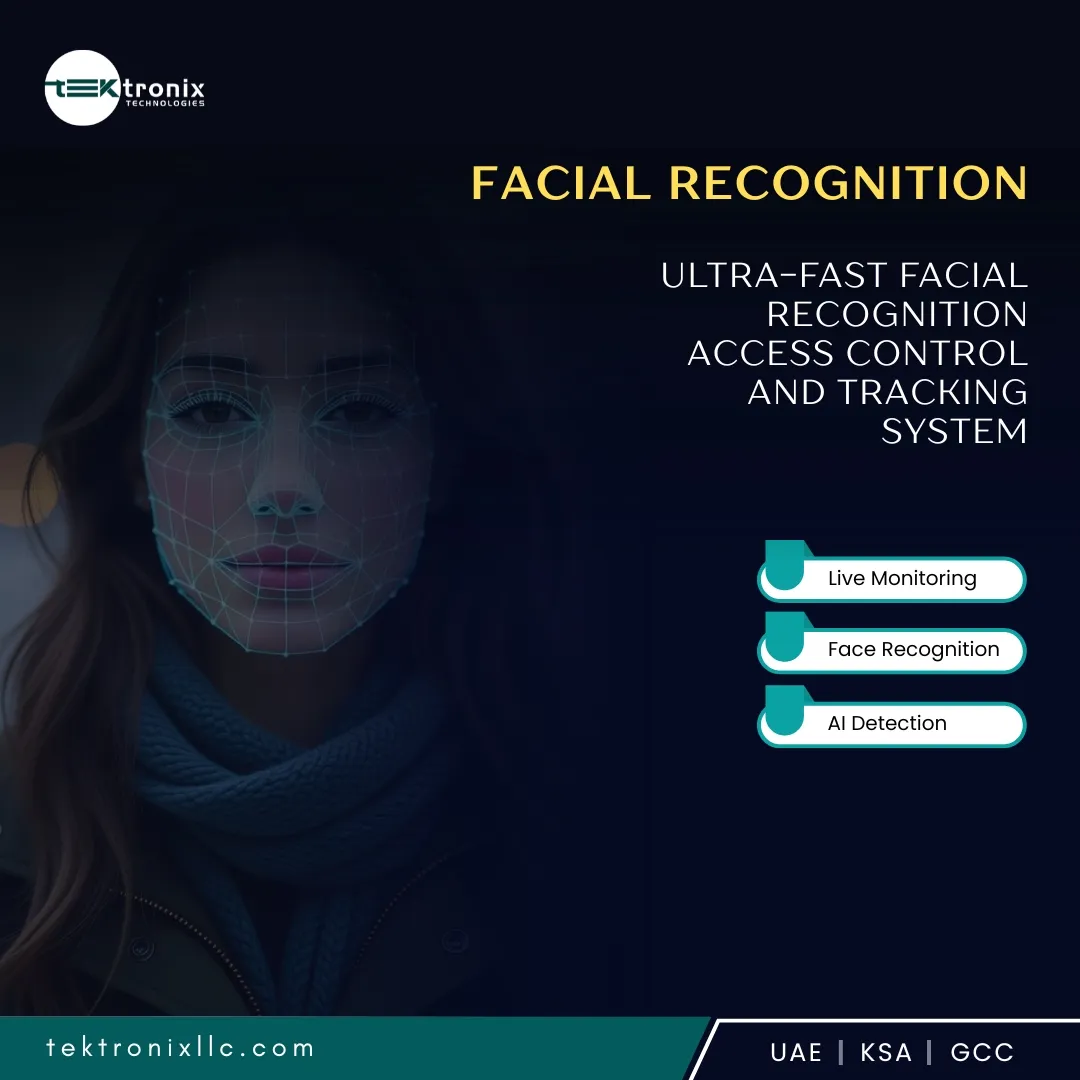
3. Authentication at the door. The user presents a face, card, PIN or phone. On the flagship HID AMICO terminals, this facial recognition step is claimed to resolve in under 0.2 seconds, with liveness detection intended to catch spoofing attempts like photos or masks.
4. Controller validation. An HID AERO controller checks the credential against the stored policy in real time — including anti-tailgating logic and time-zone rules — before deciding whether to unlock.
5. Physical release. The electric lock, turnstile or speed gate opens, and the event — timestamp, identity, and often a camera snapshot — is written to the audit log.
6. Reporting. Every event sits in a tamper-proof log that security teams or compliance officers can pull on demand, rather than reconstructing who-went-where from memory after an incident.
What's notable is the local-caching detail on the HID AERO controllers: access decisions are stored on the controller itself, so doors keep functioning on pre-set policy even if the network connection to the central server drops. For a facility that can't afford a door to fail open — or fail shut — during a network outage, that's a meaningfully different design choice from purely cloud-dependent systems.
Where biometrics come in
Cards can be shared, lost or cloned; PINs get written on sticky notes. That's the practical argument for biometric authentication, and it's the layer Tektronix leans on most heavily in its marketing. A Biometric Access Control System built on the HID AMICO terminal is described as supporting a database of 10,000-plus users per device, with dual-lens anti-spoofing hardware and performance claimed to hold up in low light, backlighting, and even with masks — a detail that matters in a region where facial coverings and strong sun glare are both everyday realities.
For facilities that need more than a single factor — a server room, a vault, a pharmaceutical storage area — the platform supports layering: face plus PIN, or card plus biometric, alongside anti-passback rules that stop one credential being used to let two people through a single scan. It's a sensible middle ground between convenience at a staff entrance and stricter control at genuinely sensitive doors, rather than forcing the same friction on every access point in a building.
The hardware behind the software
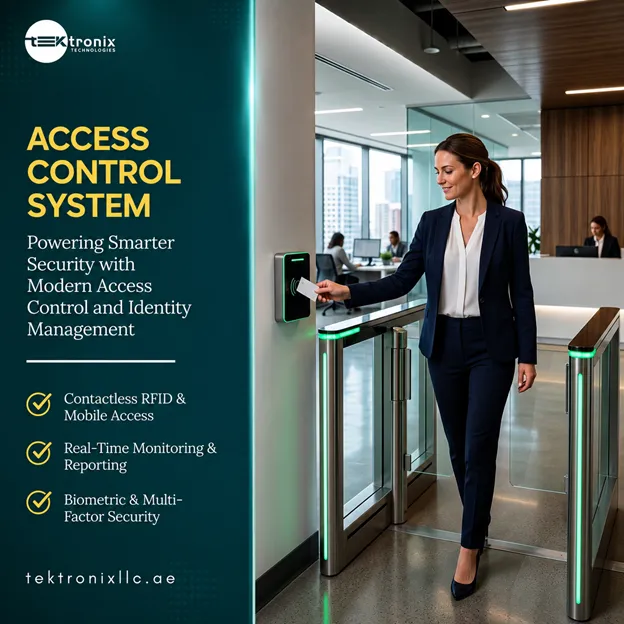
A lot of access control vendors sell software and expect you to source your own readers and controllers. Tektronix instead builds around HID Global's hardware ecosystem as a certified partner — HID AMICO for facial recognition, HID AERO for door controllers, and HID Signo readers that are compatible with iCLASS, SEOS, MIFARE and DESFire credentials, plus Bluetooth and NFC mobile access. That compatibility layer is arguably the least glamorous part of the pitch but one of the more practically useful ones: a building with an existing HID card system can often upgrade to biometric or mobile credentials without ripping out its readers.
On the physical barrier side, the product range extends to flap barrier speed gates rated for up to 40 people per minute for corporate lobbies, and full-height turnstiles aimed at data centres and high-security industrial sites where a card swipe alone isn't considered sufficient physical deterrence.
Cloud, on-premise, or both
One area where the platform tries to cover more ground than a typical single-deployment vendor is hosting flexibility. Organisations that want rapid rollout across multiple sites can run the cloud-hosted version, managed from a browser with no on-site server and — notably for regional compliance-sensitive clients — UAE data residency options. Organisations with stricter data sovereignty requirements, such as government or defence-adjacent entities, can instead run an on-premise server with an open REST API for HR and ERP integration and Active Directory/Azure AD synchronisation. Rather than forcing every client into one hosting model, the system is built to let the deployment match the organisation's actual compliance posture.
How this compares to the competition
The UAE security market isn't short on access control vendors, so the more useful question isn't "does Tektronix have an access control system" — most integrators do — but where the meaningful differences actually sit.
Depth of HID certification. Plenty of resellers will sell you "compatible" hardware. Fewer are certified HID partners carrying the full AMICO-to-Signo portfolio, which matters if you ever need warranty support, firmware updates, or a technician who genuinely understands the hardware rather than just the software dashboard.
Offline resilience. Cloud-only Security Access Control platforms that lose all function during an internet outage are a real operational risk in a region where construction and infrastructure work can occasionally disrupt connectivity. Local credential caching on the controllers is a more defensible architecture for mission-critical sites.
Regional presence, not remote support. A platform is only as good as the team that installs and maintains it. Tektronix's positioning as a Dubai-headquartered supplier with coverage claimed across all seven Emirates — rather than a system sold remotely with support routed through an overseas call centre — is a genuine differentiator for facilities that need a technician on-site within hours, not days.
Compliance-first design. Built-in alignment with UAE PDPL, ISO 27001, UAE Pass and Emirates ID integration means compliance isn't bolted on afterward — it's part of the base architecture, which saves significant rework for regulated industries like banking, healthcare and government.
Ecosystem integration. Rather than operating as an island, the system is designed to plug into CCTV, visitor management, elevator control, ANPR parking and existing enterprise directories. For a facilities or IT manager, that reduces the number of separate dashboards and vendors they have to juggle day to day.
None of that makes the platform automatically the right fit for every building — a five-door retail unit doesn't need multi-site controller architecture, and smaller sites may find simpler card-only systems more cost-effective. But for mid-to-large UAE facilities weighing biometric accuracy, offline reliability, and compliance readiness against each other, it's a reasonably complete answer to what a modern access control deployment should look like.
Who actually needs this level of system
Not every building needs turnstiles and multi-factor biometrics, so it's worth being specific about where this tier of system earns its cost. Corporate offices tend to use it for the basics done well: employee badges or face-based entry at the main doors, visitor pre-registration through an integrated visitor management module, and a simple audit trail if HR or security ever needs to check who was on-site during an incident.
Data centres and server rooms are a different story — there, the anti-passback logic and multi-factor requirements (card plus biometric) are doing real work, since a single compromised credential in those environments can be far more costly than in a general office. Healthcare facilities use zone-based restriction to keep visitors out of clinical areas without slowing down staff movement, while educational campuses tend to prioritise the visitor management layer, since schools and universities deal with a constant flow of parents, contractors and delivery staff who all need short-lived, auto-expiring credentials rather than permanent ones.
Government and free-zone facilities are where the UAE Pass and Emirates ID integration tends to matter most, since it lets an access control system align with national identity infrastructure rather than running a parallel credentialing system that has to be manually reconciled. And for logistics, ports and industrial sites, the physical barrier hardware — turnstiles, speed gates, vehicle-facing controllers — usually matters as much as the software layer, since foot traffic and vehicle traffic both need to be governed by the same policy engine.
What a rollout typically looks like
For organisations evaluating whether to make the switch, timeline is usually the first practical question. Based on Tektronix's own published estimates, a small deployment covering one to five doors typically takes one to two weeks from site assessment to go-live. Medium-sized rollouts — in the 10 to 30 door range, which covers most mid-sized office floors or small campuses — run three to five weeks. Larger, multi-site enterprise deployments across several UAE locations are quoted at six to twelve weeks, which is a realistic range given the coordination needed across procurement, cabling, and staff enrolment.
The starting point for any of these is a free site assessment, where an access control specialist walks the property, counts doors and zones, and maps out which credential types make sense where — biometric at high-security points, card or mobile at general staff entrances, and visitor kiosks at reception. That assessment is also usually where the cloud-versus-on-premise decision gets made, since it depends heavily on the client's existing IT infrastructure and data residency requirements.
The bottom line
Access control has quietly moved from "which lock do we buy" to "which identity and compliance platform do we trust with our building." Tektronix's approach — HID-certified hardware, biometric authentication under half a second, offline-capable controllers, and compliance-aligned software — reflects where the serious end of the UAE security market is heading. Whether it's the right vendor for a specific facility still comes down to site assessment, door count, and budget, but the underlying architecture is built with the right priorities: reliability first, biometrics as the convenience layer, and compliance baked in rather than added on.

























Sign in to leave a comment.