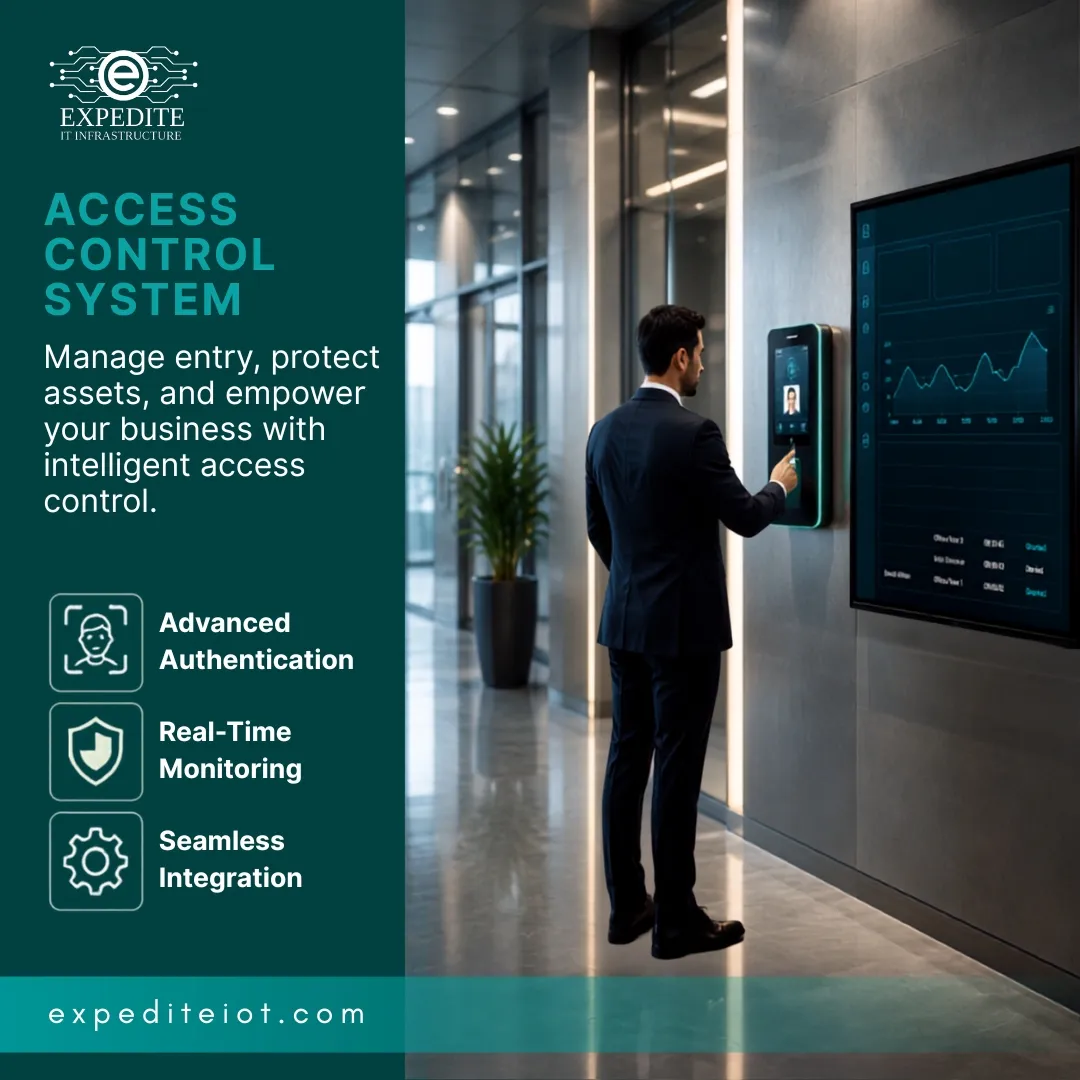

Kuwait's corporate towers, government ministries, oil and gas operational facilities, financial institutions, and healthcare campuses face a shared security imperative: controlling, verifying, and documenting every individual who enters every protected zone of their operations - and doing so with the precision, speed, and audit rigour that Kuwait's regulatory environment and operational realities demand. A modern Access Control System is the foundational technology that makes that imperative operationally enforceable, replacing mechanical keys, basic proximity cards, and manual entry logs with an intelligent, credential-verified, continuously documented security infrastructure that scales from a single office door to a multi-building petroleum sector campus. Expedite IoT brings enterprise-grade access security to Kuwait through regional deployment expertise and certified technology partnerships. Explore our access control system solutions for Kuwait, Saudi Arabia, Qatar, and Oman and discover what the future of secure entry looks like when every door is governed by verified intelligence rather than trusted assumption.
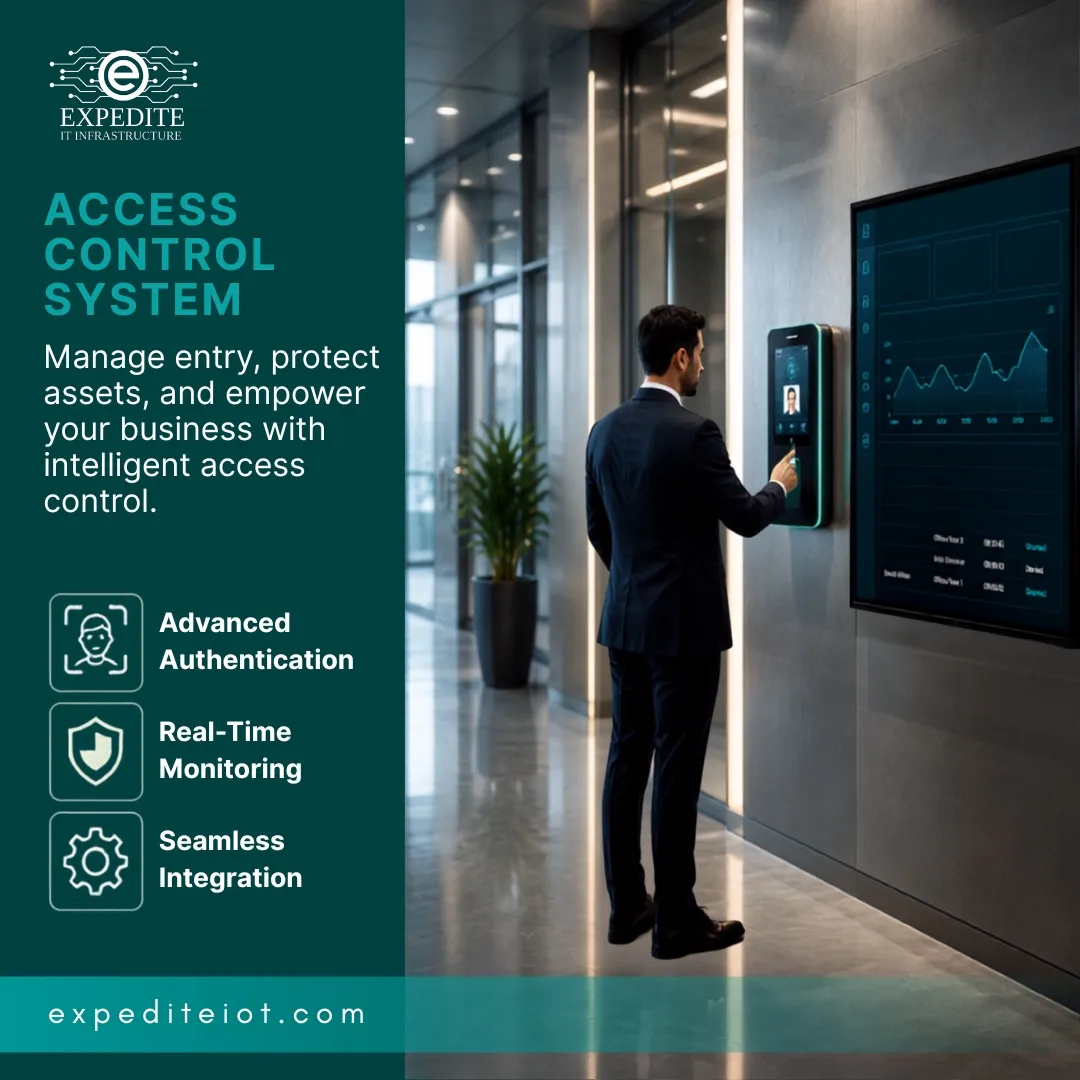
Kuwait's Security Landscape: Why the Future of Entry Has Already Arrived
Kuwait's economy is anchored by Kuwait Petroleum Corporation (KPC) and its downstream entities - Kuwait Oil Company (KOC), Kuwait National Petroleum Company (KNPC), and EQUATE Petrochemicals -whose operational facilities, administrative headquarters, and contractor management programmes represent some of the Gulf's most demanding physical security environments outside of Saudi Arabia's giga-project corridor. Alongside the petroleum sector, Kuwait's financial services industry - regulated by the Central Bank of Kuwait (CBK) - its healthcare network anchored by the Ministry of Health's hospital estate, and its government ministry compound in Kuwait City's central administrative district collectively operate environments where access governance failure carries regulatory, operational, and in some cases national security consequences.
Kuwait's Communications and Information Technology Regulatory Authority (CITRA) has progressively tightened the cybersecurity framework requirements applicable to critical infrastructure operators, with physical access governance documentation increasingly expected as a component of facility security compliance submissions. The Kuwait Fire Force's occupancy and emergency access requirements, the Ministry of Interior's commercial facility physical security guidelines, and the CBK's information security circular requirements for licensed financial institutions together create a compliance environment where an Advanced Access Control System that generates timestamped, verifiable, exportable audit documentation is not an optional enhancement but the governance baseline that Kuwait's most closely regulated organisations need to demonstrate during inspection visits and regulatory examinations.
The Technology Architecture Behind Kuwait's Most Secure Facilities
Biometric Access Control System: Credentials That Cannot Be Transferred
The most consequential evolution in Kuwait's access control landscape is the shift from transferable credentials - cards, PINs, and fobs, all vulnerable to sharing, loss, and duplication - to biometric verification that is inseparable from the authorised individual. Expedite IoT's Biometric Access Control System supports fingerprint recognition, facial recognition, iris scanning, and palm-vein authentication, with credential selection guided by the operational context: facial recognition terminals at high-throughput lobby entrances, fingerprint readers for general staff access zones, palm-vein readers for hygiene-sensitive environments including Kuwait's hospital clean rooms and pharmaceutical storage areas, and iris scanning for the highest-security zones where zero-tolerance identity confidence is required. All biometric templates are encrypted at AES-256 standard at capture, stored in secured local infrastructure or Expedite IoT's GCC-hosted cloud environment, and governed under Kuwait's data privacy principles consistent with CITRA's cybersecurity framework.
Security Access Control System: Zone Governance Across Complex Facilities
Expedite IoT's Security Access Control System delivers multi-tier zone-based permission management that assigns each employee, contractor, and authorised visitor a credential profile defining exactly which zones they may enter, during which hours, and through which entry points. For Kuwait Oil Company's operational campuses - where permanent Kuwaiti national employees, expatriate technical staff, subcontractors, international equipment vendors, and ministry inspection teams may all require simultaneous but differentiated access to overlapping areas - this granular permission architecture is the only governance model that simultaneously satisfies security requirements, operational efficiency, and the contractor management accountability that KPC's security standards mandate. Real-time occupancy dashboards give security supervisors instant zone-level headcounts, supporting Kuwait Fire Force emergency mustering requirements for large commercial and industrial facilities.
Door Access Control System: Scalable Coverage for Every Entry Point
From a single secured office to a multi-building compound spanning Kuwait City's commercial districts and the Ahmadi industrial zone, Expedite IoT's Door Access Control System scales without architectural compromise. Electric strikes, magnetic locks, motorised deadbolts, vehicle barrier arms, pedestrian turnstiles, and lift access controllers are all supported, with fail-safe configurations for Kuwait Fire Force fire exit compliance and fail-secure configurations for bonded storage areas and server infrastructure rooms where unauthorised entry during a network outage represents a regulatory or security violation. The system manages every controlled opening - from the main building entrance and car park barrier through internal zone doors to server room and executive floor access - from a single unified management console that provides the security team a coherent operational picture regardless of facility size or structural complexity.
Hardened Access Control Device for Kuwait's Environment
At every controlled entry point, an Expedite IoT Access Control Device - available in wall-mount biometric terminal, floor-standing pedestal kiosk, vehicle-rated barrier controller, and multi-technology card-and-biometric reader formats - captures credentials and communicates access decisions within milliseconds of presentation. Outdoor-rated models carry IP65 or IP67 ingress protection, ensuring reliable performance across Kuwait's extreme summer heat - regularly exceeding fifty degrees Celsius - high coastal humidity, and the dust and sand exposure common at industrial facilities in the Ahmadi and Shuaiba industrial areas. Vandal-resistant stainless-steel housings protect external perimeter gate readers, tamper detection triggers immediate security alerts if any device is physically attacked, and offline operational resilience ensures access decisions continue executing locally at each reader during network interruptions, with all events queued and synchronised to the central platform upon reconnection.
Access Control Solutions: Integration Depth That Defines Professional Deployment
Expedite IoT's Access Control Solutions are engineered to integrate natively with the complete range of security and operational technology systems that Kuwait's enterprises, government entities, and petroleum sector organisations depend on, rather than operating as an isolated access layer that creates parallel data management obligations. Video surveillance integration with Milestone XProtect and Genetec Security Center automatically associates a real-time CCTV clip with every access event, enabling security investigators to retrieve visual confirmation of any badge swipe, biometric verification, or access attempt in a single click. ANPR licence plate recognition at vehicle gates cross-references arriving vehicles against approved contractor and visitor registers, triggering automatic barrier release for authorised vehicles and alerting the security desk for unrecognised arrivals without requiring a security officer to be physically present at every gate.
HR and ERP system integration with SAP SuccessFactors, Oracle HCM, and Microsoft Dynamics 365 automates the credential lifecycle - provisioning access when a new employee or contractor is onboarded and revoking it the moment their record closes eliminating the access orphaning that creates persistent insider threat vulnerabilities in Kuwait's large expatriate workforce environments where staff turnover rates are structurally higher than in predominantly national workforce organisations. For Kuwaiti government ministries operating Oracle E-Business Suite or legacy ERP environments, open API connectivity ensures that access permission management remains synchronised with HR system records without requiring duplicate data entry. The platform's legacy integration capability with Lenel OnGuard, HID Global VertX, and Software House C-CURE 9000 protects existing Kuwait infrastructure investments during migration to Expedite IoT's unified platform, avoiding the full replacement costs that alternative providers typically impose.
Sector-Specific Applications Across Kuwait's Economy
Kuwait's petroleum sector facilities - KOC's Ahmadi operational campus, KNPC's Mina Abdullah and Shuaiba refineries, and EQUATE's petrochemical manufacturing complex - require access control configurations that address contractor workforce management at scale, Permit to Work (PTW) system integration for zone-level safety governance, and the operational continuity requirements of continuously running production environments where access control downtime creates a direct operational risk. Expedite IoT's offline operational resilience and redundant controller configurations are specifically designed for these environments, ensuring that a network maintenance window or connectivity interruption never creates a physical security gap at a critical production facility.
Kuwait's financial sector institutions regulated by CBK - Kuwait Finance House, National Bank of Kuwait, Gulf Bank, and the country's growing fintech sector require access control documentation in the format expected during CBK information security examinations, where physical access governance forms a documented component of the institution's overall information security management system audit evidence. Expedite IoT's compliance reporting suite generates CBK-appropriate audit logs covering individual access histories, zone occupancy records, after-hours entry events, and failed access attempt summaries - documentation that compliance teams can present during supervisory examinations without manual data extraction and reformatting.
Access Control System Kuwait: Configured for the Local Compliance and Cultural Context
Deploying a genuinely effective Access Control System Kuwait requires a platform and deployment methodology calibrated for Kuwait's specific regulatory framework, cultural workplace norms, and environmental conditions rather than a generic GCC product applied without localisation. Expedite IoT's system ships with a full Arabic-language management interface, Hijri calendar integration for scheduling and compliance reporting, and pre-built documentation templates aligned to CITRA cybersecurity framework physical security control requirements, Ministry of Interior commercial facility security guidelines, CBK information security circular requirements, and Kuwait Fire Force occupancy and emergency access standards. Biometric enrolment workflows are designed with cultural sensitivity to the Kuwaiti workplace environment, and recognition accuracy has been validated for the demographic diversity of Kuwait's large expatriate workforce alongside its Kuwaiti national employee population.
Redundant connectivity configurations ensure access decisions continue locally during network outages, with offline resilience critical for Kuwait's Ahmadi industrial zone and Shuaiba refinery area facilities where network infrastructure may be subject to planned maintenance or disruption during active operational activities. Expedite IoT's Kuwait access control system deployment and engineering team manages every phase of the engagement - from initial facility security assessment and zone mapping through hardware installation, biometric enrolment campaigns, system integration, bilingual staff training, and post-commissioning support - with formal project delivery timelines established at contract signature and a track record of successful deliveries across Kuwait's commercial, government, and petroleum sector environments.
Conclusion
The future of secure entry in Kuwait is already here - and it is built on an intelligent, biometric, fully integrated Access Control System that delivers certainty at every door, gate, and zone.
An Advanced Access Control System architecture and identity-verified Biometric Access Control System eliminate the credential vulnerabilities that mechanical and card-based systems cannot close.
Granular Security Access Control System zone governance and a scalable Door Access Control System cover every facility tier from lobby to server room.
Field-proven Access Control Device hardware rated for Kuwait's extreme environment and integrated Access Control Solutions protect existing technology investments while delivering one unified operational view.
For every Kuwait organisation that demands the highest security standard, the Access Control System Kuwait platform from Expedite IoT is the definitive answer.
Contact Expedite IoT today to build Kuwait's most secure, compliant, and future-ready entry system.
Frequently Asked Questions
FAQ 1: What types of Kuwait facilities benefit most from an Access Control System?
An Access Control System delivers measurable security, compliance, and operational value across every Kuwait facility type - petroleum sector operational campuses, CBK-regulated financial institutions, Ministry of Health hospitals, government ministry compounds, educational institutions, data centres, and commercial office developments. Any environment where different individuals require different levels of access to different areas, where entry events must be documented for regulatory or audit purposes, or where workforce size makes manual monitoring impractical benefits directly from automated, credential-based, continuously logged access governance.
FAQ 2: How does a Biometric Access Control System satisfy Kuwait CITRA and CBK compliance requirements?
Expedite IoT's Biometric Access Control System encrypts all biometric templates at AES-256 standard at capture, stores them within secured GCC-based infrastructure consistent with CITRA cybersecurity framework data governance requirements, and manages the complete biometric data lifecycle - enrolment consent, retention scheduling, and deletion on departure - in documented alignment with Kuwait's data privacy principles. For CBK-regulated financial institutions, the platform generates physical access audit logs in the structured format expected during CBK information security supervisory examinations, forming a documented component of the institution's ISO/IEC 27001-aligned information security management system evidence package.
FAQ 3: Can the Door Access Control System integrate with Kuwait petroleum sector PTW and ERP systems?
Yes. Expedite IoT's Door Access Control System integrates with Permit to Work (PTW) management platforms used across KOC, KNPC, and EQUATE operational facilities, ensuring that a valid, current PTW approval is a prerequisite for access credential activation in zone-specific safety-governed areas. ERP integration with SAP Plant Maintenance, Oracle Fusion, and Microsoft Dynamics 365 automates contractor vehicle and personnel credential lifecycle management - provisioning access credentials aligned to the engagement scope defined in the contractor management system and scheduling automatic expiry at engagement end, eliminating the manual administration overhead that creates persistent access security gaps in large contractor workforce environments.
FAQ 4: How do Access Control Solutions support Kuwait Fire Force emergency mustering requirements?
Expedite IoT's Access Control Solutions include real-time zone-level occupancy tracking and instant mustering report generation listing every individual currently checked into each zone, their credential type, and their check-in timestamp. During fire alarms or emergency evacuations, security coordinators share this report digitally with Kuwait Fire Force response teams, enabling accurate headcounts at assembly points within minutes of an evacuation trigger. The complete archived access log satisfies the Kuwait Fire Force post-incident accountability documentation requirements for large commercial and industrial facilities, and provides a timestamped record for insurance assessment and internal governance reporting.
FAQ 5: How long does an Access Control System Kuwait deployment take from contract to go-live?
A standard single-facility Access Control System Kuwait deployment-covering site assessment, zone mapping, hardware installation, biometric enrolment, integration with existing HR, ERP, and video surveillance systems, and bilingual staff training - is typically completed within two to four weeks depending on facility size and integration complexity. Larger multi-site petroleum sector or government ministry deployments are delivered against formal project timelines established at contract signature, with Expedite IoT's Kuwait-based engineering team coordinating directly with the client's facilities, IT, and security operations teams throughout the commissioning programme.



























Sign in to leave a comment.