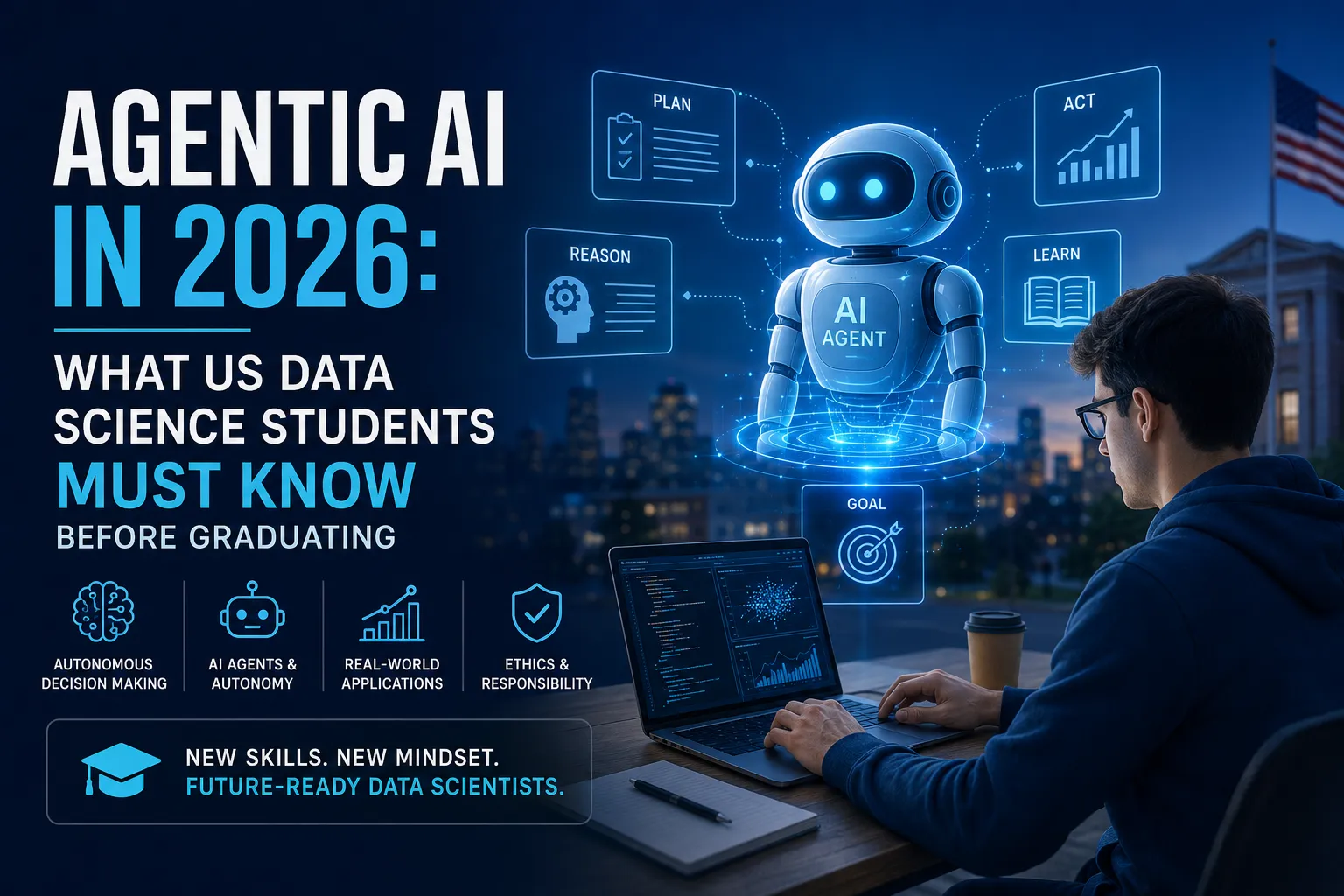

Artificial intelligence is entering a new phase, and Agentic AI is leading the shift. Unlike traditional AI systems that respond to individual prompts, agentic systems can plan, make decisions, use software tools, and complete multi-step tasks with limited human guidance. For students pursuing data science in the United States, this isn't simply another technology trend. It's quickly becoming an expectation in the job market.
The demand for data scientists remains strong, but employers are now looking beyond candidates who can build accurate machine learning models. They want graduates who understand how AI systems interact with business workflows, external applications, and human oversight. That change is redefining what it means to be career-ready in 2026.
Why Agentic AI Is Changing Data Science Careers
Traditional machine learning projects often stopped after creating a predictive model. Agentic AI pushes much further. These systems can retrieve information, call APIs, coordinate several AI models, remember previous interactions, and adapt their actions based on changing conditions.
Think about a modern customer support platform. Instead of only answering a question, an agentic system can verify account details, search company documentation, create support tickets, notify another department, and prepare a summary for a human representative. It behaves more like an experienced office assistant than a simple chatbot.
That evolution means data scientists must think beyond algorithms. Building intelligent systems now requires understanding how different technologies work together while ensuring reliability and safety throughout the process.
Skills That Employers Expect in 2026
Machine learning fundamentals still matter. Python, SQL, statistics, data visualization, and predictive modeling remain the foundation of every successful data science career. However, those skills are no longer enough on their own.
Students should become comfortable designing workflows where AI models interact with databases, APIs, cloud services, and business software. Understanding orchestration allows multiple specialized AI agents to collaborate instead of relying on one large model to complete every task.
Memory management has also become an important concept. Modern AI systems often retain context across conversations or projects, making them more consistent and useful over time. Students who understand how AI remembers information will be better prepared to build applications that solve real business problems.
Evaluation methods are evolving as well. Accuracy remains important, but companies increasingly measure response quality, execution speed, operational cost, reliability, and failure recovery. These broader performance metrics reflect how AI systems operate in production rather than in classroom demonstrations.
For students preparing assignments or learning advanced AI concepts independently, resources such as Expertsmind.com's subject expert network can help explain complex topics, connect theory with practical implementation, and provide structured academic guidance while studying rapidly changing technologies.
Governance Matters as Much as Technology
One of the biggest misconceptions about Agentic AI is that greater automation automatically creates better results. In reality, responsible AI development depends on thoughtful governance.
Organizations expect future data scientists to understand security, accountability, transparency, and human oversight. AI systems often process financial records, healthcare information, customer data, or confidential business documents. Poorly designed automation can introduce significant risks if proper safeguards are missing.
Successful graduates know when an AI system should make decisions independently and when human approval remains essential. Low-risk administrative tasks may be fully automated, while financial approvals or medical recommendations usually require human review before action is taken.
This balance between automation and supervision is becoming a valuable professional skill. Employers increasingly prefer candidates who understand both technical implementation and responsible deployment.
Building a Graduation Portfolio That Stands Out
Projects often speak louder than academic transcripts. Instead of presenting only predictive models, students should demonstrate complete AI workflows that solve practical problems.
A strong portfolio might include an AI research assistant that gathers information from multiple sources before generating reports. Another project could automate customer support requests while allowing staff members to approve sensitive responses. These examples show employers that the student understands modern AI systems rather than isolated machine learning techniques.
The best projects combine data analysis, software integration, workflow automation, and governance principles. They illustrate how different components operate together in realistic business environments.
Students should also document challenges encountered during development. Explaining why certain architectural decisions were made often impresses employers more than presenting flawless results. Real-world engineering is about solving problems thoughtfully rather than producing perfect demonstrations.
Preparing for the Future of Data Science
The role of the data scientist continues to evolve alongside artificial intelligence. Technical expertise remains important, but employers increasingly value professionals who can connect AI models with business processes, software systems, and responsible decision-making frameworks.
Graduates entering the workforce in 2026 will benefit from understanding orchestration, tool integration, memory systems, human-in-the-loop design, and AI governance alongside traditional machine learning skills. Those capabilities position them for careers where intelligent systems perform meaningful work while remaining safe, transparent, and trustworthy.
Agentic AI represents more than another software innovation. It signals a broader shift in how organizations build intelligent solutions. Students who begin developing these skills today will graduate with knowledge that aligns closely with the direction the industry is already heading.

























Sign in to leave a comment.