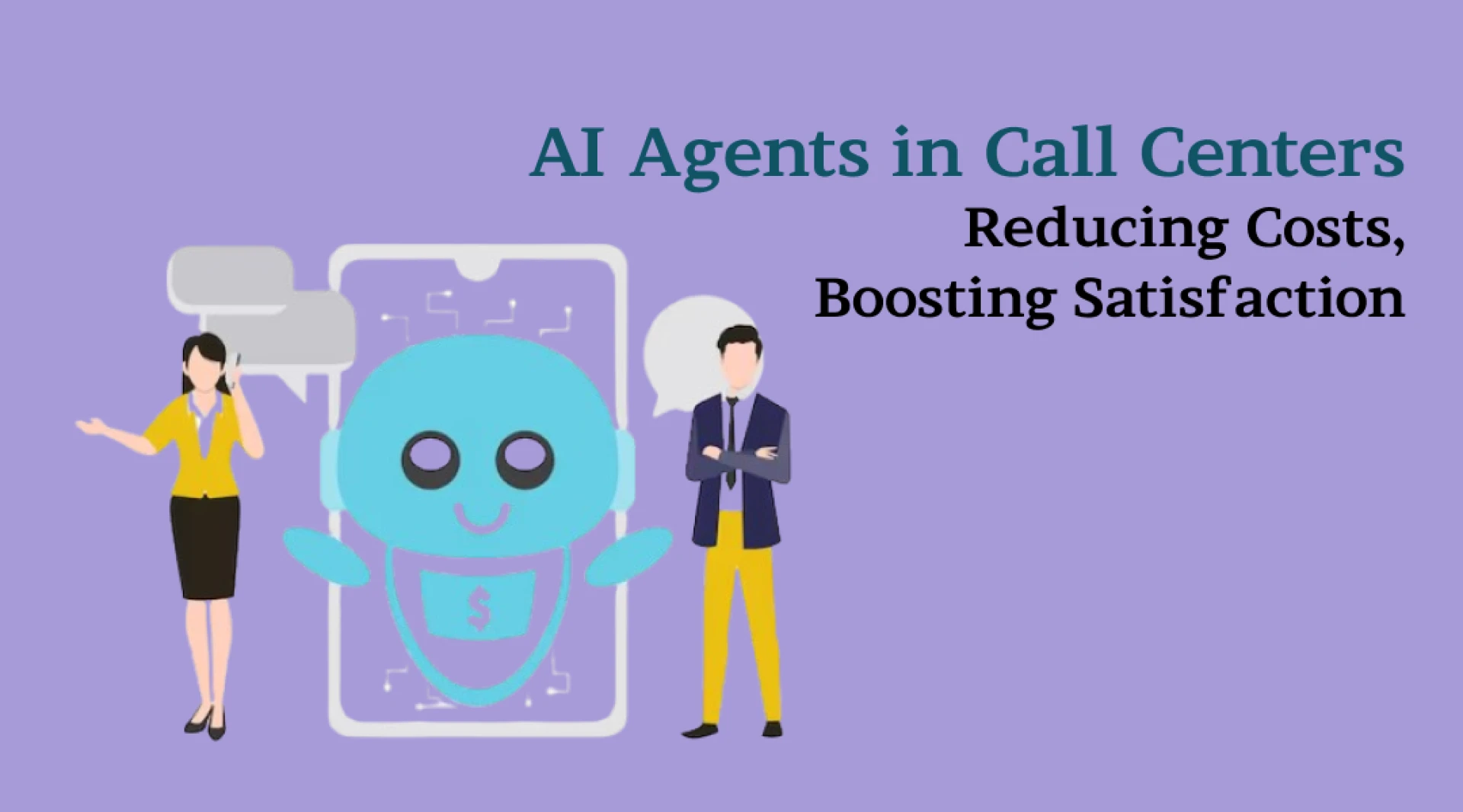
In today’s fast-paced business world, customer service has become a defining factor for enterprise success. Call centers, which serve as the frontline of customer engagement, are under pressure to deliver quicker resolutions, higher satisfaction, and cost efficiency—all at the same time. The adoption of AI agents in call centers is helping enterprises meet these challenges while transforming customer support into a growth driver.
By integrating AI call center automation, AI-powered customer support solutions, and conversational AI for call centers, businesses can significantly improve service delivery. This shift not only reduces operational costs but also enhances customer satisfaction through voice AI and intelligent workflows. In this article, we will explore how AI agents are reshaping call centers, the benefits they bring, and what the future of AI in call center operations looks like.
Why AI Agents Are Critical in Modern Call Centers
Traditional call centers have long been resource-intensive, requiring large teams of agents to handle high call volumes. Despite these efforts, customers often face long wait times, repetitive processes, and inconsistent service. This is where AI agents in call centers make a difference.
Unlike simple interactive voice response systems of the past, modern AI agents are powered by natural language processing (NLP), machine learning, and real-time data analytics. They can understand intent, detect emotion, and respond in natural language. More importantly, they integrate seamlessly with enterprise systems to provide accurate and timely information.
For example, a customer calling to check an order status can interact with an AI Voice Agent that retrieves information instantly without waiting for a human agent. If the issue is more complex, the AI Agent escalates the case to a representative while providing context so customers don’t need to repeat themselves.
AI Call Center Automation: Streamlining Operations
AI call center automation refers to the deployment of artificial intelligence to handle repetitive, rules-based, and high-volume tasks that human agents traditionally manage. This automation delivers significant efficiency gains across call center workflows.
Some of the most common applications include:
- Automating FAQs such as billing, shipping, or account-related questions.
- Routing calls intelligently by analyzing customer intent and directing them to the right department.
- Assisting agents in real time with suggested responses and knowledge base insights.
- Predicting customer needs using historical interaction data.
By automating these tasks, businesses reduce workload for human staff, improve accuracy, and speed up resolutions. This not only improves productivity but also reduces costs while maintaining high service quality.
AI-Powered Customer Support Solutions
Enterprises today rely on AI-powered customer support solutions to provide efficient, round-the-clock service. These solutions leverage conversational AI, machine learning, and data-driven insights to deliver end-to-end support across multiple channels.
Some examples include:
- Voicebots and chatbots capable of resolving queries through natural, human-like conversations.
- Real-time support tools that provide agents with customer insights and suggestions during calls.
- Multi-language support, enabling businesses to engage global customers without language barriers.
- 24/7 availability, ensuring customers always have access to assistance.
AI-powered customer support solutions not only reduce operational costs but also ensure that customers receive consistent, reliable, and personalized experiences across touchpoints.
Conversational AI for Call Centers
Conversational AI for call centers is revolutionizing customer interaction. Unlike rigid scripted systems, conversational AI leverages NLP to understand natural speech, interpret intent, and respond in context.
Benefits of conversational AI include:
- Personalized conversations based on customer history and preferences.
- Improved efficiency, as AI handles routine interactions and frees up human agents for complex tasks.
- Seamless escalation, where the system transfers issues to human agents with full context, avoiding repetitive explanations.
- Scalability, allowing call centers to handle large volumes without increasing staffing.
For instance, in a healthcare call center, conversational AI can help patients schedule appointments, provide reminders, or answer coverage questions, while human agents handle sensitive medical queries
AI Agents for Cost Reduction
One of the strongest business cases for adopting AI agents in call centers is cost efficiency. AI agents for cost reduction play a crucial role in optimizing resources while delivering high-quality service.
Key cost-saving benefits include:
- Reduced labor costs by handling high volumes of routine inquiries automatically.
- Lower error rates as AI systems provide accurate responses based on real-time data.
- Reduced training expenses since AI systems continuously learn and adapt to new customer queries.
- Optimized workforce utilization, enabling human agents to focus on complex or high-value tasks.
Industry studies show that companies implementing AI-driven call center solutions often achieve cost reductions of 20–30% while simultaneously boosting customer experience scores.
Voice AI for Customer Satisfaction
Customer satisfaction remains the top priority in call center operations. Voice AI for customer satisfaction ensures that interactions feel natural, empathetic, and efficient. Many customers prefer voice communication over text because it feels more personal, and voice AI bridges this preference with technology.
Advantages include:
- Instant responses without long hold times.
- Human-like interactions that foster trust and comfort.
- Sentiment analysis, where AI detects frustration or dissatisfaction and adapts its tone or actions accordingly.
- Consistency, providing the same level of service quality every time.
Voice AI also allows for omnichannel integration, meaning customers can start interactions through voice and continue via chat or email seamlessly. This unified experience leads to greater customer loyalty.
The Future of AI in Call Center Operations
The future of AI in call center operations promises even greater advancements in customer service and workflow optimization. Emerging trends include:
- Predictive customer support – AI will anticipate problems before they occur and offer proactive solutions.
- Hybrid AI-human models – AI will handle repetitive tasks while humans manage complex or emotional interactions.
- Emotionally intelligent AI – Systems will become better at detecting and responding to customer emotions in real time.
- Integration with enterprise systems – AI will work seamlessly with CRM, ERP, and workflow automation tools.
- Continuous learning – AI systems will evolve with every customer interaction, improving accuracy and efficiency.
These innovations will create smarter, faster, and more customer-centric call centers, ensuring businesses can scale effectively without sacrificing service quality.
Combining AI Voice Agent and AI Agent for Smarter Call Centers
The most effective enterprises combine AI Voice Agent and AI Agent technologies to create unified, intelligent workflows. For example:
- A customer calls to reset their password.
- The AI Voice Agent verifies their identity through natural conversation.
- The AI Agent processes the reset securely in the background.
This collaboration ensures customers receive fast, secure, and seamless service. By merging voice AI with backend automation, enterprises achieve both efficiency and personalization at scale.
Overcoming Challenges in AI Adoption
While the advantages are clear, implementing AI in call centers comes with challenges:
- Integration with legacy systems, which may not support AI out of the box.
- Data security concerns, as sensitive customer information must be protected.
- Upfront investment, which may be significant before cost savings are realized.
- Customer acceptance, since some individuals prefer speaking directly with humans.
- Ongoing system training, ensuring AI agents remain accurate and effective.
Enterprises can overcome these hurdles by investing in robust infrastructure, prioritizing transparency, and gradually blending AI with human support for a smoother transition.
Why Enterprises Should Act Now
Call centers are no longer just cost centers; they are strategic assets for customer engagement. Enterprises that delay adoption of AI call center automation risk:
- Falling behind competitors with more efficient support models.
- Higher operational costs due to outdated processes.
- Reduced customer satisfaction from slower, less personalized service.
On the other hand, adopting AI-powered customer support solutions today means:
- Faster issue resolution.
- Stronger customer loyalty.
- Reduced operational costs.
- Scalable support systems ready for growth.
Conclusion
AI agents in call centers are no longer optional—they are becoming essential for enterprises aiming to deliver cost-efficient and customer-centric services. With AI call center automation, AI-powered customer support solutions, and conversational AI for call centers, businesses can transform workflows, cut costs, and boost satisfaction.
AI agents for cost reduction and voice AI for customer satisfaction are already proving their value across industries. Looking ahead, the future of AI in call center operations promises predictive, emotionally intelligent, and fully integrated systems that redefine customer engagement.
By leveraging the combined strengths of AI Voice Agent and AI Agent technologies, enterprises can unlock smarter, faster, and more reliable customer support. For organizations seeking to stay ahead, the time to embrace AI in call centers is now.

























Sign in to leave a comment.