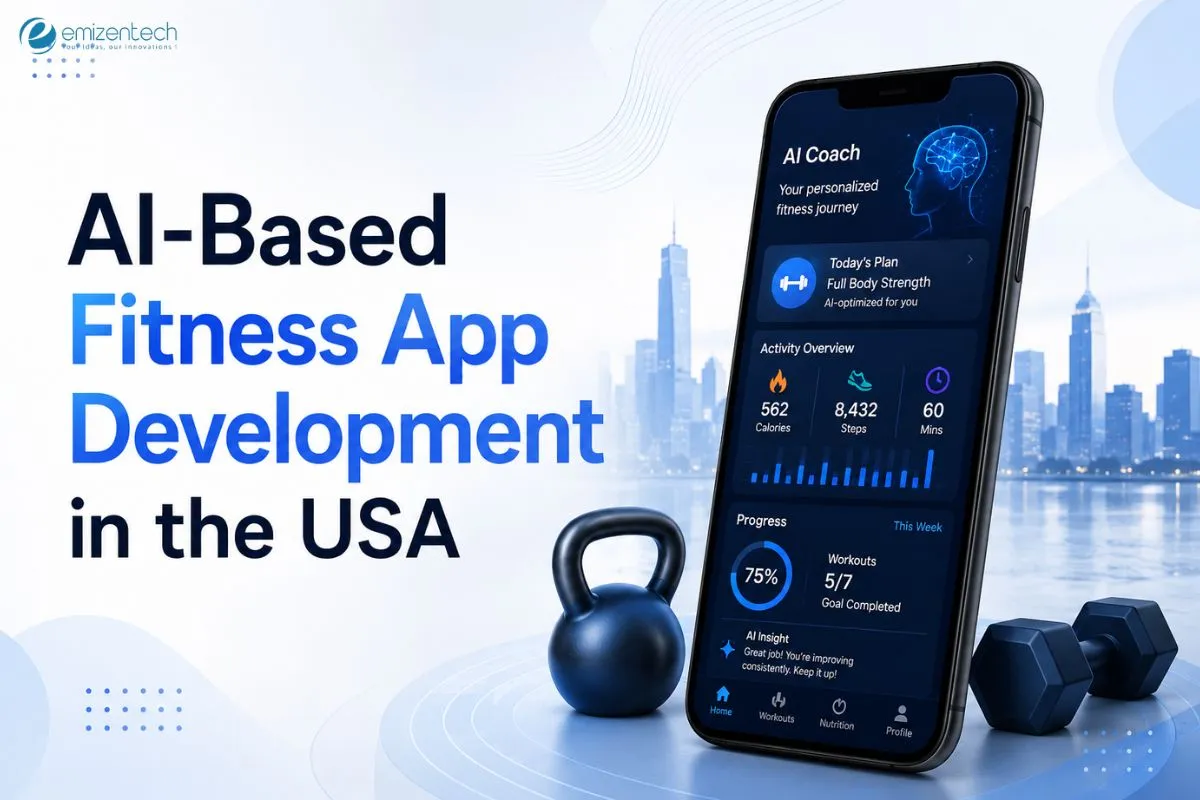

The fitness app industry in the USA has evolved from basic step-counting tools into highly intelligent, AI-driven digital health ecosystems. Earlier applications mainly focused on tracking physical activity, calories, and workout logs. However, user expectations have significantly changed, and modern fitness apps are now expected to provide intelligent guidance, predictive insights, and personalized health recommendations.
AI-based fitness app development is the key driver of this transformation. By leveraging machine learning, real-time data processing, and predictive analytics, fitness applications can now understand user behavior at a deeper level and respond dynamically to individual fitness needs. This has made fitness apps more adaptive, engaging, and outcome-driven rather than just data-recording tools, especially when built through a professional fitness app development company offering advanced digital health solutions.
Key idea shift in the industry:
- From manual tracking → automated intelligence with minimal user input
- From static fitness plans → dynamically adaptive workout systems
- From generic applications → deeply personalized fitness ecosystems
- From reactive tracking → predictive health and performance insights
Evolution of Fitness Apps in the USA
Fitness applications in the USA have gone through a structured evolution shaped by technological advancement, wearable adoption, and increased health awareness among users.
Initially, fitness apps were designed only to provide basic digital tracking of steps, calories burned, and manual workout entries. These systems had limited intelligence and required constant user input, making them less efficient for long-term engagement.
With the rise of smartphones and wearable devices, fitness apps entered a connected phase where real-time data synchronization became possible. Devices like smartwatches enabled continuous tracking of heart rate, sleep cycles, activity levels, and movement patterns, improving the accuracy of fitness monitoring.
Today, the industry has moved into the AI-powered phase, where applications do not just collect data but actively interpret it. These apps analyze user patterns, identify trends, and adjust workout or nutrition plans automatically based on progress and performance metrics.
What is AI-Based Fitness App Development?
AI fitness app development refers to the process of building mobile applications that integrate artificial intelligence systems to deliver personalized, data-driven fitness experiences.
Unlike traditional fitness applications that follow fixed programming logic, AI-powered apps continuously learn from user behavior and improve their recommendations over time. These systems are designed to analyze multiple data points such as physical activity, workout intensity, body metrics, and engagement patterns.
The primary goal is to create a responsive system that evolves with the user. As more data is collected, AI models become more accurate in predicting fitness outcomes, recommending optimized workouts, and adjusting difficulty levels dynamically.
Core functions include:
- Continuous collection and analysis of user health and activity data
- Behavioral pattern recognition to understand fitness habits
- AI-driven generation of personalized workout and nutrition plans
- Predictive modeling for future fitness performance and goal achievement
- Dynamic adaptation of fitness programs based on real-time progress
Core AI Technologies Used in Fitness Apps
Modern fitness applications rely on a combination of advanced artificial intelligence technologies that work together to create intelligent and responsive systems.
Computer vision plays a critical role in form correction and posture analysis. By using device cameras, fitness apps can detect incorrect exercise movements and provide real-time feedback to reduce injury risk and improve training effectiveness.
Predictive analytics is used to forecast fitness outcomes such as weight loss timelines, endurance improvements, and strength progression based on long-term data trends.
Key technologies include:
- Machine Learning (ML): Behavior analysis and adaptive recommendations
- Natural Language Processing (NLP): Voice and chat-based fitness assistance
- Computer Vision: Real-time posture and exercise form detection
- Predictive Analytics: Forecasting health and performance outcomes
- Data Processing Systems: Handling large-scale fitness and health datasets
Key Features of AI-Based Fitness Apps
AI has significantly enhanced the functionality of modern fitness applications by introducing intelligence-driven features that focus on personalization and real-time support.
Personalized workout plans are generated using AI models that analyze user goals, fitness levels, and past performance. These plans are continuously updated based on progress, ensuring optimal challenge levels for users.
Virtual fitness coaches act as digital trainers that provide real-time guidance, motivation, and corrections during workout sessions. These systems simulate human-like coaching experiences using AI algorithms.
Real-time activity tracking ensures continuous monitoring of health metrics through wearable devices and mobile sensors, allowing apps to deliver accurate and up-to-date fitness insights.
Core features include:
- Adaptive personalized workout generation based on user behavior
- AI-powered virtual coaching systems with real-time interaction
- Smart nutrition and diet recommendation engines
- Continuous health tracking using wearable and sensor integration
- Dynamic workout adjustment based on performance feedback
Architecture of AI Fitness Apps
AI-based fitness applications are built using a multi-layer architecture designed to ensure scalability, performance efficiency, and real-time data processing capabilities.
The frontend layer represents the user interface through which users interact with the application. It includes dashboards, workout modules, progress tracking screens, and interactive elements designed for engagement.
The backend layer manages core business logic, authentication systems, API handling, and data processing operations. It ensures smooth communication between different components of the system.
The AI processing layer is the intelligence core of the application. It runs machine learning models, recommendation engines, and predictive systems that generate personalized fitness outputs.
The data layer is responsible for securely storing user-related information, including health metrics, activity logs, and behavioral data. Cloud-based storage systems are typically used for scalability and reliability.
The integration layer connects the application with external systems such as wearable devices, third-party APIs, and health monitoring platforms.
System layers
- Frontend Layer: User experience and interaction design
- Backend Layer: Application logic, APIs, and authentication systems
- AI Layer: Machine learning models and prediction engines
- Data Layer: Cloud-based storage of health and behavioral datasets
- Integration Layer: Wearables, IoT devices, and external APIs
Role of Data in Fitness Apps
Data plays the most critical role in AI-based fitness applications, as it directly influences the accuracy and effectiveness of all AI-driven outputs.
User activity data includes daily movement, workouts, steps taken, and calories burned. This provides a baseline understanding of user engagement and fitness levels.
Health metrics collected from wearable devices include heart rate, sleep cycles, oxygen levels, and recovery patterns. These metrics help in understanding overall physical condition.
Behavioral data tracks how users interact with the application, including usage frequency, feature engagement, and workout consistency.
Types of data used:
- User activity data (steps, workouts, calories burned, active minutes)
- Health metrics (heart rate variability, sleep quality, recovery data)
- Behavioral data (app engagement, usage patterns, retention behavior)
Market Growth in the USA
The USA represents one of the largest and most advanced markets for fitness app development due to high digital adoption rates and strong health consciousness among users.
Consumers increasingly prefer personalized fitness solutions that provide real-time feedback and measurable progress tracking. This has led to a surge in demand for AI-powered fitness applications.
Additionally, the widespread adoption of wearable devices and subscription-based fitness models has significantly contributed to market expansion. Businesses are actively investing in AI-driven fitness platforms to enhance user engagement and build long-term retention strategies.
Key market drivers:
- High smartphone and wearable device penetration
- Increasing demand for personalized health and fitness solutions
- Strong subscription-based fitness economy
- Growing awareness of preventive healthcare and wellness tracking
Challenges in AI-Based Fitness App Development
Despite its advantages, AI-based fitness app development presents several technical and operational challenges that must be addressed for successful implementation.
Data privacy remains a major concern as fitness applications handle sensitive health-related information that requires strict security measures and compliance standards.
Development complexity is high due to the need for integrating AI models, real-time processing systems, and mobile platforms into a unified architecture.
Device compatibility is another challenge, as applications must work seamlessly across multiple operating systems, devices, and wearable technologies.
Data accuracy is also critical, as incorrect or incomplete datasets can significantly impact the performance of AI models and reduce user trust.
Major challenges include:
- Data privacy and regulatory compliance concerns
- High complexity in AI and mobile integration
- Multi-device and wearable compatibility issues
- Ensuring accuracy and reliability of collected data
Future of AI Fitness Apps in the USA
The future of AI-based fitness applications is expected to be highly intelligent, immersive, and deeply personalized, driven by continuous advancements in artificial intelligence and data science.
AI-powered virtual trainers will become more autonomous, offering fully guided fitness experiences without human intervention. Predictive health systems will analyze long-term user data to forecast potential health risks and fitness outcomes.
Emerging technologies such as augmented reality (AR) and virtual reality (VR) will enable immersive workout environments that enhance user engagement. Hyper-personalization will become standard, with fitness apps tailoring experiences at an individual biological and behavioral level.
Future trends include:
- Fully autonomous AI fitness coaching systems
- Predictive health monitoring and risk analysis
- AR/VR-based immersive fitness training environments
- Hyper-personalized fitness ecosystems with adaptive intelligence
- Continuous self-learning fitness platforms
Conclusion
AI-based fitness app development is fundamentally reshaping the fitness industry in the USA by transforming traditional tracking tools into intelligent, adaptive health platforms.
With the integration of artificial intelligence, machine learning, and real-time analytics, fitness applications are becoming more personalized, predictive, and user-centric. This evolution is driving a new era of digital health where fitness apps function as intelligent companions rather than passive tracking tools.



























Sign in to leave a comment.