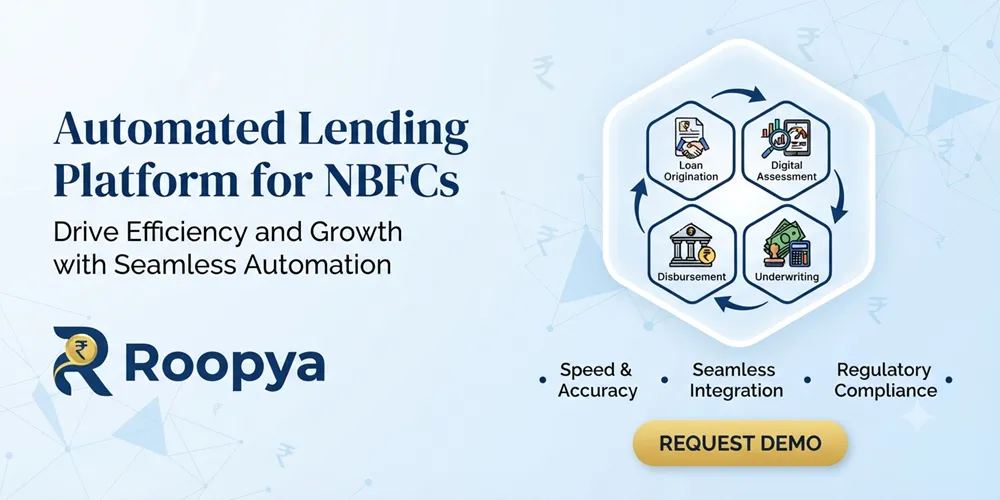

India's Non-Banking Financial Companies (NBFCs) are at the center of the country's credit expansion story. From small-ticket personal loans in Tier 3 towns to structured SME credit lines, NBFCs now originate a significant share of retail and business lending in India. But this growth has come with a challenge: the legacy technology most NBFCs run on was never built for the speed, scale, or regulatory complexity of today's lending environment.
Manual underwriting, spreadsheet-based collections, fragmented KYC checks, and siloed loan management systems slow down disbursals, increase operational cost, and expose lenders to compliance and fraud risk. This is exactly the gap that an automated lending platform for NBFCs is designed to close.
Platforms like Roopya are built specifically to give NBFCs, banks, MFIs, and Loan Service Providers a unified, no-code lending infrastructure that automates the entire loan lifecycle — from origination to collections — without requiring an in-house engineering team to build or maintain it.
This guide explains what an automated lending platform actually is, why NBFCs are adopting them, the core modules that make up a complete system, and how to evaluate a platform before you commit to one.
What Is an Automated Lending Platform?
An automated lending platform is a digital infrastructure layer that manages the entire credit lifecycle — application intake, credit assessment, underwriting, disbursal, servicing, and collections — through pre-built workflows, rule engines, and integrated APIs, instead of manual, paper-based, or spreadsheet-driven processes.
Rather than an NBFC building separate systems for origination, servicing, and recovery (and then trying to stitch them together), an automated platform brings these functions onto one connected system. Every stage of the loan — from the first application to the final repayment — flows through a single source of truth.
For an NBFC, this typically means:
- Digital, configurable loan application journeys
- Automated credit bureau pulls and scoring
- Rule-based underwriting decisions instead of manual file review
- API-driven KYC, bank statement analysis, and fraud checks
- Automated disbursal and repayment scheduling
- System-driven collections and early warning triggers
- Real-time dashboards for portfolio and compliance reporting
The goal is simple: reduce the time between "a customer wants a loan" and "the loan is disbursed and being serviced correctly," while lowering cost per loan and improving risk visibility.
Why NBFCs Are Moving Away from Legacy Systems
Most NBFCs that are still running on legacy loan management software or in-house-built tools face a familiar set of problems:
1. Slow time-to-market for new products. Launching a new loan product — say, a gold loan variant or a merchant cash advance — often takes months because it requires custom development work.
2. High cost of technology ownership. Maintaining an in-house tech stack means hiring developers, paying for servers, and constantly patching for compliance changes — a heavy overhead for a mid-sized NBFC.
3. Manual underwriting bottlenecks. When credit decisions depend on an analyst manually checking bureau reports, bank statements, and documents, turnaround time suffers and human error creeps in.
4. Fragmented data. Origination data sitting in one system and servicing data in another makes it nearly impossible to get a single view of a borrower or the portfolio.
5. Regulatory pressure. RBI's evolving digital lending guidelines, data localization norms, and disclosure requirements mean lenders need systems that can be updated quickly to stay compliant — something legacy, hard-coded systems struggle with.
An automated, no-code lending platform directly addresses each of these pain points, which is why adoption among NBFCs, digital lenders, and Loan Service Providers (LSPs) has accelerated sharply over the last few years.
Core Modules of a Complete Automated Lending Platform
A genuinely end-to-end platform — the kind Roopya positions itself as — typically covers six interconnected modules.
1. Loan Origination System (LOS)
The LOS is where the borrower journey begins. A modern automated LOS should offer:
- Digital application forms configurable without code
- Automated credit scoring pulling from bureau and alternative data sources
- Document verification through OCR and AI-based checks
- Real-time, rule-based decisioning instead of manual review queues
The objective here is to compress what used to be a multi-day underwriting process into minutes, while keeping every decision explainable and auditable.
2. Loan Management System (LMS)
Once a loan is disbursed, the LMS takes over servicing:
- Portfolio management across products and branches
- Automated payment processing and reconciliation
- Amortization schedule generation and modification
- A self-service customer portal for statements, repayments, and requests
A well-built LMS should handle everything from simple EMI schedules to complex structured products, without needing developer intervention every time a new repayment structure is introduced.
3. Collections System
Recovery is often where NBFCs lose the most operational efficiency. An automated collections module typically includes:
- Automated reminders across SMS, email, and WhatsApp
- Configurable collection workflows based on days-past-due buckets
- Structured payment plans for stressed borrowers
- Agent allocation and performance management for field collections
4. Early Warning System (EWS)
Rather than reacting to defaults after they happen, an EWS uses predictive analytics to flag risk before it materializes:
- Risk prediction models based on repayment behavior
- Behavioral analytics across the borrower's transaction history
- Automated alert management for the risk team
- Intervention workflows to trigger proactive outreach
5. Lending Analytics
Data is only useful if it's actionable. A lending analytics module should provide:
- Portfolio-level analytics across vintage, product, and geography
- Performance metrics like approval rate, disbursal turnaround, and NPA trends
- Risk assessment tools including PD, LGD, and EAD-style calculations
- Trend analysis to guide credit policy adjustments
6. Advanced Reporting
Finally, regulatory and management reporting needs to be built in, not bolted on:
- Custom dashboards for different stakeholders (credit, risk, finance, compliance)
- Regulatory report generation aligned to RBI and other statutory requirements
- Export capabilities for audits and board reporting
- Scheduled, automated report delivery
Where AI Fits Into an Automated Lending Platform
The word "automated" increasingly means AI-enabled, not just rule-based. Modern platforms are layering machine learning and natural language processing on top of traditional automation to push accuracy and speed further:
AI-Powered Document Analysis — Instead of a human reviewing every ID proof or bank statement, AI-driven OCR and NLP extract, verify, and flag anomalies in documents within seconds, catching fraud patterns that manual review often misses.
AI-Enhanced Business Rule Engines — A self-learning BRE doesn't just execute static if-then rules; it studies historical approval and rejection patterns and suggests rule refinements, while keeping a human in the loop for final sign-off.
Intelligent Credit Decisioning — Beyond the traditional bureau score, AI models can evaluate alternative data — utility payments, transaction patterns, device data — to assess borrowers with thin credit files, which is especially relevant for NBFCs serving underbanked segments.
AI-Driven Analytics and Reporting — Natural language querying lets non-technical teams ask plain-English questions about portfolio performance and get instant, data-backed answers instead of waiting on a BI team.
Platforms built around this AI layer, such as Roopya, report measurable operational gains: dramatically faster document processing (often cited as roughly 10x faster than manual review), improved fraud detection rates, and better collections outcomes through behavior-based prioritization.
Key Benefits of an Automated Lending Platform for NBFCs
Faster Go-Live
Rather than months of custom development, a no-code platform can be configured and made live for real transactions in a matter of days. For NBFCs racing to capture market share in a competitive lending environment, this speed is a genuine strategic advantage.
Lower Total Cost of Ownership
A pay-as-you-use or usage-based pricing model removes the need for heavy upfront capital expenditure on infrastructure, servers, and dedicated engineering teams — turning a fixed cost into a variable one that scales with loan volume.
Regulatory Agility
Digital lending in India is governed by a fast-evolving set of RBI guidelines covering data storage, disclosure, first-loss default guarantee (FLDG) arrangements, and borrower protection. A platform that is centrally maintained and continuously updated for compliance removes a significant regulatory burden from the NBFC's internal team.
No-Code Configurability
Business teams — not developers — can design loan products, adjust eligibility criteria, and modify approval workflows through a visual interface. This dramatically shortens the cycle from "we want to launch a new product" to "the product is live."
Pre-Integrated Ecosystem
A platform with hundreds of pre-integrated APIs (credit bureaus, KYC and Aadhaar verification, bank statement analyzers, payment gateways, e-signature and e-mandate providers) removes the integration burden that would otherwise take months of vendor negotiation and technical work.
Ready-Made Loan Products
Rather than building loan products from scratch, NBFCs can select from a library of pre-configured products spanning personal loans, business loans, gold loans, payday loans, and more — customizing only what's specific to their business.
Stronger Fraud Defense
Built-in, AI-powered fraud detection modules screen every application for identity mismatches, document tampering, and suspicious behavioral patterns before a human underwriter ever sees the file.
Open API Architecture
For NBFCs that already run a CRM, ERP, or accounting system, an open API architecture ensures the lending platform slots into the existing tech stack instead of forcing a complete overhaul.
Who Should Use an Automated Lending Platform?
While the technology benefits any lender, certain segments see outsized value:
- NBFCs launching new loan products who need to test and scale quickly without a multi-quarter build cycle.
- MFIs and small-ticket lenders who process high volumes of low-value loans, where manual underwriting costs eat directly into margins.
- Digital-first lenders and fintech NBFCs whose entire value proposition depends on speed and a seamless digital borrower journey.
- Loan Service Providers (LSPs) operating in partnership models with regulated entities, who need a compliant, auditable system that satisfies both their own operational needs and their lending partner's due diligence.
- Banks and co-lending partners looking to modernize a specific portion of their lending operations — such as a digital personal loan vertical — without touching their core banking system.
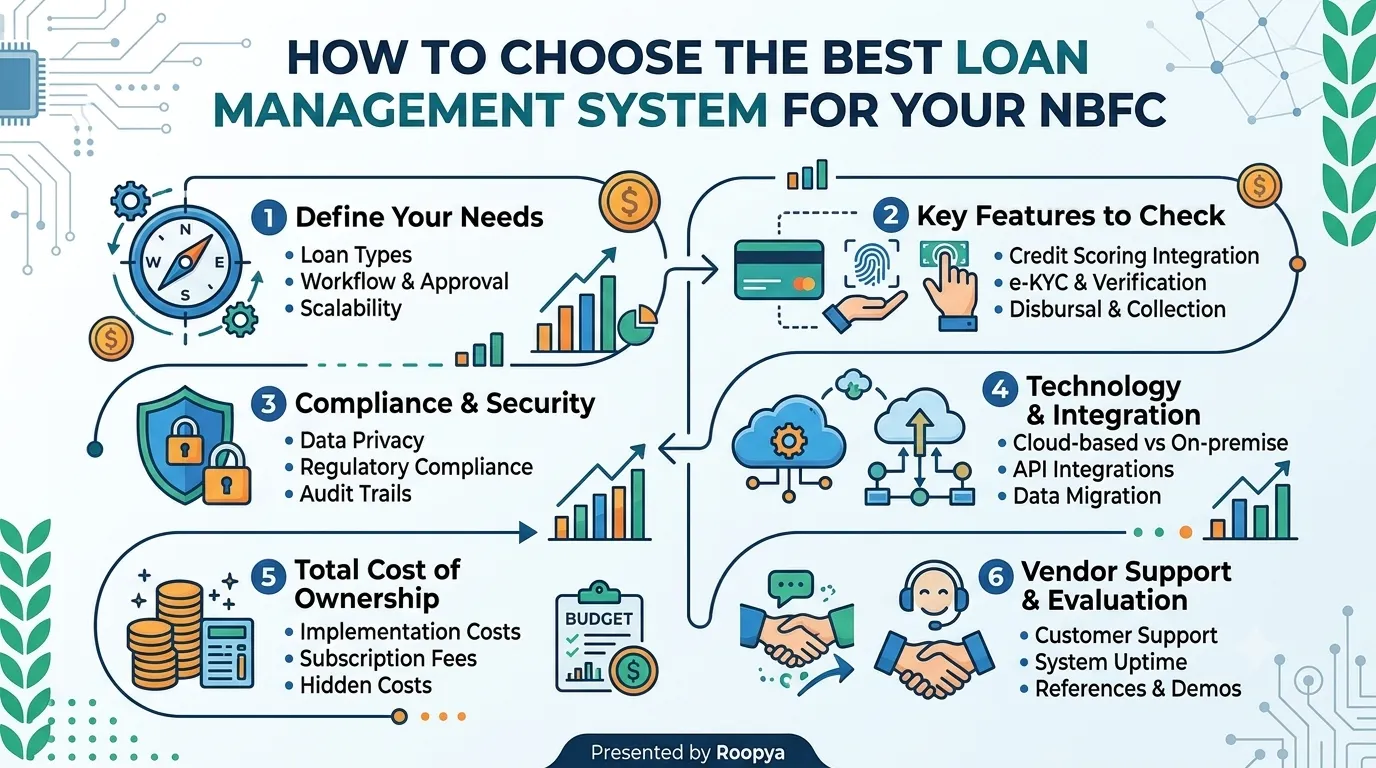
How to Evaluate an Automated Lending Platform Before You Buy
Given how central this infrastructure becomes to daily operations, NBFCs should evaluate vendors carefully across a few dimensions:
- Breadth of coverage — Does it handle origination, servicing, collections, and analytics as one connected system, or will you still need to stitch together multiple vendors?
- Configurability vs. custom development — Can your business team actually change workflows and products without raising a developer ticket every time?
- Depth of API integrations — How many credit bureaus, KYC providers, and payment rails come pre-integrated, and how quickly can new ones be added?
- AI and analytics maturity — Is the risk and fraud detection genuinely model-driven, or is it just static rules dressed up as "AI"?
- Compliance posture — Is the platform actively maintained to track RBI's Digital Lending Guidelines and other regulatory updates?
- Pricing model — Does the cost structure scale with your loan volume, or does it lock you into large upfront license fees regardless of usage?
- Implementation speed — What is the realistic time from contract signing to processing your first live loan?
Roopya: A Purpose-Built Example
Roopya (https://roopya.money/) illustrates how these principles come together in practice. It positions itself as a no-code, unified lending infrastructure covering the full lifecycle — Loan Origination System, Loan Management System, Collections, and Early Warning System — backed by Lending Analytics and Advanced Reporting.
Notable elements of its approach include:
- 1-day go-live claim through plug-and-play onboarding
- Zero upfront cost, pay-as-per-use pricing
- 300+ pre-integrated APIs spanning bureaus, verification services, and payment gateways
- 20+ pre-configured loan products, including personal, payday, gold, business, home, and auto loans
- AI-powered document analysis, fraud detection, and credit decisioning
- A self-configurable Business Rule Engine (BRE) that lets business users, not developers, manage lending policy
- Dedicated modules for Credit Risk Analytics, including scorecard development, PD/LGD/EAD/ECL calculations, and stress testing — capabilities NBFCs typically need for both internal risk management and regulatory reporting
- An Embedded Finance offering for platforms looking to embed lending into their own product
This combination of origination, servicing, collections, risk analytics, and embedded finance under one no-code platform is representative of where the category is heading: fewer point solutions, more unified infrastructure.
The shift toward automated lending platforms isn't a passing trend — it reflects a structural change in how NBFCs need to operate to stay competitive. Borrowers expect near-instant decisions, regulators expect tighter compliance and transparency, and business teams expect the ability to launch and adjust products without waiting on engineering cycles.
An automated lending platform for NBFCs consolidates origination, servicing, collections, risk analytics, and reporting into a single, no-code system — cutting go-live time from months to days, lowering the cost per loan, and giving lenders the risk visibility they need to grow responsibly. Whether an NBFC is scaling small-ticket digital loans or building out a diversified SME lending book, this kind of unified infrastructure is quickly becoming table stakes rather than a nice-to-have.
For NBFCs, MFIs, banks, and Loan Service Providers evaluating their next technology move, platforms like Roopya offer a practical starting point: a system built specifically for the realities of Indian lending, ready to go live fast, and designed to scale as the business grows.
Frequently Asked Questions (FAQs)
1. What is an automated lending platform for NBFCs? An automated lending platform for NBFCs is a digital infrastructure that manages the complete loan lifecycle — application, credit scoring, underwriting, disbursal, servicing, and collections — through pre-built, configurable workflows instead of manual or paper-based processes.
2. How is an automated lending platform different from a traditional Loan Management System (LMS)? A traditional LMS usually only handles loan servicing after disbursal. An automated lending platform typically combines origination (LOS), servicing (LMS), collections, early warning systems, and analytics into one connected system, rather than requiring separate tools for each stage.
3. Is a no-code lending platform actually suitable for complex loan products like SME or business loans? Yes. No-code platforms with a configurable Business Rule Engine can support complex eligibility criteria, multi-stage approval workflows, and structured repayment schedules for SME and business loans, without requiring custom software development for each variation.
4. How long does it typically take to go live on an automated lending platform? Implementation timelines vary by vendor and complexity, but modern plug-and-play platforms are built to go live in days rather than the months typically required for custom-built systems. Some platforms, like Roopya, advertise go-live in as little as one day for standard configurations.
5. Are automated lending platforms compliant with RBI's digital lending guidelines? Reputable platforms are built and maintained to stay aligned with RBI's Digital Lending Guidelines and related regulatory requirements. NBFCs should confirm compliance coverage, data localization practices, and audit trail capabilities directly with the vendor before onboarding.
6. What role does AI play in automated lending platforms? AI is typically used for document verification and OCR, fraud detection, alternative-data-based credit scoring, and generating natural-language analytics and reports — improving speed and accuracy compared to fully manual processes.
7. How much does an automated lending platform cost for an NBFC? Pricing varies by vendor, loan volume, and modules used. Many modern platforms use a pay-as-you-use model with zero or low upfront cost, so pricing scales with the number of loans processed rather than requiring a large fixed license fee.
8. Can an automated lending platform integrate with our existing CRM or core banking system? Yes, platforms with an open API architecture are designed to integrate with existing CRMs, ERPs, core banking systems, and other business tools rather than replacing the entire technology stack.
9. Is this type of platform suitable for MFIs and small-ticket lenders? Yes. Automated platforms are particularly valuable for MFIs and small-ticket lenders because they reduce the cost per loan through automated underwriting and collections — critical for maintaining margins on low-value, high-volume loan books.
10. What should an NBFC look for before choosing a lending platform vendor? Key evaluation criteria include breadth of lifecycle coverage (origination to collections), configurability without code, depth of pre-integrated APIs, maturity of AI/analytics capabilities, regulatory compliance posture, pricing flexibility, and realistic implementation timelines.


























Sign in to leave a comment.