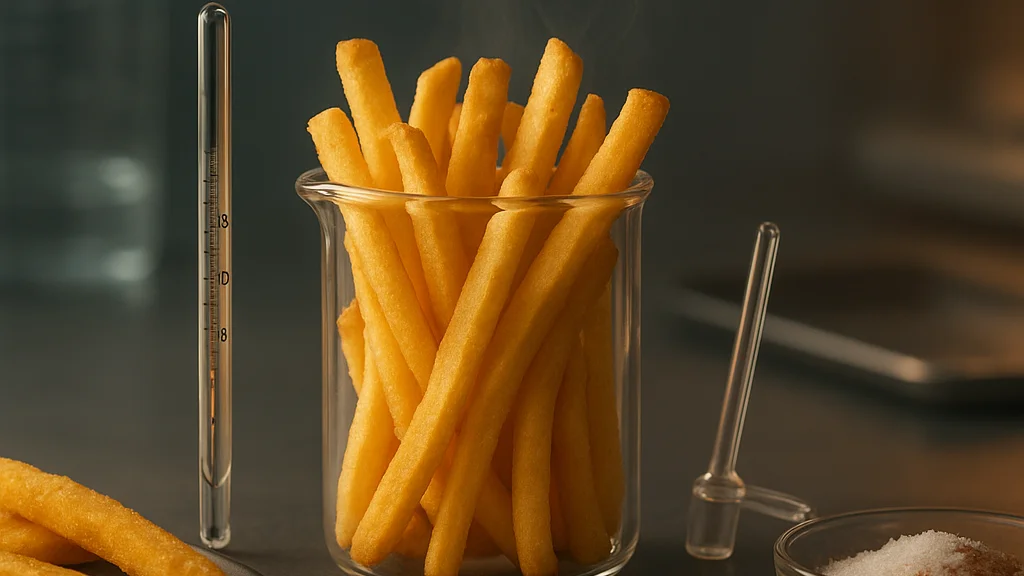

A proper chip should manage a small miracle. Crisp shell, fluffy middle, enough golden colour to make a pub lunch feel cheerful, but not so much browning that chemists start frowning into their lab coats. That last bit is where the latest French fry breakthrough becomes rather more interesting than a passing food headline. Researchers have been studying how to make fries healthier by reducing the formation of acrylamide, a chemical compound that can form in starchy foods when they are cooked at high temperatures. According to the approved MSN report, scientists have discovered a way to make French fries healthier without asking people to abandon the very qualities that make fries popular in the first place.
For beginners, that matters because food science often sounds intimidating when it is actually deeply practical. This is not a story about molecular gastronomy vapour or laboratory chips served under a glass cloche in Shoreditch. It is about the ordinary potato meeting heat, sugar, amino acids and time. If you have ever wondered why one batch of fries turns beautifully blond while another goes too dark, tastes slightly bitter, or leaves you feeling that the fryer got away from you, you are already asking the right questions. The science sits inside those everyday kitchen moments.
There is also a wider reason to pay attention. Regulators in Europe have spent years focusing on acrylamide reduction in foods such as chips, crisps, bread and coffee. Food manufacturers, restaurant chains and home cooks alike have had to think more carefully about raw ingredients, storage conditions and cooking methods. The recent French fry breakthrough is best understood as part of that longer story rather than a lone eureka moment. If you have read this related WriteUpCafe overview or the broader complete guide on the French fry breakthrough, you will know the basic premise. What follows is the beginner-friendly version with the science unpacked, the hype trimmed back, and the practical implications laid out plainly.
The breakthrough is not that scientists reinvented the fry. It is that they found smarter ways to manage the chemistry that happens before the potato ever reaches your plate.
Why French fries became a scientific problem in the first place
French fries are deceptively simple. Potatoes are cut, rinsed or not rinsed, blanched or not blanched, dried, then fried. Yet the chemistry is unusually busy. When potatoes are heated above roughly 120C in low-moisture conditions, the Maillard reaction kicks in. This is the same family of reactions that gives toast, roast potatoes and baked goods their appetising colour and complex flavour. It is also the pathway through which acrylamide can form, especially when the amino acid asparagine reacts with reducing sugars such as glucose and fructose.
That means the potato variety matters. Storage matters. Temperature matters. Even the time between harvest and frying can matter. According to food safety authorities in Europe, acrylamide has been a concern for years because animal studies have linked high exposures to cancer risk, which is why manufacturers have been encouraged or required to reduce levels where reasonably possible. The point is not that a bowl of chips is a toxic event. The point is that repeated exposure from multiple foods adds up, and food producers have strong incentives to lower avoidable formation.
One of the biggest complications is that the conditions that create lovely flavour and colour are often the same conditions that increase acrylamide. So the challenge has never been merely “make fries healthier.” The real challenge is “make them healthier without making them pale, limp and forgettable.” Anyone who has suffered a joyless oven chip knows the stakes. This is why scientists and manufacturers have spent years working on interventions that preserve texture and taste while nudging the chemistry in a safer direction.
Recent coverage has focused on methods that alter pre-treatment of potatoes before frying. That might involve soaking, blanching, coatings, or ingredient adjustments designed to reduce the precursors that lead to acrylamide formation. The details vary by study, but the principle is consistent: if you can reduce reducing sugars or interrupt the reaction pathway, you can often lower acrylamide while keeping acceptable sensory quality.
- Acrylamide forms mainly in starchy foods cooked at high temperatures.
- Potato sugars and asparagine are key starting materials in its formation.
- Darker colour often signals more browning, which can correlate with higher acrylamide.
- Storage conditions, especially cold storage, can increase reducing sugars in potatoes.
Seen that way, the French fry story is less about one magical trick and more about controlling a chain of small variables. Food science loves that sort of puzzle—annoying in the kitchen, fascinating in the lab.
What the breakthrough actually means for beginners
Headlines can make scientific progress sound grander or simpler than it is. The beginner’s version is this: scientists are finding better pre-cooking methods that reduce harmful compounds in fries without ruining the eating experience. According to the MSN report, the healthier-fry development centres on changing how potatoes are treated before they are cooked, which influences how much acrylamide forms later. That is important because the fry itself does not need to become a sad imitation of the original. The aim is to keep the crunch and flavour while improving the chemistry.
For a newcomer, it helps to separate three ideas that often get muddled together. First, “healthier” does not mean low-calorie. A fry can have lower acrylamide and still be fried in oil. Second, “scientific breakthrough” does not necessarily mean supermarket shelves change overnight. Food manufacturing moves through testing, scaling, regulation and cost analysis. Third, “safer” does not mean risk-free. It means risk-reduced, which is how most public-health improvements work in real life.
The practical mechanism is usually one of these: remove some of the sugars from the cut potato, alter the surface chemistry, or use processing steps that reduce the chance of excessive browning. Blanching in hot water is one familiar method. Soaking can help too. Some industrial approaches use additives or enzymes, though those are not always relevant for home cooks. What makes the current discussion notable is that researchers appear to be refining these interventions to get better results without compromising texture.
If you are just entering the subject, compare it to making tea properly. Tiny changes in time, temperature and preparation can produce a dramatically different cup. Fries are much the same, only with more oil and considerably less forgiveness. The WriteUpCafe piece on common mistakes in the healthier French fry breakthrough is useful here because it shows how easy it is to undo a good scientific method with poor handling—overcrowding the fryer, storing potatoes too cold, or cooking them too dark.
For beginners, the key lesson is simple: the breakthrough is about process control, not potato wizardry.
That distinction matters because it makes the science usable. You do not need a research lab to understand the logic. You need to know what causes the problem, what step interrupts it, and what trade-offs come with the fix.
The chemistry behind healthier fries, minus the headache
Now for the nuts and bolts—or rather, the starch and sugar. Potatoes naturally contain amino acids and sugars. When they are heated hard enough, those compounds react and produce browning molecules, aroma compounds and, in some cases, acrylamide. The amount formed depends heavily on the raw material. Potatoes stored at low temperatures can accumulate more reducing sugars through a process often called cold-induced sweetening. That is one reason commercial fry producers are fussy about variety selection and storage regimes.
Scientists have therefore approached the problem from both ends. One route is agricultural and logistical: grow or select potato varieties with lower reducing sugar potential and store them under conditions that do not encourage sugar build-up. Another route is processing: wash, soak, blanch or otherwise treat the potato strips so less sugar remains available for the reaction. The current breakthrough sits most comfortably in that second category, though the best industrial outcomes usually combine both.
There is a balancing act here. If you soak or blanch too aggressively, you can remove too much surface starch and compromise the final crust. If you fry too cool, the chips absorb more oil and lose crispness. If you fry too hot, acrylamide formation rises and colour darkens too quickly. The ideal process therefore tries to hit a narrow corridor: enough heat for structure and flavour, but not so much that the chemistry races ahead.
According to food-industry guidance and long-running European mitigation strategies, several methods have been shown to help:
- Select potato varieties intended for frying rather than general-purpose table potatoes.
- Avoid storing potatoes in overly cold domestic conditions, especially the fridge.
- Rinse or soak cut potatoes to remove some surface sugars.
- Blanch before final frying when appropriate.
- Cook to a golden yellow rather than a deep brown.
- Maintain stable frying temperatures instead of letting oil spike.
That list may sound basic, but basic is often where public health wins are made. The latest scientific attention matters because researchers are quantifying which interventions work best and how they affect taste, colour and texture. A method that lowers acrylamide by a meaningful margin but produces a poor fry is unlikely to spread. A method that lowers acrylamide while preserving consumer acceptance has a real chance in factories, restaurants and perhaps eventually domestic cooking advice.
There is also a commercial incentive. Frozen potato giants, quick-service restaurants and foodservice suppliers all operate at scale. Small percentage improvements in quality consistency or compliance can translate into large operational gains. That is why a fry story can move from a laboratory note to a boardroom discussion faster than you might expect.
How the food industry is likely to use the breakthrough
Industrial fry production is not a matter of chucking spuds in a basket and hoping for the best. Major processors already monitor sugar levels, dry matter, blanching times, oil turnover and colour targets with impressive precision. So when scientists identify a more effective pre-treatment or process tweak, manufacturers see a potential tool for compliance, product quality and brand protection. Nobody wants a food-safety concern attached to a global comfort food.
In Europe especially, acrylamide mitigation has been built into food manufacturing routines for years. Producers have used benchmark levels and mitigation practices to show that they are managing the issue responsibly. A genuine breakthrough, then, is not necessarily revolutionary in appearance. It may be an improved version of an existing step that is easier to scale, cheaper to run, or better at preserving sensory quality. Sometimes progress in food science looks less like a moon landing and more like a factory engineer quietly smiling at a spreadsheet.
For restaurants and takeaway chains, the implications are slightly different. They need systems that work under pressure, with variable staff skill and high throughput. A method requiring delicate timing or specialist ingredients may be fine in a lab but awkward in a busy kitchen on a Saturday night. The best innovations for foodservice are the ones that slot into existing workflows—pre-soaked frozen fries, for example, or standardised products from suppliers that already incorporate the mitigation step.
That is why developments reported in consumer-facing headlines should be read alongside broader trend pieces such as this WriteUpCafe analysis and this discussion of French fry innovation. The central question is not merely whether the science works in principle. It is whether it can survive cost pressures, supply-chain variability, and the public’s insistence that a fry should still taste like a treat rather than a lecture.
- Manufacturers care about regulatory compliance, consistency and shelf appeal.
- Restaurants care about speed, repeatability and customer satisfaction.
- Consumers care about flavour first, then health benefits if quality holds up.
- Retailers care about whether a healthier claim can be made credibly and legally.
That hierarchy may sound cynical, but it is realistic. Healthier fries will only travel if they remain recognisably fries. No one queues for chips in the rain because they fancy a cautionary tale.
What has changed recently, and why 2026 matters
By 2026, the conversation around fries is sharper than it was a decade ago for three reasons. First, consumers are more accustomed to hearing about processing risks and ingredient transparency. Second, manufacturers have better analytical tools for monitoring food chemistry. Third, the market for “permissible indulgence” has grown—foods that remain indulgent but carry a stronger health or safety story. That is fertile ground for innovations in staple comfort foods.
Recent reporting has framed the French fry breakthrough as part of a broader move toward healthier versions of familiar foods rather than a niche scientific curiosity. That framing matters. Public appetite for reformulation has matured. People may not want lecture-hall nutrition, but they are increasingly receptive to products that quietly improve on the old model. It is the same instinct that has driven interest in lower-sugar sauces, air-fryer recipes and better-for-you ready meals across British supermarkets.
What is different in 2026 is that the technical conversation is also more nuanced. Industry and media coverage are no longer treating “healthy fries” as a binary. The better question is healthy in what sense: lower acrylamide, lower fat absorption, improved fibre profile, different oil composition, or reduced sodium? The current breakthrough specifically points to reduced harmful compounds formed during cooking, which is scientifically credible and commercially relevant. It does not magically transform chips into a salad. Thank heavens for that honesty.
There is also stronger integration between agricultural science and food processing. Breeders, storage specialists and processors are increasingly looking at the whole potato journey rather than isolated stages. A lower-sugar potato variety paired with improved pre-treatment and controlled frying can deliver better results than any single intervention alone. That systems thinking is one of the most important developments of the past few years.
According to Reuters and other long-running coverage on food reformulation trends, large food companies have become more willing to invest in incremental health improvements when they can be measured, scaled and marketed responsibly. Fries fit that model neatly. They are ubiquitous, emotionally resonant, and technically improvable. If there is a breakout success in this area, expect it to appear first in frozen and foodservice channels before trickling into home-cooking advice and branding.
What home cooks can learn from the breakthrough right now
You do not need industrial equipment to borrow the logic of the science. Home cooks can already reduce the factors associated with excessive acrylamide formation while improving the final chip. The trick is to focus on preparation, not punishment. Good chips are not achieved by fearfully undercooking them into pale batons fit only for a school canteen memory. They are achieved by controlling moisture, sugar and heat.
Start with the potato. Floury varieties generally make better chips because they produce a fluffy interior and tend to fry more cleanly. Store them in a cool, dark place—not the fridge, which can increase sugar levels and lead to darker browning. Cut evenly so the pieces cook at the same rate. Then rinse or soak them. Even a brief soak can remove some surface starch and sugars; a longer soak, followed by thorough drying, can improve texture too.
Blanching is where many home cooks lose patience, but it is one of the most useful steps. A short pre-cook in hot water or a first lower-temperature fry helps set the interior before the final crisping stage. Drying after blanching is essential, unless you enjoy oil splatter as an evening entertainment. The final fry should be hot enough to crisp quickly, but you still want a golden finish rather than a dark mahogany one.
- Choose a floury potato suited to frying.
- Do not refrigerate raw potatoes before use.
- Soak cut chips in water, then dry thoroughly.
- Blanch or par-fry before the final fry.
- Cook to golden yellow, not deep brown.
- Use a thermometer if possible to keep oil steady.
Air fryers complicate the picture slightly. They can reduce oil use, but they still rely on high heat and can still overbrown starchy foods if pushed too far. So the same visual rule applies: aim for golden, not dark. The science is less glamorous than a Bake Off showstopper, but far more useful on a Tuesday. If the breakthrough teaches anything at domestic level, it is that careful prep beats culinary machismo every time.
The healthiest improvement most home cooks can make is not abandoning chips. It is learning how colour, storage and pre-treatment affect what comes out of the fryer.
What to watch next in French fry innovation
The next phase of this story will probably not be a single headline-grabbing invention. More likely, it will be a cluster of improvements arriving from different parts of the supply chain. Expect further work on potato varieties bred for lower sugar accumulation, smarter blanching or soaking protocols, and coatings that help control browning while preserving crunch. Some of these changes will happen invisibly in commercial production long before consumers notice them.
There is also room for better communication. One of the persistent problems in food science reporting is that “healthier” becomes a catch-all term. The more responsible approach is specificity. If a new fry has lower acrylamide potential, say that. If it also reduces oil uptake, say that separately. If it simply uses a different cooking method but offers no proven chemical advantage, do not oversell it. Consumers are perfectly capable of understanding nuance when brands and media bother to provide it.
For beginners, the most useful takeaway is that food innovation often improves staples in modest but meaningful ways. Not every breakthrough rewrites the cookbook. Some simply make familiar foods a bit safer, more consistent and easier to produce well. That can still matter enormously when the food in question is eaten across homes, pubs, school canteens and restaurant chains every single day.
So keep an eye on three things over the next couple of years:
- Whether major frozen potato brands begin highlighting acrylamide-reduction methods more openly.
- Whether restaurant suppliers adopt standardised pre-treated fries at scale.
- Whether public cooking guidance places more emphasis on golden colour and proper potato storage.
- Whether breeding and storage research continues to reduce sugar build-up before processing even begins.
French fries will never become saintly. Nor should they. Part of their charm is their unapologetic status as comfort food. But there is something pleasingly British about improving a beloved indulgence through methodical tinkering—rather like perfecting roasties after years of family arguments. The recent scientific breakthrough deserves attention not because it promises culinary utopia, but because it shows how careful research can make a familiar pleasure a little smarter. For beginners, that is the whole lesson: understand the process, respect the chemistry, and never trust a chip that is trying too hard to be virtuous.




























Sign in to leave a comment.