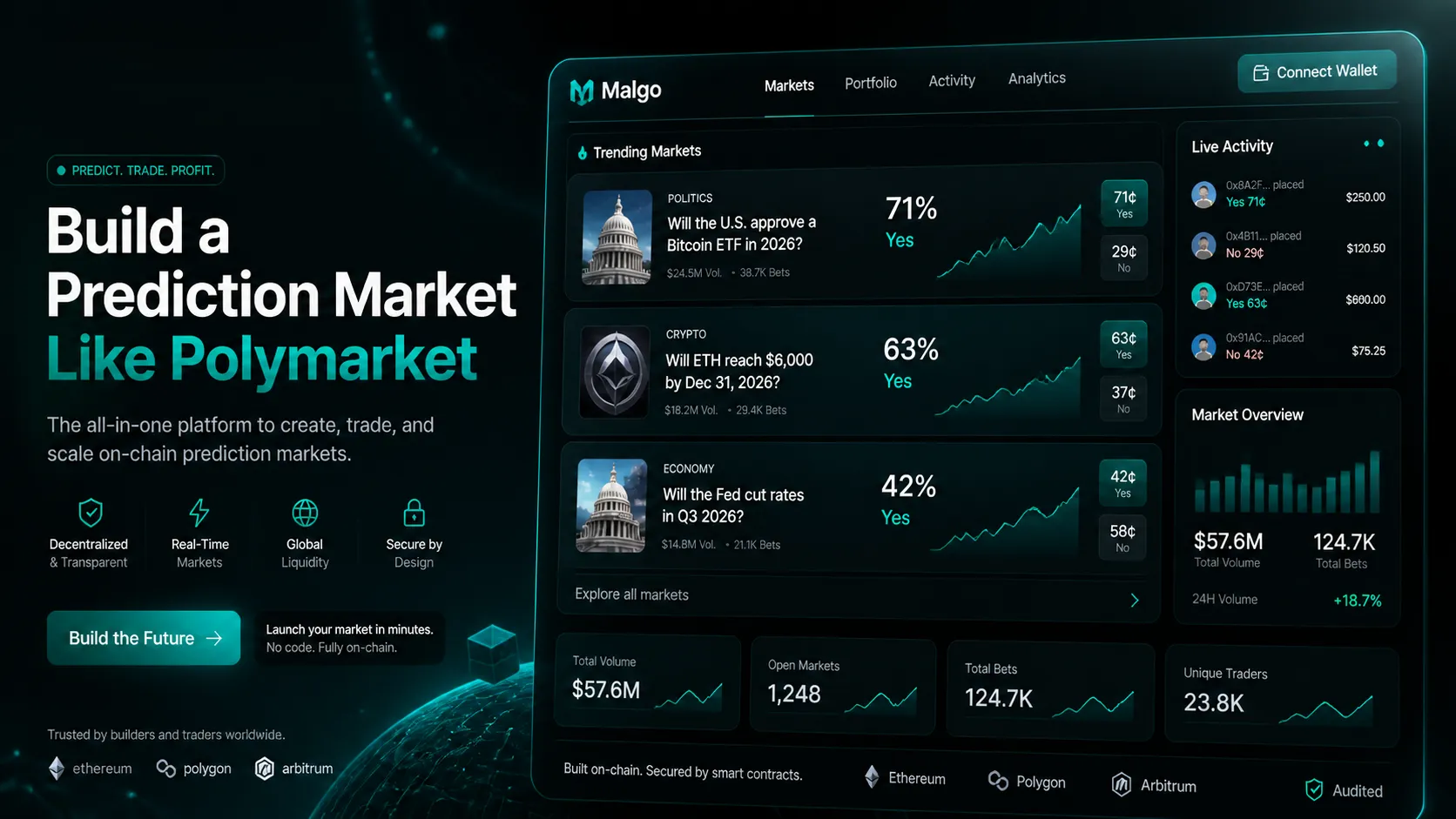

Building a modern prediction market platform requires more than just smart contracts—it demands a blockchain ecosystem that can handle real-time trading, transparent settlement, low-latency interactions, and scalable user participation. Platforms like Polymarket have demonstrated how decentralized infrastructure can transform forecasting markets into globally accessible financial instruments.
Choosing the right blockchain network is one of the most critical architectural decisions in prediction market app development. It directly impacts transaction speed, liquidity depth, user experience, and long-term scalability.
Why Blockchain Matters for Prediction Markets
Prediction markets rely on trustless execution of bets or positions tied to real-world outcomes—such as elections, sports, crypto prices, or global events. Blockchain technology ensures:
- Transparent settlement of outcomes via smart contracts
- Immutable record of trades and resolutions
- Reduced dependency on centralized intermediaries
- Global participation without geographic restrictions
- Verifiable liquidity and market fairness
Networks that support high throughput, low latency, and smart contract flexibility are especially important for real-time prediction trading systems.
Key Criteria for Selecting a Blockchain Network
Before choosing a blockchain for prediction market app development, developers typically evaluate:
1. Transaction Speed & Finality
Prediction markets require fast order execution and settlement finality to maintain accurate pricing.
2. Scalability
High user activity during major events (elections, sports finals) demands strong throughput.
3. Smart Contract Flexibility
Advanced conditional logic is essential for automated market resolution.
4. Ecosystem Liquidity
A strong DeFi ecosystem improves market participation and liquidity depth.
5. Security & Decentralization
Market integrity depends on tamper-proof execution and robust validator sets.
6. Developer Tooling
Strong SDKs, APIs, and documentation reduce development friction.
Top Blockchain Networks for Prediction Market App Development
1. Ethereum – The Institutional Standard for Prediction Markets
Ethereum remains the most widely adopted blockchain for decentralized applications, including prediction markets.
Why it works well:
- Mature smart contract ecosystem (Solidity)
- High security and decentralization
- Strong developer community and tooling
- Extensive DeFi integrations and liquidity access
Ethereum’s credibility makes it ideal for high-trust prediction platforms where transparency and security are top priorities. Many early decentralized prediction markets were built on Ethereum due to its reliability and battle-tested infrastructure.
Considerations:
- Network congestion during peak demand
- Higher transaction latency compared to newer L1s
Despite scalability challenges, Ethereum remains the gold standard for institutional-grade prediction market systems.
2. Polygon – Scalable Layer 2 for High-Volume Prediction Trading
Polygon is a leading Layer 2 scaling solution designed to improve Ethereum’s performance.
Strengths:
- Fast transaction processing
- Low-fee environment suitable for micro-trading
- Compatibility with Ethereum smart contracts
- Strong DeFi and gaming ecosystem
For prediction markets, Polygon is particularly useful when user activity spikes during major global events. Its scalability allows smoother order matching and better user experience without compromising Ethereum compatibility.
Ideal use case:
Prediction market apps that require Ethereum security but need higher throughput and lower latency for retail users.
3. Solana – High-Speed Engine for Real-Time Prediction Markets
Solana is known for its extremely fast block times and high transaction throughput.
Advantages:
- Near-instant transaction finality
- Extremely high scalability
- Optimized for real-time trading systems
- Growing ecosystem of financial applications
Solana is well-suited for prediction markets that resemble high-frequency trading environments. Its architecture enables rapid price updates and smooth order book interactions, making it ideal for event-driven markets like sports or crypto price predictions.
Considerations:
- Smaller validator set compared to Ethereum
- Ecosystem maturity still evolving
Despite these trade-offs, Solana is one of the strongest choices for performance-first prediction platforms.
4. Arbitrum – Optimized Layer 2 for Efficient Market Execution
Arbitrum enhances Ethereum scalability through optimistic rollup technology.
Key benefits:
- Low-latency execution with Ethereum-grade security
- High compatibility with Ethereum tooling
- Efficient gas optimization for frequent trades
- Strong adoption in DeFi ecosystems
Arbitrum is particularly effective for prediction markets that require a balance between decentralization and performance efficiency. It allows developers to deploy Ethereum-native contracts while significantly improving throughput.
Best suited for:
Prediction markets with continuous trading activity and complex settlement logic.
5. Avalanche – Customizable Subnet Architecture for Specialized Markets
Avalanche offers a unique subnet architecture that enables tailored blockchain environments.
Strengths:
- High throughput and low latency
- Customizable subnets for dedicated prediction markets
- Strong consensus finality
- Flexible infrastructure for enterprise-grade applications
Avalanche is ideal for developers building specialized prediction market ecosystems, such as sports forecasting platforms or enterprise-grade event derivatives.
Its subnet model allows isolation of workloads, which enhances performance and compliance control.
6. BNB Chain – High Liquidity Ecosystem for Mass Adoption
BNB Chain is known for its large user base and strong transaction volume.
Advantages:
- High liquidity and user engagement
- EVM compatibility for easy migration
- Fast block times and low operational friction
- Strong ecosystem of consumer-facing dApps
For prediction markets targeting mass adoption, BNB Chain offers access to a broad global audience and active trading behavior. This can significantly enhance market participation and liquidity depth.
Considerations:
- More centralized validator structure compared to Ethereum
- Trade-offs in decentralization vs performance
7. Base – Emerging Layer 2 for Consumer Prediction Apps
Base is a rapidly growing Ethereum Layer 2 network designed to onboard mainstream users into Web3.
Key strengths:
- Seamless integration with Ethereum ecosystem
- Strong onboarding potential via Coinbase infrastructure
- Developer-friendly environment
- Low-cost transaction execution
Base is particularly attractive for prediction markets targeting mainstream users who may be new to decentralized finance. Its accessibility and ecosystem alignment make it a strong candidate for consumer-facing forecasting applications.
Architectural Insight: Multi-Chain Strategy for Prediction Markets
Modern prediction market applications often benefit from a multi-chain approach:
- Ethereum for settlement and finality assurance
- Layer 2 networks (Polygon, Arbitrum, Base) for daily trading activity
- High-performance chains like Solana for real-time market engines
- Specialized subnets (Avalanche) for enterprise or niche markets
This hybrid model ensures scalability, security, and user experience optimization across different market conditions.
E-E-A-T Considerations for Prediction Market Development
To build a trustworthy prediction market platform, developers should emphasize:
Experience
Real-world trading simulations and testnet validation of market mechanics.
Expertise
Use of audited smart contracts, robust oracle systems, and proven token standards.
Authoritativeness
Integration with reputable blockchain ecosystems and transparent governance structures.
Trustworthiness
Secure oracle design, anti-manipulation mechanisms, and transparent settlement logic.
Prediction markets thrive only when users trust the integrity of outcomes—making blockchain selection a foundational pillar of credibility.
Final Thoughts
Selecting the right blockchain for prediction market app development is not a one-size-fits-all decision. Each network offers unique strengths:
- Ethereum for trust and security
- Polygon and Arbitrum for scalable Ethereum compatibility
- Solana for high-speed execution
- Avalanche for customizable infrastructure
- BNB Chain for liquidity and adoption
- Base for mainstream onboarding
Platforms like Polymarket demonstrate that the future of forecasting markets lies in combining multiple blockchain strengths into a cohesive, user-friendly ecosystem.
A well-architected prediction market today is not just a dApp—it is a real-time financial intelligence system powered by decentralized infrastructure.

























Sign in to leave a comment.