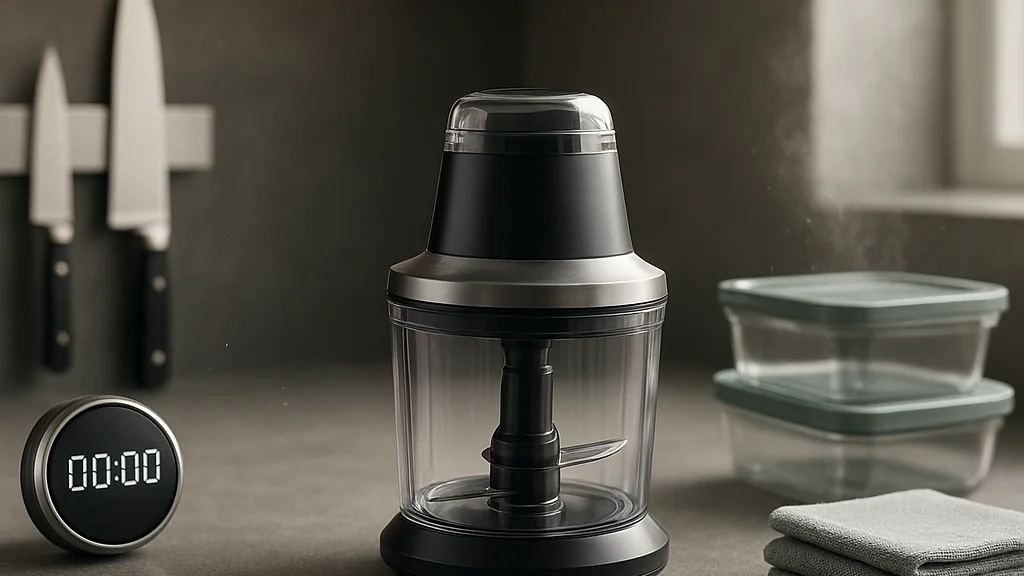

The best kitchen gadgets that save time are not the flashiest ones. They are the tools that remove friction from repeat tasks: chopping onions on a weeknight, reheating leftovers without drying them out, pressure-cooking beans without planning a day ahead, or cleaning up fast enough that cooking still feels worth it. That distinction matters because kitchens are crowded with promises. According to MSN’s roundup of kitchen gadgets that save time, some products genuinely cut prep or cook time, while others mostly shift work from one stage to another. Actually, that is the right lens for any serious buyer: not novelty, but net time saved across prep, cooking, serving, and cleanup.
I see this as an operations problem, almost an OKR for the home kitchen. If your goal is to cook more often with less stress, the key result is not owning more devices. It is reducing the number of minutes lost to repetitive low-value tasks. A good gadget does one of three things extremely well: it automates a slow process, improves consistency enough to prevent mistakes, or compresses cleanup. A bad one creates setup and washing time that cancels out its promise.
That is why the strongest category leaders are surprisingly stable. Pressure multicookers, air fryers, food processors, high-powered blenders, rice cookers, digital thermometers, and efficient dishwashers continue to dominate because they solve old bottlenecks. Meanwhile, newer trends in 2026, especially compact multifunction appliances and app-assisted cooking systems, are trying to prove they can do the same without adding complexity. If you have already skimmed broad buyer guides such as Top 8 Best Kitchen Gadgets That Save Time at Home or Beginner’s Guide to Best Kitchen Gadgets That Save Time, the next step is sharper analysis: which tools save meaningful time, for whom, and under what cooking habits.
A time-saving gadget is only efficient if it beats your existing method after setup, cooking, and cleanup are all counted.
Why time-saving kitchen gadgets matter more now
The market for kitchen gadgets has always ridden on aspiration, but recent consumer behavior has made practicality more important than image. Households are balancing food inflation, restaurant fatigue, and tighter schedules. More people are cooking at home to control cost, yet they still expect speed. That tension has changed what counts as a “good” appliance. A stand mixer may be excellent for bakers, but for the average weekday cook, a compact chopper or multicooker often delivers more measurable value.
Retail behavior supports this shift. Warehouse clubs and mass retailers keep surfacing the same categories because they move volume: air fryers, immersion blenders, countertop ovens, and food prep tools. AOL’s report on kitchen gadgets Costco shoppers swear by reflects something useful beyond shopping enthusiasm. The products that win broad household approval are usually those with low learning curves and high repeat use. That is an important filter. A gadget used four times a week is a labor-saving asset. One used once a quarter is mostly storage.
There is also a hidden productivity angle: reducing decision fatigue. Appliances with reliable presets, clear interfaces, and predictable outcomes lower the mental load of cooking. A rice cooker that nails texture every time saves more than minutes; it saves attention. An instant-read thermometer prevents the cycle of cutting into chicken, guessing, and adding more time. A dishwasher with an effective quick cycle changes how often people are willing to cook from scratch because cleanup no longer feels punitive.
Actually, the strongest products are those that improve the full workflow. A food processor does not merely chop vegetables faster. It can shred cheese, slice potatoes, blitz sauces, and knead some doughs, replacing multiple manual steps. An immersion blender turns a pot of soup into a smooth puree without transferring hot liquid. These are not tiny conveniences. They are structural improvements to a cooking system.
- Prep compression: tools that shorten chopping, mixing, slicing, or shredding.
- Cook acceleration: tools that reduce active or total cooking time.
- Error reduction: tools that improve consistency and avoid rework.
- Cleanup efficiency: tools that minimize dishes, splatter, or scrubbing.
When readers ask for the best kitchen gadgets that save time, they are usually asking for some mix of all four.
The highest-return gadgets, ranked by real workflow impact
If I had to rank kitchen gadgets by practical time savings for most households, the leaders would not be chosen by hype but by cumulative minutes saved over a month. Multicookers sit near the top because they combine pressure cooking, sautéing, slow cooking, and often steaming in one vessel. Dried beans, braises, soups, stock, rice, and even some pasta dishes become easier to fit into a workday. Air fryers score highly because they preheat quickly, crisp food efficiently, and often beat a full-size oven for frozen foods, vegetables, and reheating. Food processors remain elite for bulk prep. Rice cookers are underrated in Western kitchens but indispensable in homes that cook grains often.
Then come the precision tools. An instant-read thermometer is one of the cheapest high-impact purchases in the category. It does not make food cook faster, but it ends overcooking and undercooking. That means fewer do-overs, less hovering, and more confidence. Digital scales do something similar for baking and portioning. Immersion blenders save transfer time and reduce dish count. Electric kettles, especially variable-temperature models, turn water boiling into a fast, predictable task for tea, coffee, oats, noodles, and blanching.
The real winners usually share three traits. First, they work across many recipes. Second, they are fast to set up. Third, they are easy to clean. Remove one of those and value drops sharply. A gadget that shaves three minutes but adds eight minutes of washing is not saving time. This is why many single-purpose tools underperform despite clever design.
- Pressure multicooker: strongest for batch cooking, beans, stews, stocks, braises, and one-pot meals.
- Air fryer or air-fryer toaster oven: strongest for weeknight proteins, vegetables, reheating, and frozen foods.
- Food processor: strongest for large-volume prep, slaws, sauces, slicing, and shredding.
- Rice cooker: strongest for grains, hands-off timing, and meal prep rhythm.
- Instant-read thermometer: strongest for accuracy and preventing wasted time from guesswork.
- Immersion blender: strongest for soups, sauces, dressings, and fewer dishes.
- Electric kettle: strongest for fast boiling and parallel meal prep.
For readers comparing broader roundups, Top 6 Best Kitchen Gadgets That Save Time and 2026’s Best Kitchen Gadgets That Save Time: Efficiency in Every Chop both point toward the same truth: multifunctionality beats novelty when the goal is consistent household efficiency.
The best gadget is rarely the one with the most features. It is the one you reach for often enough that the saved minutes compound.
Where gadgets fail: the products that promise speed but add work
Every kitchen category has dead weight. The common failure mode is not that a gadget does nothing; it is that the time it saves in one stage is erased elsewhere. Small manual choppers can be useful, but many are awkward to load, hard to clean, and inferior to a sharp chef’s knife for modest quantities. Specialized slicers, avocado tools, banana cutters, egg gadgets, and novelty peelers often belong in this group. They solve a narrow task, but kitchens do not run on narrow tasks. They run on sequences.
MSN’s analysis gets at this tension by separating tools that save time from those that merely appear efficient. That distinction matters because consumers often confuse speed of action with speed of workflow. A garlic press may mince cloves quickly, but if it clogs and requires fiddly scrubbing, the net advantage depends on how often you cook with garlic and whether a knife or rasp is already in hand. Likewise, a bulky juicer can be brilliant for households that juice daily and a burden for everyone else.
Another trap is over-automation. Some app-connected appliances promise guided cooking, remote monitoring, recipe integration, and custom programs. For certain users, especially beginners, that can reduce friction. For experienced cooks, it can create one more interface to manage. Actually, software should disappear into the background. If pairing, updates, and notifications become part of dinner, the product has misunderstood the assignment.
Space is part of the time equation too. A device stored in a high cabinet is less likely to be used than one that lives within reach. Countertop footprint, cord management, and accessory sprawl all influence adoption. This is why compact toaster-oven air fryers and stackable multicookers are gaining favor in apartments and smaller homes. The tool that stays accessible wins more often than the one with a longer feature list.
- Red flags: too many parts, hard-to-read controls, narrow use cases, poor dishwasher compatibility.
- Warning sign: a gadget that requires a separate gadget to clean it well.
- Common mismatch: buying for aspiration cooking instead of actual weekday habits.
The discipline, then, is simple: buy for frequency, not fantasy.
What changed in 2026: compact multifunctionality and smarter heat
Kitchen tech in 2026 is not being transformed by one revolutionary invention. It is being refined through consolidation, better sensors, and more efficient form factors. The biggest development is compact multifunctionality. Manufacturers have understood that consumers want fewer boxes doing more jobs. Air-fryer toaster ovens have become more capable at roasting, baking, broiling, reheating, and dehydrating. Multicookers continue to absorb functions once spread across slow cookers, steamers, and rice cookers. Induction-compatible cookware and portable induction burners are also benefiting from broader awareness of speed and energy efficiency.
Sensor-driven cooking is another important shift. Better temperature probes, humidity management, and preset logic are reducing guesswork, especially in countertop ovens and premium rice cookers. The practical effect is not futuristic spectacle. It is fewer interruptions. Food finishes more reliably, and users can step away. That matters in the same way good infrastructure matters in a company: less babysitting, fewer exceptions, smoother throughput.
There is also stronger interest in energy-aware cooking. Full-size ovens are expensive to preheat for small portions, both in time and electricity. Countertop appliances that heat smaller cavities faster are attractive for economic reasons as much as culinary ones. Reports from retailers and consumer product coverage suggest this is helping air fryers maintain momentum rather than fading as a trend. They are no longer a novelty item in many homes; they are a weekday default.
Meanwhile, software integration has become more selective. Consumers seem more willing to pay for digital features when they directly improve outcomes, such as probe-guided doneness or well-designed recipe presets, and less willing when apps feel ornamental. That is a healthy correction. The strongest 2026 products are not trying to turn cooking into screen time. They are trying to remove manual monitoring.
If you want a current snapshot of how this category is being framed for mainstream buyers, Best Kitchen Gadgets That Save Time in 2026: Efficiency Meets Innovation offers a useful companion view. My addition would be this: innovation only matters if it survives a month of weekday use. The products gaining real traction are those that combine speed, reliability, and low cleanup in smaller footprints.
How different households should choose: one size does not fit all
The phrase “best kitchen gadgets that save time” sounds universal, but the right answer changes sharply by household pattern. A family cooking five nights a week needs different tools than a single person reheating portions, and both differ from a serious home baker. The mistake many buyers make is evaluating gadgets in isolation rather than against meal volume, menu style, and kitchen constraints.
For busy families, the pressure multicooker and air fryer form a strong core. One handles batch proteins, soups, grains, and legumes; the other covers fast vegetables, nuggets, salmon, roasted potatoes, and leftovers. Add a dishwasher-safe food processor and much of the weeknight bottleneck disappears. For apartment dwellers with limited storage, a combination toaster oven-air fryer can replace several devices if it is genuinely easy to clean. For meal preppers, a rice cooker and digital scale may deliver more sustained value than trendier appliances because they support repeatable portions and parallel cooking.
Beginners often benefit most from tools that reduce uncertainty rather than maximize speed on paper. A thermometer, a rice cooker, and an immersion blender can improve outcomes immediately without demanding technique. Experienced cooks, by contrast, may gain more from prep acceleration: a quality processor, a mandoline used carefully, or a high-powered blender that can handle sauces, nut butters, and soups.
Budget is not a simple predictor of value. Some of the best returns come from modestly priced tools. Thermometers, kettles, scales, and immersion blenders often outperform expensive niche gadgets in time saved per dollar. Premium products justify themselves when they add durability, easier cleanup, better sensors, or enough versatility to replace other appliances.
- If you cook grains weekly: buy a rice cooker before a novelty countertop gadget.
- If you batch-cook proteins: prioritize a multicooker or air fryer with enough capacity.
- If prep slows you down: invest in a food processor or efficient chopper system.
- If cleanup stops you from cooking: choose devices with dishwasher-safe parts and simple interiors.
- If you are a beginner: buy for consistency first, then for speed.
That framework is more useful than any universal top-ten list because it maps the tool to the bottleneck.
Real-world scenarios: where the time savings show up
Consider three ordinary situations. First, a weeknight chicken dinner. In a conventional oven, preheating alone may take long enough to delay the meal, and reheating leftovers later risks drying them out. In an air fryer, small cuts of chicken and vegetables can cook with less lead time and often better texture on the second day. The time saved is not only in cooking; it is in confidence that leftovers will still be worth eating.
Second, think about a pot of black beans or lentils, a staple familiar across Latin American kitchens, including mine in Bogotá. Stovetop cooking can be excellent, but it demands planning, soaking decisions, and occasional supervision. A pressure multicooker compresses that process and makes batch cooking more realistic on a workday. The advantage compounds when those beans become tacos one night, soup the next, and lunch bowls after that. One appliance changes the cadence of the week.
Third, imagine soup night. A countertop blender can puree beautifully, but transferring hot liquid in batches is slower and riskier. An immersion blender does the job in the pot. Fewer vessels. Less mess. Faster cleanup. This is a recurring theme: the best gadgets save time because they reduce movement as much as labor.
There is also the invisible win of consistency. A digital thermometer can turn a nervous cook into a calm one. Chicken reaches a safe temperature without guesswork. Steak hits the target doneness. Fish is removed at the right moment. That means fewer rescue maneuvers and fewer disappointing meals. Time saved from not fixing mistakes is still time saved.
Actually, the strongest case studies are boring in the best sense. They are not about making restaurant foam at home. They are about getting dinner on the table with less drag. That is why broad consumer lists, whether from mainstream outlets or guides like Top 8 Best Kitchen Gadgets That Save Time at Home, keep converging on the same categories. The market has tested these workflows repeatedly, and the survivors are the tools that keep earning countertop privilege.
What to buy first, what to skip, and what to watch next
If you are building a more efficient kitchen from scratch, start with the tools that have the widest use and the lowest regret. A thermometer, electric kettle, immersion blender, and digital scale are inexpensive foundations. After that, choose one major appliance based on your biggest pain point: air fryer for fast weeknight cooking, multicooker for batch meals and legumes, or food processor for prep-heavy cooking. Add a rice cooker if grains are central to your routine. This staged approach avoids the common mistake of buying five gadgets before identifying the real bottleneck.
What should you skip? Most single-purpose novelty tools, especially those solving tasks already handled well by a knife, peeler, grater, or blender. Skip products with poor cleaning ergonomics, weak capacity, or interfaces that require a manual every time. Also be skeptical of “all-in-one” claims when one function is clearly dominant and the rest feel compromised. A mediocre blender hidden inside a giant appliance is still a mediocre blender.
Looking ahead, the next phase of the category will likely be less about adding features and more about refining usability. Better nonstick durability, easier-to-clean baskets and lids, more accurate sensors, quieter motors, and smaller footprints are where meaningful gains remain. I would also watch induction-related tools and cookware systems, because speed and energy efficiency are becoming more visible purchase criteria.
The final takeaway is straightforward. The best kitchen gadgets that save time are not the ones that make cooking look futuristic. They are the ones that make ordinary meals easier, more repeatable, and less mentally expensive. Buy according to frequency. Count cleanup as part of performance. Favor versatility over novelty. If a tool shortens prep, improves consistency, and disappears into routine, it has earned its place. Everything else is just countertop theater.




























Sign in to leave a comment.