
How do you know where your building is leaking energy? What does a blower door test actually reveal beyond high utility bills? And when is it worth spending money on testing instead of guessing?
If you own a home or manage a building in a colder region, these questions tend to show up right after another uncomfortable winter—or when energy costs refuse to settle down no matter how careful you are.
Blower door testing exists to answer those questions clearly, with numbers instead of assumptions.
What a Blower Door Test Actually Measures (and Why That Matters)
A blower door test measures how much outside air sneaks into a building through unintended gaps. It does this by calculating Air Changes Per Hour (ACH)—the number of times the entire volume of indoor air is replaced by outside air in one hour.
Here’s why that matters in real life:
- Too much air leakage means your heating system works harder than it should
- Drafts form in places that never feel comfortable
- Moisture rides in with cold air, increasing long-term damage risk
These issues are first uncovered during a home energy audit New Hampshire, where excessive air leakage shows up as a major contributor to heating loss.
How the Testing Process Works
What Happens During the Test
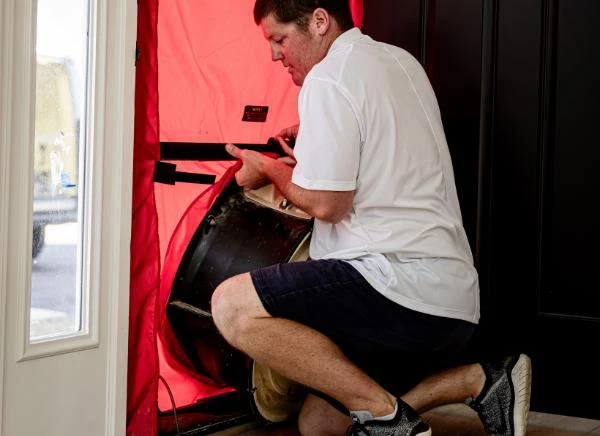
A trained technician installs a calibrated fan into an exterior doorway and gently depressurizes the building. This pressure difference exaggerates leaks so they’re easier to detect.
Using tools like smoke tracers or infrared thermography (thermal imaging that shows temperature differences), the technician identifies where air is moving when it shouldn’t. In many cases, this level of detail goes beyond what homeowners experience during a standard home energy audit Maineor other places, providing clearer guidance on where sealing will matter most.
The entire process usually takes less time than a routine service call.
What You Walk Away With
You don’t just get a pass/fail result. You get data:
- Total leakage levels
- Priority areas for sealing
- A clear picture of where money is being lost
This type of measured data is especially valuable in programs like a home energy audit Rhode Island, where airtightness results directly influence recommendations and incentive eligibility.
That information becomes the foundation for smarter upgrades.
How Testing Fits into Energy Audits and Sealing Strategies
Blower door testing helps determine whether energy loss is coming from the building shell, the duct system, or both—something visual inspections alone can’t confirm.
In some cases, results clearly point toward targeted improvements like duct sealing New Hampshire, or duct sealing Rhode Island. This happens especially when pressure imbalances suggest leakage inside conditioned spaces.
Testing may show that service like duct sealing Maine offers a faster return than adding insulation alone in colder, mixed-use buildings.
The test often shows whether duct sealing will actually deliver results now, or if air leaks in the walls, attic, or structure itself need attention first in older homes and retrofits.
This approach prevents unnecessary work and keeps budgets focused on real problems.
FAQs
Q: Will a blower door test disrupt daily activities?
A: Not really. The process is non-invasive and usually wraps up in a couple of hours.
Q: Does the test itself solve energy problems?
A: No. It shows where the issues are so the right sealing or insulation work can fix them.
Q: When should testing be done?
A: After renovations, when rooms feel uncomfortable, or when energy bills rise without a clear reason.
Final Thought
Blower door testing replaces uncertainty with clarity. Instead of throwing money at symptoms—new equipment, higher thermostat settings, temporary fixes—you address the root cause.
Schedule professional testing with a professional company, for example, JB’s Home Energy, review the data carefully, and focus your improvement budget where it will actually pay off. Over time, the building tells you the difference—through comfort, consistency, and lower bills.
























Sign in to leave a comment.