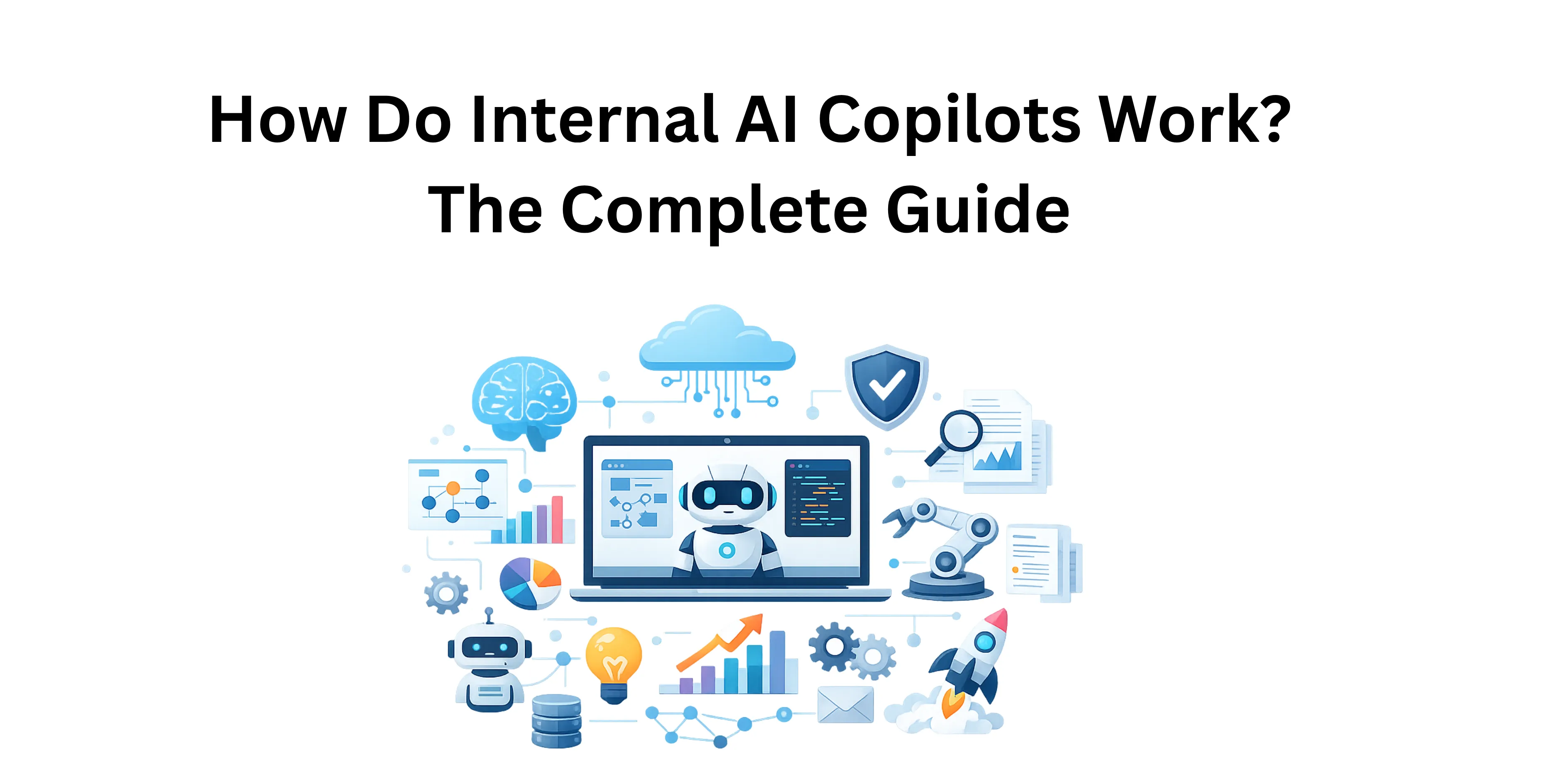

Internal AI Copilots are becoming increasingly potent tools that improve productivity, optimise workflows, and facilitate more intelligent decision-making as companies continue to incorporate AI into their everyday operations. However, what are the true inner workings of Internal AI Copilots? Organisations can implement them more successfully if they are aware of how they work.
What Are Internal AI Copilots?
AI-powered assistants created especially for use inside a company are known as internal AI copilots. They operate in secure environments and are trained on corporate data, including company papers, knowledge bases, and procedures, in contrast to public AI technologies. Their goal is to help workers by giving them accurate information, automating tedious activities, and increasing departmental efficiency. And if you are looking to build internal copilots with small language models, here is the complete guide.
The Core Working Mechanism
Internal AI Copilots work at a high level by combining machine learning models, data retrieval systems, and natural language processing. This is a condensed explanation of how they operate:
1. Understand User Input
When a user asks a query or issues a directive to the copilot, the process starts. Internal AI Copilots use natural language processing (NLP) to determine the purpose of the question. The technology recognises context and meaning in commands like "summarise this document" and "retrieve last month's sales data."
2. Connecting to Internal Data Sources
The copilot accesses pertinent internal systems after comprehending the question. CRMs, ERPs, cloud storage, and internal databases are a few examples of these. Instead of depending only on pre-trained knowledge, this integration enables Internal AI Copilots to retrieve real-time, organisation-specific data.
3. Retrieval-Augmented Generation (RAG)
Retrieval-Augmented Generation (RAG) is a fundamental technology of Internal AI Copilots. Rather than producing responses at random, the system first gathers the most pertinent information before using it to produce precise answers.
This guarantees that Internal AI Copilots produce outputs that are factually accurate and contextually relevant, both of which are essential for business settings.
4. Producing Contextual Answers
The AI retrieves the required data, processes it, and then creates a response that is specific to the user's request. Employees without technical experience can easily use the output because it is usually conversational, straightforward, and actionable.
5. Learning and Improving Over Time
Internal AI Copilots are built with constant improvement in mind. Over time, they improve their accuracy and efficiency by learning from user interactions, feedback, and new datasets. Because of their flexibility, they become more and more important as the organisation's demands change.
Security and Access Control
Internal AI Copilots emphasis on security is one of their distinguishing characteristics. They are designed with stringent access controls since they deal with critical corporate data. In order to ensure adherence to corporate policies and industry requirements, users can only obtain data that they are authorised to access.
Why Understanding How They Work Matters
Understanding how Internal AI Copilots work is crucial for CEOs and other company executives to make wise implementation choices. These systems are tightly integrated solutions that improve internal operations, decrease human labour, and increase overall efficiency; they are not only chatbots.
Conclusion
Internal AI Copilots provide intelligent support within organisations by fusing safe, real-time data access with sophisticated language comprehension. Every stage, from deciphering user enquiries to obtaining pertinent information and producing precise answers, is intended to maximise output and decision-making.
Internal AI Copilots will continue to be crucial in changing how companies function as AI adoption increases, turning them into a strategic advantage rather than merely a technological advancement.






















Sign in to leave a comment.