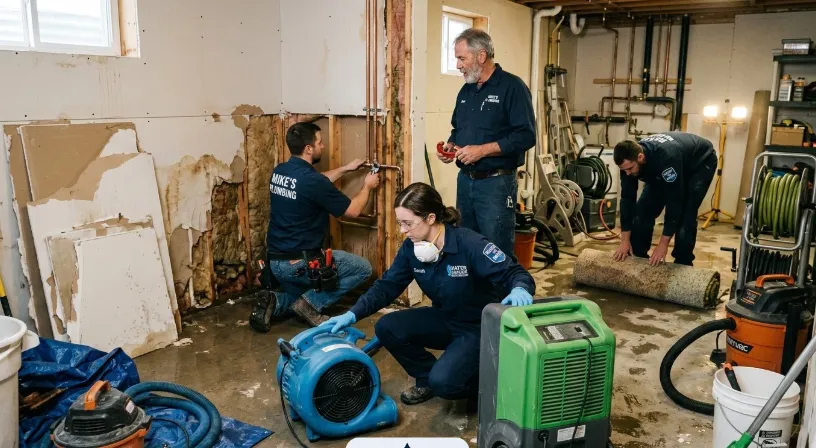

Water damage jobs fall apart when technicians handle the same situation in different ways. One person records moisture levels and documents the job properly, while another skips photos or leaves gaps in the report. Equipment may be set up correctly on one visit and mismanaged on the next.
These inconsistencies lead to rework, insurance delays, safety risks, and frustrated customers who question the quality of work.
In this article, we’ll list the ways to build a high-performance plumbing and water damage crew that responds faster, follows the same process, and delivers cleaner results under pressure.
9 Ways to Build a High-Performance Plumbing and Water Damage Crew
1. Create job-specific SOPs
Each common job type needs a written process that tells technicians what to check, what to record, what tools to use, and when to escalate the job.
For example, a burst pipe in a finished basement needs a different process than a sewage backup or a slow leak behind a bathroom wall. The crew should know how to identify the water source, assess affected rooms, inspect hidden moisture, protect customer belongings, and decide whether materials can be dried or need removal.
The early decisions usually decide whether the job stays controlled or turns into mold risk, rework, and customer complaints. IICRC describes the S500 standard as guidance for the procedures and precautions used in professional water damage restoration, which is exactly why crews need to process.
2. Assign clear emergency roles
You should assign roles before the crew reaches the site. For example:
- Lead technician: assesses the damage, speaks with the customer, and makes the main field decisions
- Documentation owner: takes photos, records readings, and captures job notes
- Extraction/equipment technician: handles water removal, air movers, dehumidifiers, and setup
- Safety lead: checks electrical risk, contaminated water risk, access issues, and PPE needs
This keeps the first visit organized. The customer sees a crew that knows what it is doing. The team moves faster because each person owns part of the response.
3. Standardize moisture inspections
Moisture inspections need to be consistent because visible water is only part of the problem. Set a fixed inspection method. Technicians should know which areas to check, which tools to use, how to record readings, and how to compare progress over time.
For example, on a kitchen leak, the inspection should not stop at the puddle near the sink. The crew may need to check toe kicks, cabinets, drywall, flooring, adjacent rooms, and the ceiling below if it is a multi-storey property.
A good moisture inspection answers three questions clearly:
- Where did the water travel?
- Which materials are affected?
- What needs to happen before the job can be considered dry?
4. Document every job properly
Documentation protects the customer, the crew, the company, and the invoice.
Every job should include photos, moisture readings, equipment logs, notes on affected materials, customer approvals, and changes made during the job.
Many teams also rely on crucial apps for plumbing to capture photos, store moisture readings, assign follow-up visits, and keep job notes connected to the customer record.
5. Build drying plans by material type
Carpet, drywall, hardwood, insulation, concrete, cabinets, and subflooring all respond differently to moisture.
For example, carpet may need extraction and drying, while wet padding may need removal. Hardwood needs careful drying because too much heat or aggressive airflow can create new damage. Wet drywall may dry in some cases, but insulation behind it can hold moisture and slow the entire job.
Your crew should be trained to ask:
- Can this material be dried safely?
- Does it need removal?
- Is there hidden moisture behind or beneath it?
- Will drying this material create secondary damage?
6. Train for mold prevention
Mold prevention starts with moisture control. The EPA says water-damaged areas and items should be dried within 24 to 48 hours to help prevent mold growth.
That means the crew needs to act quickly, but not carelessly. Technicians should know how to remove standing water, dry affected materials, reduce humidity, and identify materials that should not stay in place.
For example, wet drywall behind a cabinet or damp padding under carpet can keep moisture trapped even when the room looks dry. If the crew only dries what they can see, the customer may call later about odor, staining, or suspected mold.
7. Enforce jobsite safety rules
Water damage sites can carry serious safety risks. There may be electrical hazards, slippery floors, contaminated water, damaged ceilings, weakened flooring, sharp debris, or poor air quality.
Safety needs to be a fixed part of the job, not something technicians remember when the site looks dangerous. OSHA’s role is to ensure safe and healthful working conditions through standards, training, outreach, education, and assistance, so safety has to be treated as an operating requirement.
For a plumbing and water damage crew, that can mean checking power before entering wet areas, using PPE based on the water category, marking unsafe zones, lifting equipment properly, and refusing to work in areas that need further assessment.
8. Review callbacks and rework
Callbacks show where the process failed, where training is weak, or where technicians are making different decisions on similar jobs.
When a customer calls back because of odor, visible staining, damp materials, poor communication, or equipment confusion, the company should review the job file and ask what happened.
Look at:
- Were moisture readings taken properly?
- Were photos clear enough?
- Was the drying plan followed?
- Did the technician explain the next steps to the customer?
- Did someone remove equipment too early?
- Was the issue a training gap or a process gap?
9. Build accountability into the crew culture
A process only works when people are expected to follow it. Accountability means technicians know the standard, understand why it matters, and see that shortcuts have consequences.
Accountability also affects reputation. A crew that arrives prepared, documents properly, communicates clearly, and finishes jobs cleanly gives customers more confidence in the company. That consistency supports getting water damage leads because satisfied customers, property managers, and insurance contacts are more likely to refer a team they trust.
Turn Your Crew Standards Into Field Habits
A high-performance plumbing and water damage crew is built through repeated, visible standards. Fix the missed photos, the unclear emergency roles, the inconsistent moisture readings, or the messy handoffs. Small operational improvements add up fast when every technician knows exactly what good work looks like and how to repeat it.































Sign in to leave a comment.