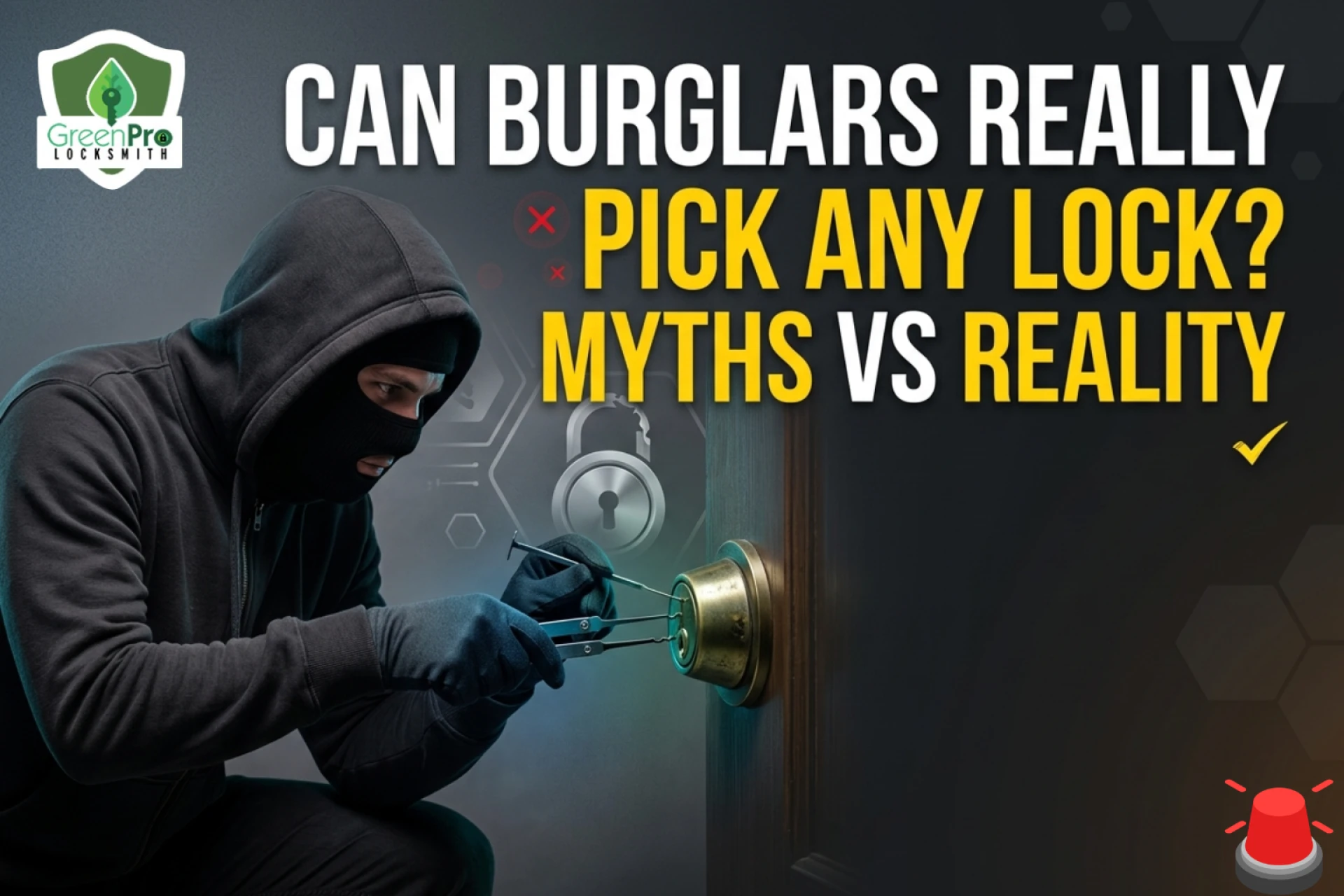

We’ve all seen the movies. The sophisticated thief pulls out a tiny set of tools, tinkers with a doorknob for exactly three seconds, and click—they’re inside the high-security vault. It looks cool, it’s dramatic, and it’s enough to make any homeowner a little paranoid about their own front door.
But how much of that is Hollywood magic, and how much is a real threat to your home? If you’ve ever lay awake at night wondering if your deadbolt is actually doing its job, this guide is for you. We’re going to break down the myths versus the reality of lock picking and home security.
If you’re living in the Northlake, Decatur, Clarkston, Stone Mountain, Embry Hills or any nearby area around Tucker and want a professional eyes-on-site evaluation, calling a licensed locksmith is the best way to move from "paranoia" to "preparedness." But for now, let's separate fact from fiction.
Myth #1: Every Burglar is a Master Lock Picker
The Reality: Most burglars aren't interested in being "elegant."
In the world of professional locksmithing, lock picking is an art form that takes years to master. For a criminal, however, time is the biggest enemy. The longer they stand at your front door fiddling with a tension wrench, the higher the chance a neighbor or a patrol car will spot them.
Statistically, very few residential burglaries involve lock picking. Instead, most intruders look for the path of least resistance:
- Unlocked windows or back doors.
- Kicking in a door (brute force).
- Using a pry bar on a weak frame.
Picking a lock requires fine motor skills, expensive tools, and—most importantly—quiet concentration. Most burglars prefer "smash and grab" tactics over "click and turn."
Myth #2: "Bump Keys" Work on Every Lock
The Reality: They are a threat, but they have a massive weakness.
You may have seen viral videos about "lock bumping." This involves a specially cut key that, when struck with a hammer or screwdriver, "bumps" the pins inside a standard tumbler lock into the open position. It is a real technique, and it is one of the primary ways how burglars bypass residential locks without leaving obvious signs of forced entry.
The Good News: High-security locks are specifically designed to be "anti-bump." Modern locks from reputable brands include telescopic pins or sidebars that make bumping almost impossible. If you have a basic, contractor-grade lock from a big-box store, you might be at risk. If you’ve upgraded your hardware recently, you’re likely much safer than you think.
Myth #3: A Deadbolt Makes Your Home "Unbreakable"
The Reality: A lock is only as strong as the frame it’s attached to.
You could have the most un-pickable, high-tech lock in the world, but if it’s installed into a flimsy wooden door frame with 1-inch screws, a single well-placed kick will bypass it entirely.
When burglars "pick" a house, they aren't just looking at the keyhole. They are looking at the "strike plate" (the metal piece on your door jamb).
- The Reality Check: Most standard strike plates are installed with short screws that only go into the decorative trim. A professional locksmith will replace those with 3-inch screws that anchor directly into the structural studs of your house.
How to Actually Protect Your Home (The Reality)
Since we know that master-level lock picking is rare, what should you actually focus on? Security is about "layers." You want to make your home look like a "hard target" so the burglar moves on to an easier option.
1. Upgrade to Restricted Keyways
One of the biggest security risks isn't picking; it's unauthorized key duplication. If you’ve ever given a spare key to a contractor, a cleaner, or a former roommate, they could have easily made a copy at a hardware store kiosk. Restricted keyways require a specific ID card to make copies, giving you total "key control."
2. High-Security Strike Plates
As mentioned before, reinforcing the frame is just as important as the lock. A heavy-duty, four-screw strike plate makes it significantly harder for someone to kick the door open.
3. Smart Locks and Audit Trails
Modern smart locks allow you to see exactly when a door was opened and by which code. While no electronic system is 100% hack-proof, they eliminate the "hidden key under the mat" tradition, which is a burglar’s favorite way to enter a home.
Why Local Expertise Matters: GreenPro Locksmith
Security isn't "one size fits all." A home in a quiet Tucker cul-de-sac has different vulnerabilities than a storefront on Lawrenceville Highway.
At GreenPro Locksmith, we don’t just swap out hardware; we analyze your home’s entry points from a security professional's perspective. We can identify if your current locks are vulnerable to bumping, if your frames need reinforcement, or if a smart-home integration would better serve your family's lifestyle. Being local to the Tucker area means we understand the specific trends and needs of our community.
Frequently Asked Questions (FAQs)
Q: Can a burglar use a magnet to open my door?
A: This is a myth for most standard residential deadbolts. While some very specific, poorly designed electronic or commercial "reach-style" locks have had vulnerabilities in the past, a standard mechanical deadbolt is not affected by magnets.
Q: Does WD-40 help keep my locks more secure?
A: Actually, stay away from WD-40 for locks! It’s a solvent, not a long-term lubricant. It eventually becomes "gummy" and attracts dust, which can actually make your lock easier to bypass or cause it to fail. Use a graphite-based or Teflon-based lubricant instead.
Q: If a lock is "Pick Resistant," does that mean it can't be picked?
A: In the security world, "un-pickable" doesn't really exist. Everything is about time. A "Pick Resistant" lock is designed to take a skilled person 15 to 20 minutes to open. A burglar isn't going to stand on your porch for 20 minutes. They want to be in and out in under 60 seconds.
Q: Are "Smart Locks" easier to hack than traditional locks are to pick?
A: For your average neighborhood burglar? No. Most burglars are not computer hackers; they are opportunists. A smart lock is generally much more secure than a standard cheap deadbolt because it removes the "lost key" and "hidden key" vulnerabilities.
Conclusion: Awareness is Your Best Deadbolt
So, can burglars really pick any lock? Technically, if they have enough time, the right tools, and world-class skill—maybe. But in the reality of home security, that almost never happens. Most intruders are looking for an unlocked window, a weak door frame, or a key hidden under a fake rock.
By focusing on high-quality hardware, reinforced frames, and professional installation, you make your home a "hard target." Security is about making the "cost" of entry (in time and noise) too high for the criminal to bother.


















Sign in to leave a comment.