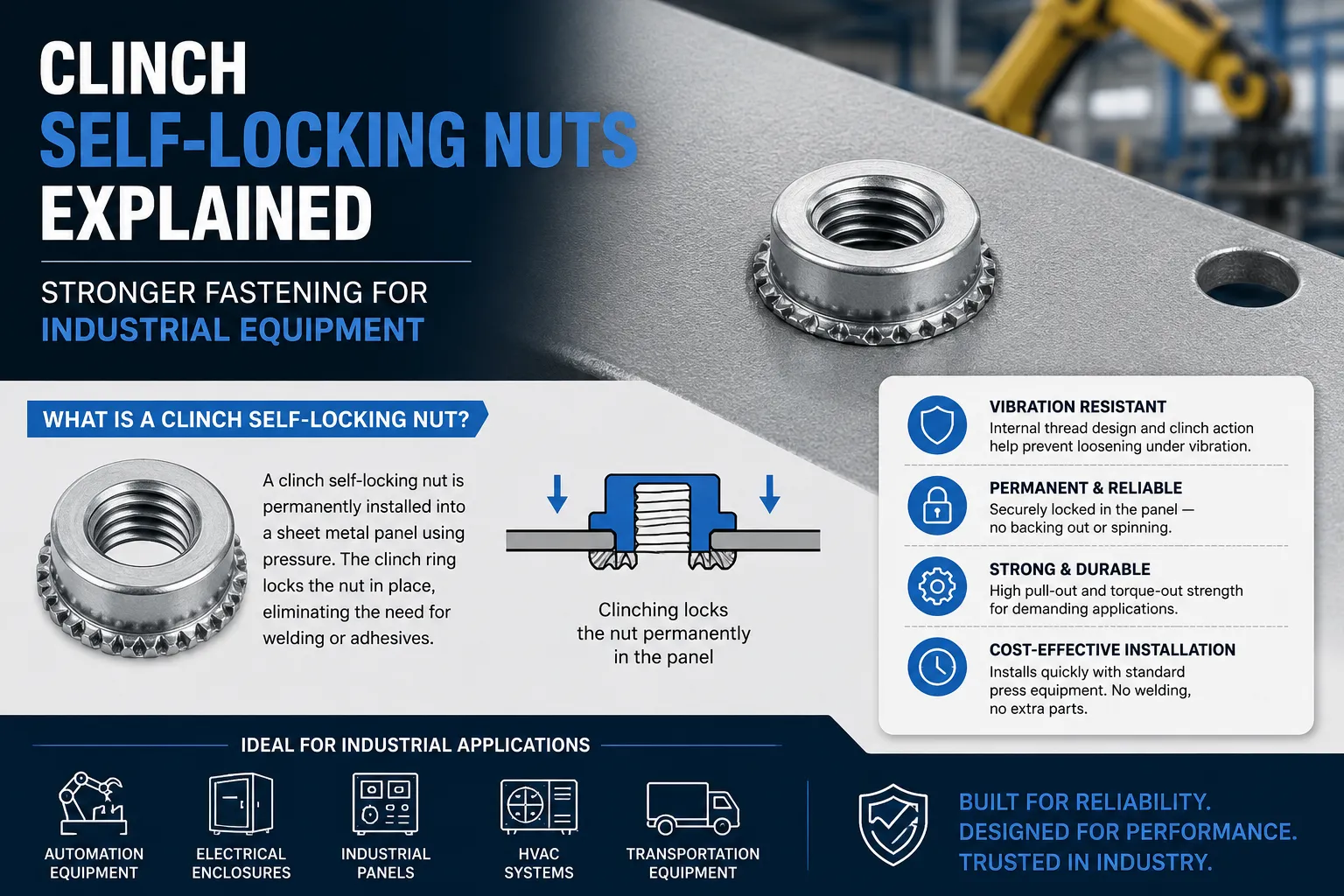

In industrial equipment and high-performance manufacturing environments, fastening security plays a critical role in maintaining operational safety, structural stability and long-term reliability. Equipment exposed to constant vibration, dynamic loads and repeated movement requires fastening solutions that can resist loosening and maintain consistent clamping force over time.
Clinch self-locking nuts are specifically engineered to address these challenges. Widely used in sheet metal assemblies, electrical enclosures, automotive systems and industrial machinery, these fasteners provide strong, permanent threads in thin materials while delivering reliable locking performance without additional hardware.
At G-Fast, we manufacture precision-engineered clinch self-locking nuts designed to meet the demanding requirements of OEMs, industrial manufacturers and high-volume production environments.
This guide explains how clinch self-locking nuts work, their key advantages, common industrial applications and how to choose the right fastening solution for secure, vibration-resistant assemblies.
What Are Nylon Insert Lock Nuts?
Nylon insert lock nuts, commonly known as nyloc nuts are designed with a nylon collar embedded at the top of the nut. When threaded onto a bolt, the nylon insert creates friction that resists loosening caused by vibration or dynamic loads.
How They Work
The nylon insert has a slightly smaller internal diameter than the bolt threads. As the nut is tightened, the threads cut into the nylon, creating a prevailing torque that locks the nut in place.
This built-in locking mechanism eliminates the need for additional washers or adhesives, making installation faster and more efficient.
Key Benefits of Nylon Insert Lock Nuts
1. Excellent Vibration Resistance
The nylon insert prevents loosening even in high-motion environments like engines or rotating machinery.
2. Reusable and Cost-Effective
These nuts can be reused multiple times while maintaining reliable locking performance, reducing replacement costs.
3. No Additional Locking Components Needed
Unlike traditional nuts, nyloc nuts don’t require lock washers or thread-locking compounds.
4. Corrosion-Resistant Options
Available in stainless steel and coated finishes, making them suitable for harsh or outdoor environments.
Common Applications
- Automotive assemblies (engines, suspensions)
- Industrial machinery
- Construction equipment
- Electrical and electronic systems
These nuts are widely used where consistent clamping force and vibration resistance are essential.
What Are Clinch Self-Locking Nuts?
Clinch self-locking nuts, also called self-clinching nuts or press-in nuts are fasteners designed to be permanently installed into thin materials such as sheet metal or panels.
Unlike standard nuts, these are pressed into a pre-drilled hole, where the surrounding material deforms and locks the nut securely in place.
How They Work
During installation, pressure forces the panel material into the grooves or undercut of the nut. This creates a mechanical interlock, ensuring the nut remains fixed and cannot rotate or loosen.
Key Benefits of Clinch Self-Locking Nuts
1. Permanent Installation
Once installed, the nut becomes part of the material, eliminating the need for additional hardware.
2. Ideal for Thin Materials
Perfect for sheet metal, aluminum panels, and enclosures where traditional threading isn’t possible.
3. Clean, Flush Finish
Clinch nuts sit nearly flush with the surface, improving aesthetics and functionality.
4. High Load-Bearing Strength
Provides strong, reliable threads in lightweight materials.
Common Applications
- Electrical enclosures and panels
- Automotive body components
- Aerospace assemblies
- HVAC systems and metal fabrications
They are especially useful in applications where space is limited and access to the backside is available during installation.
How to Choose the Right Fastener
Selecting the right nut depends on your specific application and performance requirements.
1. Consider Vibration Levels
If your assembly is exposed to constant motion or vibration, nylon insert lock nuts are the better choice.
2. Evaluate Material Thickness
For thin sheet materials that cannot be tapped, clinch nuts provide a secure, permanent solution.
3. Installation Requirements
- Use nyloc nuts when easy assembly and disassembly are required.
- Use clinch nuts when a fixed, embedded fastener is needed.
4. Load and Strength Needs
Clinch nuts offer strong thread retention in lightweight materials, while nylon insert nuts maintain consistent clamping force over time.
5. Environmental Conditions
Choose corrosion-resistant materials, like stainless steel for outdoor or harsh environments.
Why Choose G-Fast?
At G-Fast, we understand that fastening solutions must perform under real-world conditions. That’s why we offer:
- High-quality nylon insert lock nuts for vibration resistance.
- Precision-engineered clinch self-locking nuts for sheet metal applications.
- Multiple sizes, materials and finishes.
- Reliable supply for OEMs and industrial buyers.
Our products are designed to deliver consistent performance, durability and ease of installation, helping you reduce downtime and improve assembly efficiency.
Final Thoughts
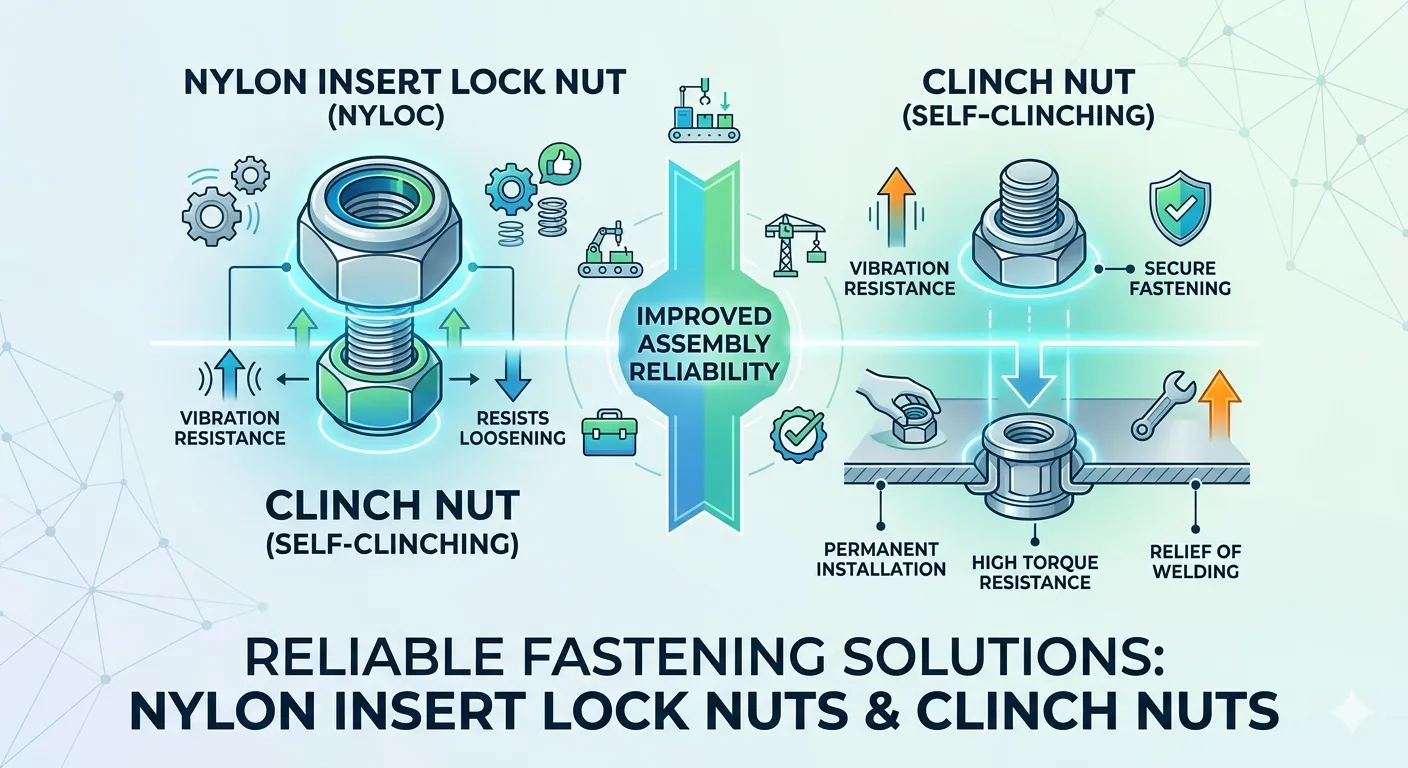
Both nylon insert lock nuts and clinch self-locking nuts are essential in modern engineering but they serve different roles:
- Choose nylon insert lock nuts for vibration resistance and reusable fastening.
- Choose clinch nuts for permanent, high-strength threads in thin materials.
By understanding these differences, you can improve assembly reliability, reduce maintenance and ensure long-term performance.






















Sign in to leave a comment.