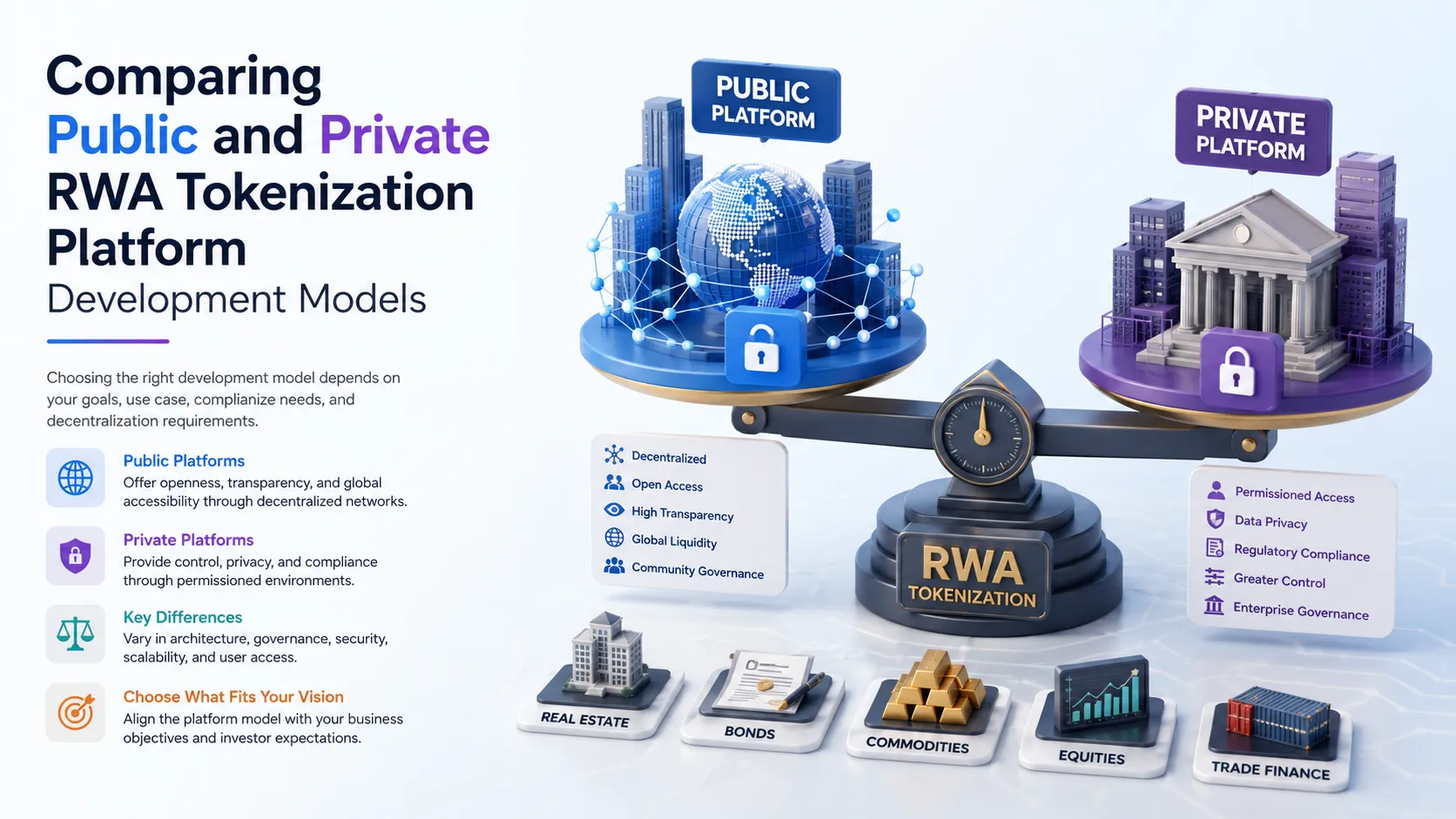

The market for digital assets continues to expand as organizations seek practical methods to represent ownership of physical and financial assets on blockchain networks. Real estate, commodities, bonds, invoices, intellectual property, and collectibles are increasingly becoming part of the digital asset economy through Real World Asset Tokenization. As institutions, investment firms, property owners, and fintech companies enter this sector, one important decision arises early in the planning phase: should the project operate on a public blockchain or a private blockchain?
This question has become central to every rwa tokenization platform development initiative. The choice influences governance, compliance, transaction visibility, user participation, operational costs, and long-term business objectives. While both approaches support digital ownership and asset fractionalization, they serve different operational requirements.
Understanding the differences between public and private tokenization models helps organizations select a framework that aligns with their regulatory obligations, investor expectations, and business strategies.
Understanding RWA Tokenization
RWA Tokenization refers to the process of converting ownership rights of physical or financial assets into digital tokens recorded on a blockchain network. These tokens can represent full ownership, fractional ownership, revenue-sharing rights, or other asset-linked interests.
Examples include:
- Commercial real estate
- Residential property
- Government bonds
- Precious metals
- Fine art
- Infrastructure projects
- Private equity investments
- Trade finance assets
Through Real World Asset Tokenization, ownership records become digitally represented, making asset transfers more efficient and improving access to investment opportunities for a wider group of participants.
As adoption increases, businesses are working with a RWA Tokenization Company to determine which blockchain architecture best suits their operational requirements.
The Foundation of Public Tokenization Models
Public tokenization platforms operate on open blockchain networks where transaction data can be viewed by anyone. Popular public networks include Ethereum, Polygon, Solana, and Avalanche.
In public environments, participants generally do not require special permission to access network information. Transactions are validated through decentralized mechanisms, and asset records remain available for public verification.
Organizations pursuing public rwa tokenization platform development often focus on broader investor participation and cross-border accessibility.
Public networks have become attractive for projects that want visibility within the digital asset ecosystem and interaction with decentralized finance applications.
The Foundation of Private Tokenization Models
Private tokenization models operate within restricted blockchain environments. Access is controlled by approved participants, and transaction visibility is limited to authorized parties.
Private networks are frequently selected by:
- Financial institutions
- Banks
- Asset management firms
- Government entities
- Insurance companies
- Large enterprises
Unlike public networks, private blockchain participants must receive permission before joining the ecosystem.
Many organizations offering Real World Asset Tokenization Services recommend private environments when strict compliance, confidentiality, and institutional governance requirements exist.
Private blockchain networks may use platforms such as Hyperledger Fabric, Corda, or enterprise blockchain frameworks specifically designed for regulated industries.
Accessibility and Participation
One of the most visible distinctions between public and private models is participant access.
Public tokenization systems allow investors from different regions to participate, subject to applicable legal requirements. This broader accessibility can support larger investor communities and increased market activity.
For example, a real estate project operating on a public blockchain may attract participants from multiple countries who can purchase fractional ownership interests through digital wallets.
Private systems operate differently. Access is restricted to approved investors, institutions, or partners. Participation often requires identity verification, legal review, and compliance screening before investors can transact.
Organizations offering RWA Tokenization Services often recommend private environments when investor eligibility requirements are highly regulated.
Data Visibility Considerations
Data visibility remains a major factor when comparing public and private tokenization models.
Public blockchains record transactions in a manner that can be viewed by anyone using blockchain explorers. While user identities may not always be visible, transaction records remain accessible.
This visibility can increase confidence among participants because ownership history and transaction records can be independently verified.
However, certain organizations may view public visibility as unsuitable for sensitive financial operations.
Private blockchain environments address this concern by limiting access to transaction data. Only authorized participants can review records and asset activity.
Many enterprises pursuing RWA Tokenizaion development select private networks because confidential business information remains accessible only to approved stakeholders.
Compliance Requirements
Compliance obligations often influence blockchain selection more than technical considerations.
Public networks can support compliance frameworks through identity verification, investor qualification procedures, and smart contract controls. However, because public blockchains are open systems, additional compliance mechanisms are often required.
Private blockchain networks generally provide greater administrative control. Organizations can define participation rules, transaction permissions, approval workflows, and reporting requirements directly within the platform.
A RWA tokenization development company frequently evaluates regulatory obligations before recommending a public or private architecture.
Industries such as banking, insurance, and regulated securities often favor private environments due to compliance requirements imposed by regional authorities.
Governance Structures
Governance differs considerably between public and private ecosystems.
Public blockchains typically rely on decentralized governance mechanisms. Network upgrades and protocol decisions may involve validators, developers, community participants, and stakeholders.
This structure can create broad participation in network decision-making but may reduce direct control for individual organizations.
Private networks operate under defined governance models controlled by participating institutions or consortium members.
Organizations involved in rwa tokenization platform development frequently select private systems when governance authority must remain within a controlled group of stakeholders.
This arrangement simplifies policy implementation and operational oversight.
Security Approaches
Both public and private blockchain models offer security benefits, although their approaches differ.
Public blockchains derive security from extensive network participation and distributed validation mechanisms. Large decentralized networks often benefit from substantial computing resources and widespread node distribution.
Private blockchains focus on controlled access and participant verification. Security measures may include:
- Permissioned access
- Identity management
- Multi-level authorization
- Institutional-grade monitoring
- Internal audit controls
A RWA Tokenization Company typically evaluates operational risks before recommending a security framework aligned with business objectives.
Liquidity Opportunities
Liquidity often becomes a deciding factor for asset owners considering tokenization.
Public blockchain environments generally provide broader market exposure. Tokens may become available to a larger community of investors, creating more opportunities for buying and selling.
Public ecosystems can also interact with digital asset marketplaces and decentralized financial applications.
Private tokenization environments generally operate within restricted investor groups. While transactions remain possible, the available participant pool may be smaller.
Organizations pursuing Real World Asset Tokenization often balance liquidity objectives against regulatory obligations when selecting a deployment model.
Cost Considerations
Cost structures differ between public and private blockchain deployments.
Public blockchain projects typically incur network transaction fees determined by blockchain activity. During periods of increased usage, transaction costs may fluctuate significantly.
Private blockchain environments usually involve infrastructure management, network administration, maintenance, and governance expenses.
A RWA tokenization development company evaluates anticipated transaction volume, investor activity, and operational requirements before estimating total deployment costs.
In some cases, public systems offer lower initial entry costs, while private environments may provide greater predictability for enterprise operations.
Institutional Adoption Trends
Institutional participation in tokenized assets continues to increase.
Banks, investment firms, and asset managers frequently prefer private blockchain frameworks because they support established compliance procedures and governance standards.
However, public blockchain adoption among institutions is also growing. Improvements in regulatory frameworks, custody solutions, and identity verification tools have increased confidence in public network participation.
Many RWA tokenization development services providers now support hybrid architectures that combine characteristics from both models.
These approaches seek to balance institutional oversight with broader investor access.
Smart Contract Management
Smart contracts play a significant role in both public and private tokenization systems.
They automate activities such as:
- Asset issuance
- Ownership transfers
- Dividend distribution
- Compliance verification
- Investor restrictions
- Voting procedures
Public blockchain smart contracts often undergo external security reviews because code visibility is available to a broader audience.
Private blockchain smart contracts may operate within controlled environments where access and modification rights remain restricted.
Organizations investing in RWA token development frequently evaluate contract management requirements before selecting a deployment model.
Investor Experience
Investor expectations continue to influence platform architecture decisions.
Public blockchain participants often prioritize accessibility, market exposure, and interoperability with digital asset ecosystems.
Private platform investors may prioritize:
- Regulatory compliance
- Institutional governance
- Asset quality
- Reporting standards
- Operational oversight
A successful Real World Asset Tokenization strategy aligns investor expectations with the chosen blockchain environment.
Understanding the target audience helps determine whether public or private infrastructure is more appropriate.
Hybrid Models Are Gaining Attention
While public and private models are often discussed separately, many organizations are adopting hybrid approaches.
Hybrid systems may maintain sensitive data within private blockchain environments while publishing selected transaction records or ownership proofs to public networks.
This structure allows organizations to maintain confidentiality while offering external verification capabilities.
Many providers of RWA tokenization development services now recommend hybrid architectures for enterprises seeking both institutional controls and broader market engagement.
As tokenized asset markets mature, hybrid frameworks are expected to receive increasing attention from financial institutions and asset issuers.
Selecting the Right Model
There is no universal answer when choosing between public and private tokenization environments.
Organizations should evaluate:
- Regulatory obligations
- Investor demographics
- Asset categories
- Governance requirements
- Liquidity objectives
- Reporting standards
- Data privacy requirements
- Long-term business strategy
A qualified RWA Tokenization Company can conduct technical and regulatory assessments before recommending a suitable deployment structure.
The decision should focus on operational goals rather than industry trends alone.
Different asset classes often require different approaches, and the most effective architecture depends on the specific use case.
Conclusion
The growth of Real World Asset Tokenization continues to create new opportunities for investors, enterprises, financial institutions, and asset owners. As organizations enter this market, choosing between public and private blockchain environments remains one of the most important strategic decisions.
Public models support broader participation, greater market visibility, and interaction with digital asset ecosystems. Private models offer controlled access, governance oversight, and stronger alignment with institutional compliance requirements.
Neither approach is universally superior. The right choice depends on asset characteristics, regulatory obligations, investor expectations, and business objectives. Many organizations pursuing rwa tokenization platform development are now evaluating hybrid frameworks that combine features from both environments.
As adoption expands across global markets, businesses working with experienced providers of RWA Tokenization Services, RWA Tokenizaion development, RWA token development, and Real World Asset Tokenization Services will be better positioned to develop platforms that align with operational requirements while supporting long-term growth in the digital asset economy.

























Sign in to leave a comment.