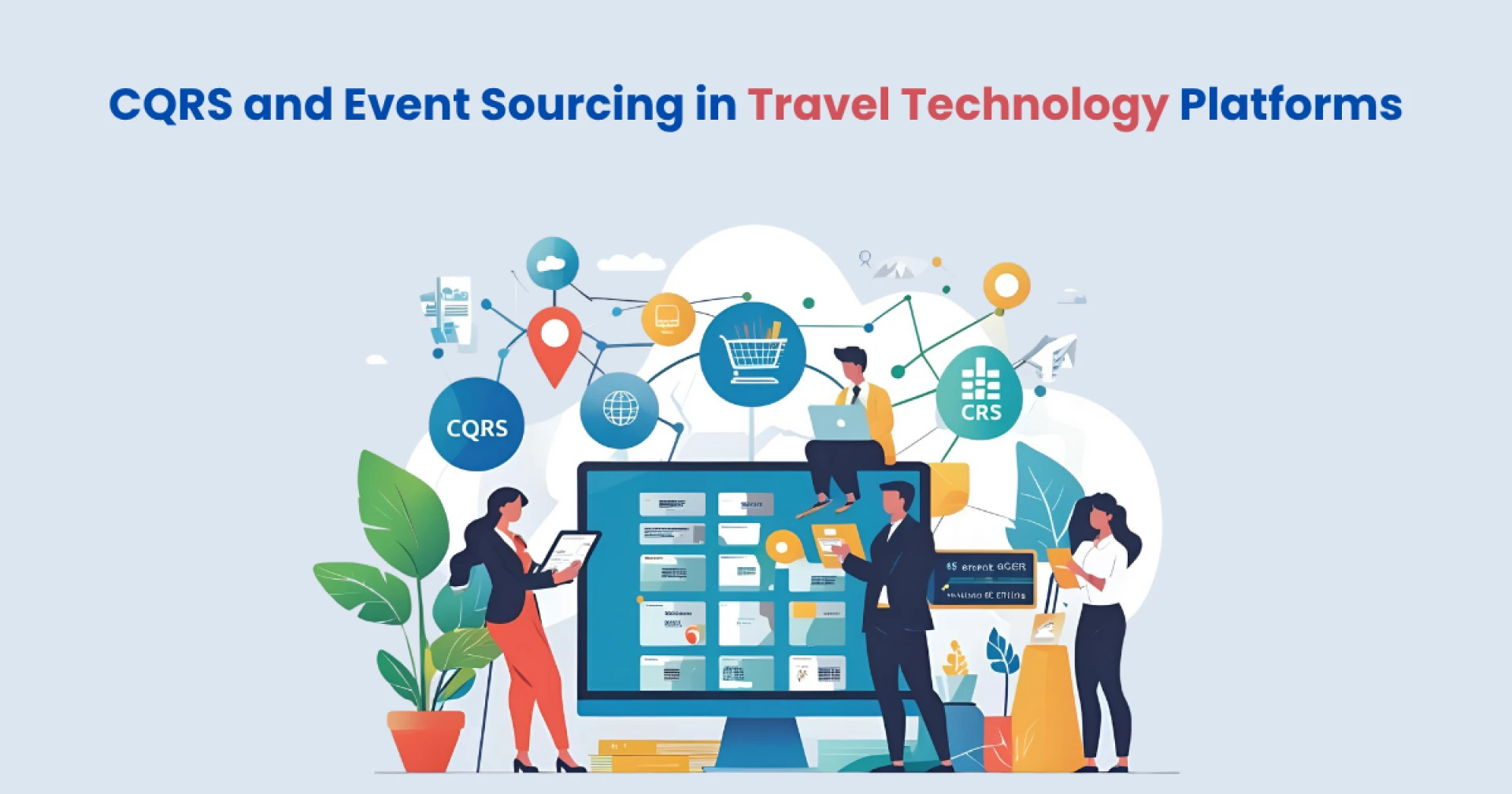

Travel technology platforms are among the most data-intensive and operationally complex systems in existence. They handle millions of concurrent operations like searching for flights, booking accommodations, checking availability, calculating dynamic fares, and syncing with third-party providers.
To keep up with these demands, traditional CRUD (Create, Read, Update, Delete) application architectures often fall short. They tend to mix responsibilities, leading to poor scalability, difficult maintenance, and fragile consistency.
This is where CQRS (Command Query Responsibility Segregation) and Event Sourcing come into play—offering a clean, resilient, and auditable way to design core travel systems like booking engines, loyalty platforms, and inventory systems.
What is CQRS (Command Query Responsibility Segregation)?
CQRS is an architectural pattern that separates the data handling responsibilities of your system:
- Commands modify data (e.g., booking a flight, canceling a reservation).
- Queries retrieve data (e.g., checking booking history, searching available flights).
By splitting these into separate models, travel platforms can optimize each side for performance, security, and scalability. The command model focuses on ensuring business rules are followed when changing data, while the query model is optimized for fast reads and presentation.
In travel tech, this separation is extremely beneficial. For example, the booking engine (command model) can enforce complex business rules and validations, while the search engine (query model) can retrieve millions of availability records optimized for speed and sorting.
What is Event Sourcing?
Event Sourcing shifts how we store data. Instead of saving only the latest state, we save a log of all the events that led to that state.
In a travel system, rather than just saving a booking as “Confirmed,” you store:
- A booking was created
- A payment was processed
- A confirmation was issued
The final state (Confirmed) can always be reconstructed by replaying these events in order.
This approach offers strong auditability (you know exactly what happened), reproducibility (you can replay history to debug or simulate), and flexibility (you can change how you interpret events without changing the source of truth).
Why Travel Technology Platforms Need CQRS and Event Sourcing
Travel platforms are complex ecosystems. Here’s why CQRS and Event Sourcing work so well in this domain:
1. High Write and Read Volume
Thousands of users simultaneously search flights, book tickets, modify itineraries, and make payments. Separating reads from writes allows scaling each independently.
2. Complex Business Rules
Fare calculation, cancellation penalties, baggage policies, and loyalty programs are governed by intricate logic. A command model can rigorously enforce these rules.
3. Audit and Compliance
With global operations, travel companies face audits and regulatory requirements. Event sourcing naturally stores a detailed log of every action taken.
4. Asynchronous Workflows
Booking flows often involve multiple systems (payment gateways, airlines, third-party APIs). Events allow systems to stay loosely coupled and reactive.
Architectural Overview: CQRS + Event Sourcing in Travel Systems
A travel system using CQRS and Event Sourcing typically contains:
1. Command Side
Handles incoming requests that modify the system. For example:
- Book a hotel
- Apply a discount
- Cancel a ticket
This side enforces rules, processes data, and emits events.
2. Event Store
Stores all domain events in order. This log becomes the single source of truth. Every state in the system can be rebuilt from this store.
3. Query Side
Keeps separate models for data read operations. These models are built using the events from the command side and are designed for high-performance reads. They often use caching and denormalized schemas.
4. Message/Event Bus
Events are propagated through an event bus, ensuring other services get notified (e.g., sending confirmation emails, updating loyalty points, adjusting seat inventory).
This decoupled architecture promotes flexibility, observability, and fault tolerance—ideal for travel systems operating across global regions and time zones.
Key Use Cases in Travel Tech
1. Flight and Hotel Booking Engines
Booking workflows can be split into commands (CreateBooking, ConfirmBooking) and events (BookingCreated, BookingConfirmed). The system ensures integrity while also building real-time views for customers and agents.
2. Inventory and Availability Management
Blocking a seat, releasing availability, or syncing inventory with a GDS can be treated as events. These update the query models which serve real-time seat maps or hotel room availability.
3. Loyalty and Rewards Systems
Adding and redeeming loyalty points are classic candidates for event sourcing. Full traceability is required for each action, and audit logs must be maintained.
4. Dynamic Pricing Systems
Events like competitor fare changes, inventory shifts, or time-of-day triggers can adjust prices in real-time. These updates flow through CQRS pipelines to keep pricing engines consistent and fast.
Benefits of the Pattern
1. Independent Scalability
Reads (like flight searches) often vastly outnumber writes (like bookings). CQRS lets you scale the query side separately, ensuring performance at peak loads.
2. Complete Audit Trail
You never lose information. Every step—who did what, and when—is captured. This is invaluable in customer support, debugging, and compliance.
3. Easier Evolution
You can create new read models without touching the core domain logic. This is especially useful when building dashboards, mobile views, or admin portals.
4. Resilience and Recovery
You can rebuild your system state from the event log after a crash. This is crucial in travel, where lost data could mean missed flights or overbooked hotels.
5. Decoupled Systems
Each service in your platform can listen to and react to relevant events, reducing tight integration and improving modularity.
Challenges and Mitigations
Despite their power, CQRS and Event Sourcing come with certain challenges:
1. Increased Complexity
The system becomes more distributed, and debugging may require tracing through event logs.
Mitigation: Use monitoring tools and structured logging. Adopt platforms that abstract much of the boilerplate.
2. Eventual Consistency
The read model may not reflect the latest write instantly, which could confuse users.
Mitigation: Implement user interface patterns like loading indicators, and ensure eventual convergence is fast enough to be imperceptible.
3. Data Model Versioning
As business rules evolve, older events may become incompatible.
Mitigation: Use event versioning, transformation scripts, and schema management best practices.
4. Testing Complexity
Testing distributed command and event flows is more difficult.
Mitigation: Invest in integration tests, message simulators, and isolated testing environments.
Tools and Technologies
To build and operate a CQRS + Event Sourcing travel platform, companies use a variety of tools:
- Event Stores: Purpose-built solutions like EventStoreDB or relational databases with append-only patterns
- Messaging Systems: Kafka, RabbitMQ, or NATS for handling event distribution
- Frameworks: Axon (Java), Lagom (Scala), EventFlow (.NET), and NestJS (Node.js) support these patterns out of the box
- Read Model Stores: Redis, Elasticsearch, and MongoDB are common choices for fast query layers.
Final Thoughts
CQRS and Event Sourcing aren’t silver bullets—but they solve real problems for complex, fast-growing platforms like those in the travel industry.
They help create systems that are scalable, fault-tolerant, auditable, and future-proof. For a travel technology company aiming to deliver seamless booking experiences, real-time availability, and accurate pricing—all at scale—these patterns are not just advantageous, they’re becoming essential.
Travel platforms built on CQRS and Event Sourcing are better positioned to respond to market demands, regulatory requirements, and global user expectations.
FAQs
1. Is CQRS required for every travel system?
No. It’s most beneficial in systems with high complexity, scalability requirements, or regulatory demands. Simpler use cases may not need it.
2. Do CQRS and Event Sourcing always go together?
Not necessarily. You can implement CQRS without Event Sourcing and vice versa, depending on your use case.
3. Is real-time UI possible with this architecture?
Yes. When properly implemented, event-driven systems can update query models fast enough for near-instant updates.
4. What skills does a team need to implement this?
Strong understanding of DDD (Domain-Driven Design), asynchronous programming, event-driven architecture, and message queues is crucial.
5. Can legacy travel platforms adopt this?
Yes, but it’s usually done incrementally. Start with a single service or feature and gradually refactor others.























Sign in to leave a comment.