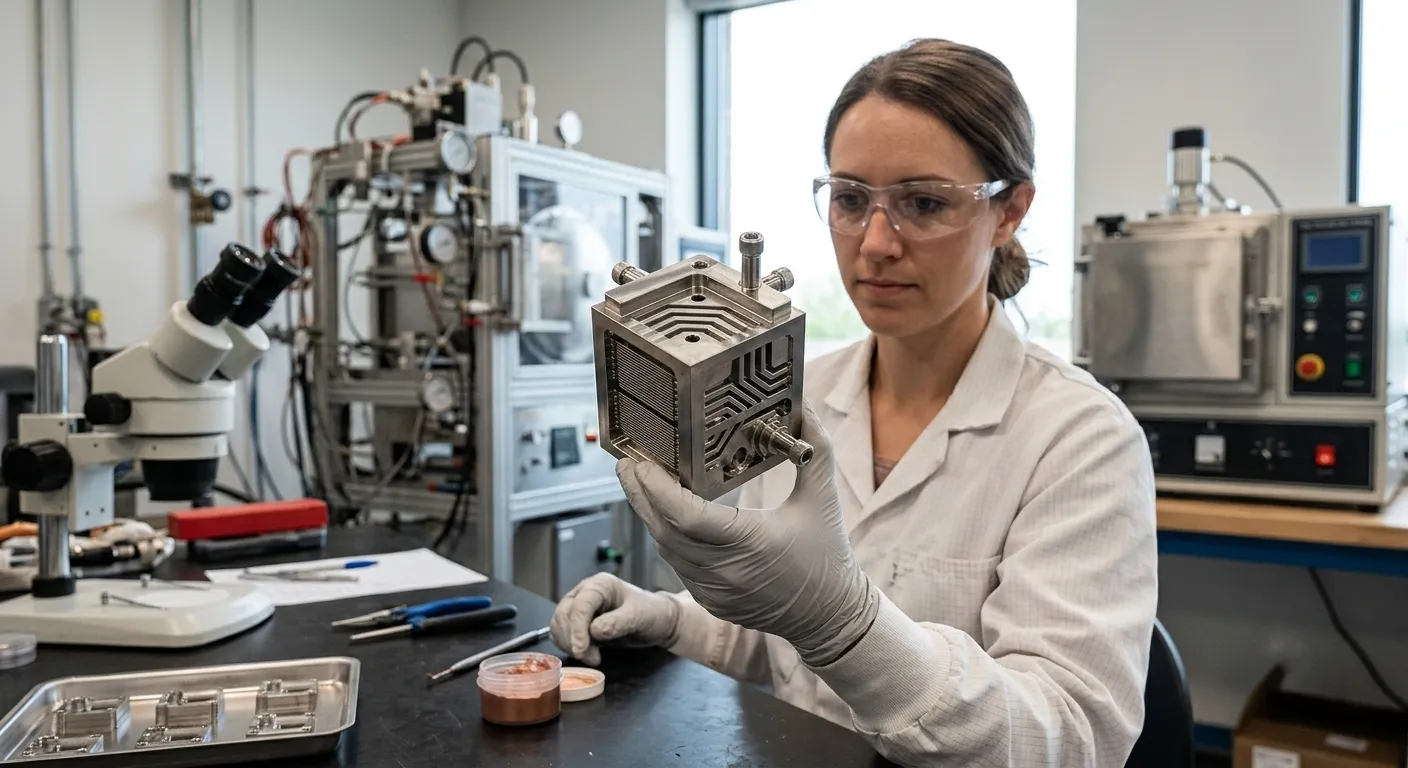

Microchannel heat exchangers, also known as printed circuit heat exchangers (PCHEs), have become the go-to solution wherever engineers need extreme compactness combined with high-pressure, high-temperature performance. From hydrogen refueling stations to aerospace cooling systems to EV battery cold plates, these etched-plate designs can shrink a heat exchanger's footprint by as much as 85% compared to a traditional shell-and-tube unit.
But before any of that performance shows up in the field, the plates have to be joined and how they're joined is where diffusion bonding and brazing (including aluminum vacuum brazing) start to look like very different processes with very different tradeoffs.
Two Ways to Join a Stack of Etched Plates
A microchannel heat exchanger core is built from thin metal plates or shims, each etched with a precise flow pattern. Once stacked in a counter-flow configuration, those plates need to be permanently joined into a single, leak-tight core. There are two dominant ways to do that:
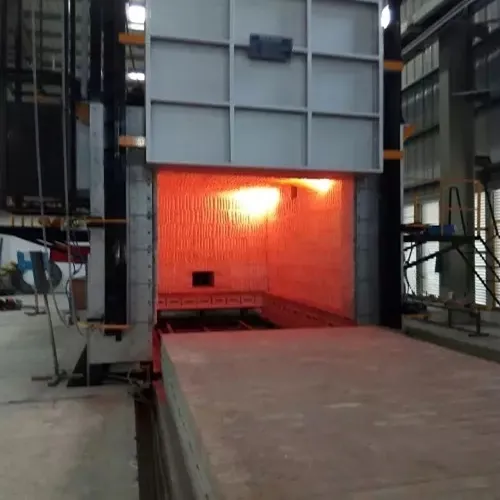
Diffusion bonding is a solid-state joining process. The stacked plates are placed under heat and pressure inside a vacuum or controlled-atmosphere furnace until the metal at each interface diffuses across the joint, fusing the plates together at a molecular level with no filler metal involved at all.
Brazing joins the plates using a filler metal with a lower melting point than the base material. In a vacuum furnace, that filler flows into the joint by capillary action, wetting the surfaces and solidifying into a bonded seam. For aluminum heat exchangers specifically, this is done as aluminum vacuum brazing using vacuum (rather than flux) to break down aluminum's natural oxide layer so the braze alloy can properly wet the joint.
Why the Difference Isn't Just Academic
For a microchannel design, this distinction matters more than it would for a simple structural joint. The channels etched into these plates are often only fractions of a millimeter wide. During brazing, molten filler metal can wick into those channels and solidify inside them partially or fully blocking the very flow paths the heat exchanger depends on. In a solid-state diffusion bonding process, there's no filler metal to migrate anywhere, so the etched channel geometry stays exactly as designed.
Diffusion bonding also produces a joint that, metallurgically, is indistinguishable from the parent material. There's no separate filler layer with its own strength, corrosion resistance, or thermal expansion characteristics which is a major reason diffusion bonded PCHEs can be rated for hundreds of bars of pressure and operating temperatures well above 800°C.
So Why Does Aluminum Vacuum Brazing Still Exist?
If diffusion bonding avoids the channel-blockage risk entirely, why isn't every microchannel heat exchanger diffusion bonded? The answer comes down to metallurgy specifically, aluminum's oxide layer.
Diffusion bonding depends on clean metal-to-metal contact so atoms can migrate across the joint interface. Stainless steels and nickel alloys the workhorse materials for high-pressure PCHEs bond well this way. Aluminum, however, forms an extremely tenacious, self-healing oxide film (Al₂O₃) that resists the kind of diffusion needed for a true solid-state bond, making aluminum a difficult candidate for conventional diffusion bonding at production scale.
This is exactly the gap aluminum vacuum brazing fills. Using braze alloys engineered to chemically disrupt that oxide layer under vacuum, aluminum components can be joined into strong, leak-tight, flux-free assemblies without needing the specialized parameters diffusion bonding would require for aluminum. It's why most lightweight aluminum microchannel heat exchangers, cold plates, and compact heat exchangers used in automotive, EV, and HVAC applications are vacuum brazed rather than diffusion bonded, while stainless steel and nickel-alloy PCHEs for oil & gas, hydrogen, and aerospace applications lean toward diffusion bonding.
Diffusion Bonding vs. Aluminum Vacuum Brazing: Side-by-Side
| Factor | Diffusion Bonding | Aluminum Vacuum Brazing |
| Joining mechanism | Solid-state atomic diffusion, no filler | Molten filler metal, flux-free (vacuum breaks oxide layer) |
| Typical materials | Stainless steel, nickel alloys, titanium | Aluminum and aluminum alloys |
| Channel integrity risk | None no filler to migrate | Requires careful process control to avoid channel blockage |
| Pressure/temperature capability | Very high hundreds of bar, 800°C+ | High, but generally lower ceiling than diffusion bonded stainless/nickel cores |
| Joint properties | Matches parent material exactly | Filler-metal joint with its own mechanical/thermal profile |
| Weight | Heavier (steel/nickel base materials) | Lightweight key advantage for automotive/aerospace |
| Typical applications | Hydrogen refueling, oil & gas, aerospace, nuclear, power generation | EV battery cold plates, automotive heat exchangers, HVACR, power electronics cooling |
| Relative cost & cycle time | Higher equipment/process cost, longer cycles | Generally faster and more cost-effective for aluminum designs |
Matching the Process to the Application
Choose diffusion bonding when:
- The application involves extreme pressure or temperature (hydrogen stations, oil & gas processing, aerospace propulsion cooling)
- The base material is stainless steel, nickel alloy, or titanium
- Channel geometry is fine enough that any filler metal intrusion would be unacceptable
- The heat exchanger must survive severe thermal cycling over a long service life
Choose aluminum vacuum brazing when:
- Weight is a critical design driver EV battery cooling, automotive, or aerospace cold plates
- The application calls for aluminum's thermal conductivity and corrosion resistance
- Production volumes and cost targets favor a faster, well-established joining process
- Operating pressures and temperatures fall within aluminum's practical limits
The Real Takeaway
Neither process is universally "better" they solve different engineering problems for different materials. The right choice depends on your operating envelope, base material, and how much channel-level precision your design can afford to risk.























Sign in to leave a comment.