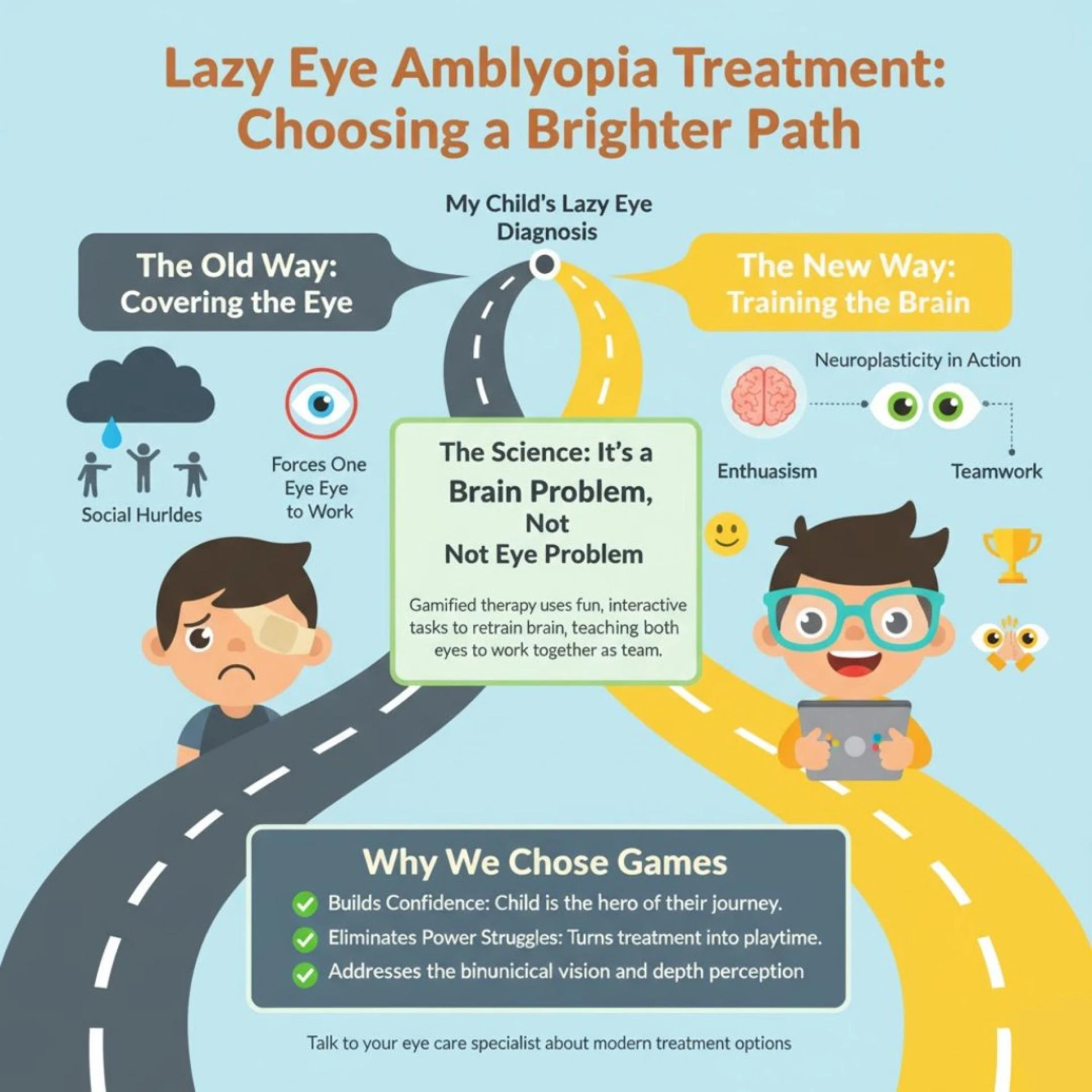

The word "therapy" often brings to mind hard work and sterile clinical settings. For parents of a child with a lazy eye, it can also mean daily battles over eye patches and frustrating exercises. But what if therapy could feel more like playtime? What if the path to clearer, stronger vision was through an engaging video game?
This isn't science fiction; it's the new reality of digital therapies for amblyopia. The idea of using screen time to fix an eye problem seems counterintuitive, but a specific, scientifically-backed category of games and exercises is revolutionizing the field. So, do these digital treatments actually work? The answer is a resounding yes when they are the right kind of digital tools.
Beyond the Patch: A New Way to Treat Lazy Eye
For decades, the standard amblyopia treatment involved covering the stronger eye with a patch to force the weaker eye to work. While this can be effective, it fails to address the root of the problem. A lazy eye (amblyopia) isn't an issue with the eye itself; it's a breakdown in the communication between the brain and the eye. The brain has learned to ignore the signal from the weaker eye.
Digital therapies are designed to tackle this problem head-on. They are built on the principle of binocular vision training the brain to use both eyes together as a team. This is a crucial shift from strengthening one eye in isolation to rebuilding the entire visual system.
How Do Therapeutic Games and Exercises Work?
These aren't your typical app store downloads. Medically-proven digital therapies are sophisticated tools prescribed by eye care professionals. They often use a technique called dichoptic presentation.
Here’s a simple breakdown:
- Special Glasses: A patient wears special glasses (often red-green or shutter glasses) that allow different images to be shown to each eye.
- Cooperative Gameplay: The game or exercise is designed so that crucial elements are visible only to the weaker eye, while other elements are visible only to the stronger eye.
- Forced Teamwork: The only way to succeed whether it’s navigating a maze or completing a puzzle is for the brain to stop suppressing the weaker eye and start fusing the two images into a single, cohesive picture.
This process actively rebuilds the neural pathways that have been neglected, making it a powerful form of lazy eye amblyopia treatment.
What to Look for in a Digital Therapy Program
With the rise of "brain training" apps, it can be hard to tell what's a fun distraction versus a legitimate medical tool. A truly effective digital therapy program will always have the following:
- It is Prescribed: It should be recommended and monitored by an optometrist or ophthalmologist.
- It is Backed by Science: The methods should be based on proven principles like binocular vision and neuroplasticity.
- It is Personalized: The difficulty and settings should be calibrated to the individual's specific visual needs and adjusted as their vision improves.
Conclusion
The future of lazy eye treatment is here, and it's more engaging and effective than ever before. Digital therapies offer a powerful way to retrain the brain and build strong, lasting binocular vision without the daily tears and tantrums of traditional methods. By turning the hard work of therapy into a fun and rewarding game, we can empower both children and adults to unlock their full visual potential. The key is to look beyond entertainment and seek out the science-backed, professionally guided tools that truly work.
FAQs
1. Can my child just play regular video games for their lazy eye?
No. Regular video games are not designed to present different images to each eye and therefore do not provide the necessary binocular stimulation to treat amblyopia.
2. Is this type of therapy only for children?
Not at all! Because these therapies leverage the brain's ability to change (neuroplasticity), they have been shown to be effective in treating lazy eye in teenagers and adults as well.
3. Are these digital therapies done in a doctor's office or at home?
Many modern programs are designed to be used at home on a computer or tablet, which makes them convenient for daily use. However, they are always prescribed and remotely monitored by a medical professional to track progress and make adjustments.




























Sign in to leave a comment.