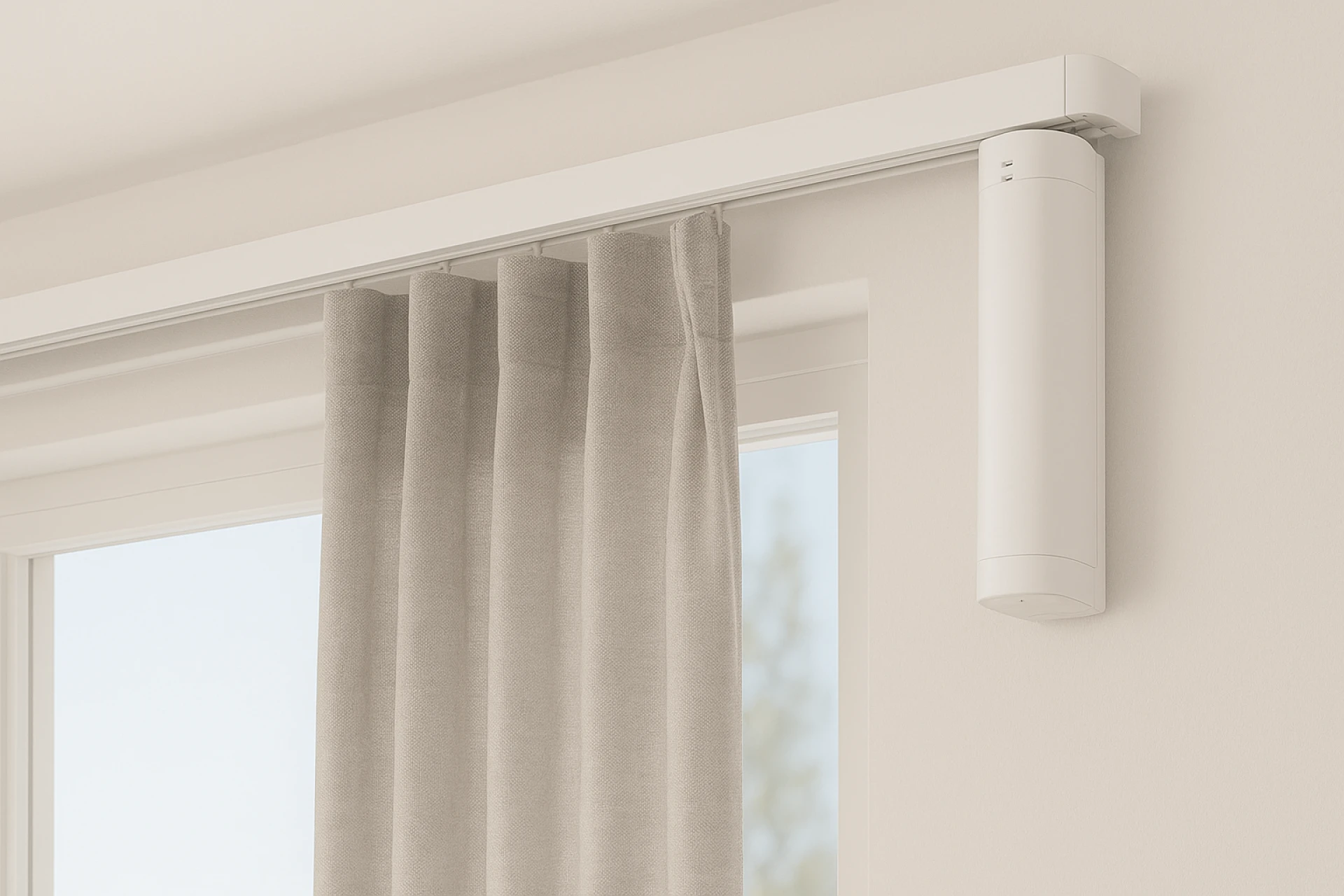
In the world of smart homes and automated interiors, a curtain motor is one of the most transformative upgrades you can make.
It brings together convenience, energy efficiency, aesthetics, and modern control. In this guide, we dive deep into what curtain motors are, how they work, their use‑cases, selection criteria, installation best practices, integration with smart home systems, maintenance, and future trends.
This article is aimed at customers, architects, system integrators, and interior designers who want a thorough, authoritative resource on curtain motors—particularly, Dooya’s range of advanced solutions.
Table of Contents
- What is a Curtain Motor?
- Benefits & Use Cases of Motorized Curtains
- Key Components & How a Curtain Motor Works
- Dooya Curtain Motor Features & Differentiators
- How to Choose the Right Curtain Motor
- Installation Guidelines & Best Practices
- Integration with Smart Home & Automation Systems
- Maintenance, Troubleshooting & Lifespan
- Cost, ROI & Energy Efficiency
- Future Trends & Innovations
- Summary & Call to Action
1. What is a Curtain Motor?
A curtain motor (also called a curtain automation motor, motorised curtain actuator, or electric curtain motor) is a device that automates the opening and closing motion of curtains. Rather than pulling on cords or using manual draw rods, the motor drives a mechanism (typically via a belt, chain, tubular motor in a roller, or trolley) to move the curtain along its track.
Curtain motors can operate:
- On straight or curved tracks
- On rod-based systems (via adapters)
- On roller‑type or fabric folding curtains
When paired with smart controllers, sensors, schedules, or voice assistants, a curtain motor becomes a fully automated system.
2. Benefits & Use Cases of Motorized Curtains
2.1 Key Benefits
- Convenience & Comfort: Open or close your curtains via remote, smartphone, or voice command.
- Safety: Eliminate trailing cords, ideal for homes with children, pets, or large windows.
- Energy Efficiency: Automate curtain operation based on sun, time, or temperature to reduce heating/cooling loads.
- Precision & Smooth Motion: Soft start / soft stop, anti-blocking, quiet operation.
- Aesthetics & Integration: Clean, sleek appearance — no cords or manual mechanisms cluttering the environment.
- Scalability: Group control, zoning, integration with lighting, HVAC or shading systems.
2.2 Use Cases & Scenarios
ScenarioBenefit of Curtain MotorResidential living rooms & bedroomsHands-free control, wake-up routines, privacy at night. Home theatres/media roomsAutomated “cinema mode” curtain closingOffices & commercial spacesCentralized control, scheduled shading for glare controlHotels & hospitalityGuest comfort, scheduled sunrise routines, integration with room automationHigh-rise or hard-to-reach windowsSafe automated operation without manual effortSmart homes / IoT housesIntegration with sensors, scenes, and home automation rules
For instance, in a hotel, curtains in each room might open at sunrise, close at sunset, or close automatically when the air conditioning is turned off—improving guest experience and energy management.
3. Key Components & How a Curtain Motor Works
A curtain motor system typically comprises:
- Drive Motor & Gearbox
- Core of the system; converts electrical power to mechanical motion.
- Often includes torque gearing to handle heavy fabric loads.
- Limit Mechanism / Feedback Sensors
- Define the endpoints (open and closed) so the motor stops precisely.
- May use potentiometers, Hall effect sensors, or electronic calibration.
- Control Electronics / Receiver
- Interface that accepts commands (wireless, wired, or bus protocols).
- Manages features like obstacle detection, soft start/stop, manual override.
- Track, Belt, Chain, or Trolley Mechanism
- Physical means to convert rotary motion into linear movement of the curtain.
- Power Supply / Wiring
- AC or DC supply lines; in some cases battery or solar options.
- User Interface / Controllers
- Wall switch, remote, smartphone app, or automated control system.
Basic Workflow
- A command (open/close/preset) is sent to the control electronics.
- Motor starts, accelerates gradually (soft start).
- Curtain moves along track; sensors monitor progress.
- At endpoint or on blocking, motor decelerates (soft stop) and halts.
- In many systems, manual pull or tug can also trigger motion in desired direction (touch-start).
Modern curtain motors also include safety features like obstruction detection (stop if blocked), memory recall of preferred positions, and adaptive speed control.
4. Dooya Curtain Motor Features & Differentiators
At Dooya, we invest heavily in engineering, quality, and innovation to offer curtain motor systems you can rely on for years. Below are the standout features:
4.1 Quiet & Smooth Operation
- Whisper-quiet motors with noise typically below ~ 35 dB (varies by model)
- Soft start / soft stop avoids jerky movement and extends curtain life
- Stall protection to prevent damage in the event of obstruction
4.2 Precise Auto-Limit & Memory
- Automatic limit calibration: the motor can learn open/close endpoints without manual adjustment
- Preferred stop (midpoint) memory for “half-open” or preset positions
- Multiple limit positions for customized scenes
4.3 Built-in Wireless & Interfaces
- Integrated radio receiver supporting Dooya’s remote or RF controllers
- Support for RS485 or dry contacts in selected models
- Optional bus protocols (e.g. KNX) for integration with building automation systems
- Hotel mode functionality (centralized control in hospitality setups)
- Dry-contact input for existing building control systems
- Manual override for emergency or power-outage operation
4.4 Durability & Safety
- Long lifespan, running over tens of thousands of open/close cycles
- High IP protection in outdoor or humid environments (IP-rated models)
- Over-current protection, stall detection, and obstruction sensing
- Consistent torque handling under varying loads (curtain fabric, wind, etc.)
4.5 Wide Load & Track Support
- Models capable of handling curtain loads from a few kilograms up to 60 kg or more
- Support for straight, curved, S-curve, bay windows, and even wraparound tracks
- Compatibility with both standard curtain fabrics and heavier blackout drapes
- For instance, Dooya’s DT52S 75 W model handles up to 100 kg safe curtain weight (as published in product specs) My Blog+2Alibaba+2
4.6 Smart Functionality & Integration
- Full smartphone app control
- Support for voice assistants (Alexa, Google Home) via gateways or integration
- Scheduling, timer-based automation, and scene triggers
- Integration with shading, lighting, HVAC, and occupancy sensors
- Multi-motor grouping and grouped control
5. How to Choose the Right Curtain Motor
Selecting the right curtain motor involves matching your use case, environment, and control preferences. Here’s a step‑by‑step checklist:
5.1 Determine Curtain Load & Dimensions
- Curtain weight: Weigh a fully drawn curtain or refer to the fabric weight per meter × length.
- Track length & number of curtains: Longer spans or side-by-side panels may require more torque or dual motors.
- Track type: Straight vs. curved vs. S‑shaped vs. bay corners → influences motor style or coupling.
- Wind or external force considerations (for exposed windows or facades).
5.2 Motor Torque & Speed
- Choose a motor with torque margin (e.g. 20–30 % above required) to handle friction and aging.
- Speed: For everyday use, 15–20 cm/s is comfortable. For very tall spans, slower might be better for control.
5.3 Control Interface & Protocols
- Do you prefer remote control, RF, wired wall switches, app, or home automation bus (KNX, RS485)?
- For smart home integration, ensure the motor supports or can interface with your control ecosystem.
5.4 Manual Override & Fail-safes
- Ensure manual override (pull-operated or manual mode) is possible in power failures.
- Check for obstruction detection and safety cut-off.
5.5 Environmental Conditions & IP Rating
- Indoor vs outdoor, humidity, temperature swings — choose IP-rated models accordingly.
5.6 Grouping & Scalability
- If multiple motors are used in one zone, ensure the system supports grouping or synchronized control.
5.7 Warranty, Service, and Lifecycle
- Choose motors backed by multi‑year warranty and with local service support.
- Consider expected cycle life (e.g. 50,000 to 100,000 cycles).
5.8 Budget & Return on Investment
- Factor in not just acquisition cost but energy savings, convenience, and aesthetic value over the lifespan.
- For example, automated shading may reduce HVAC load by 5–15 %.
With these criteria, you can hone in on the appropriate Dooya model (or consult your Dooya representative for custom solutions).
6. Installation Guidelines & Best Practices
Although professional installation is strongly advised (for safety, alignment, warranty compliance, and precision), here are key points to guide installation and expectation setting.
6.1 Pre-Installation Checks
- Verify power availability, voltage compatibility, and cable routing.
- Confirm track alignment, straightness, and anchoring.
- Ensure motor mounting position is suited (e.g. at headrail, end cap, or remote drive).
- Mark endpoints realistically, leaving margin for limit sensors.
6.2 Mounting & Alignment
- Mount the motor firmly to avoid vibration or sag.
- Ensure curtain track is level or properly sloped for smooth motion.
- For curves or bends, use correct curvature radius and avoid over-bending belts or mechanisms.
- Reinforce joints and support at corners or transitions.
6.3 Wiring & Cabling
- Use proper gauge wires as per motor datasheet.
- Limit cable length and avoid interference or cross-talk with signal lines where possible.
- For KNX or RS485 lines, use shielded twisted pair and terminators as required.
6.4 Limit Setting & Calibration
- Use the motor’s auto-limit or manual limit procedure to set open/close positions.
- Verify intermediate stops (preferred stop) if needed.
- Confirm the motor reverses direction properly and stops at correct points.
6.5 Safety & Testing
- Simulate an obstruction condition to confirm the motor stops safely.
- Test manual override (pull / tug) to see if motor responds appropriately.
- Program and check the control interface, remote, app, or automation link.
6.6 Final Checks & Commissioning
- Observe multiple open/close cycles and verify smoothness and consistency.
- Check for brushing, rubbing, or misalignment.
- Provide user training on manual override, reset procedures, and emergency use.
6.7 Installation Tips & Common Pitfalls
- Avoid sharp bends or tight radius in belt or chain portions.
- Minimize unsupported track spans to prevent sag.
- Do not oversize the motor beyond necessity — excess torque can stress the system.
- Keep power supply clean and well-grounded.
7. Integration with Smart Home & Automation Systems
One reason curtain motors shine is their ability to integrate into a larger smart ecosystem. Here’s how:
7.1 Control Protocol Options
- RF / Proprietary remote — simple and effective for standalone installations.
- Wired wall switch / dry contact — for conventional manual switches to control motor.
- Bus / Communication Protocols (e.g. KNX, RS485, Modbus) — for integration into building control.
- Wireless / Wi-Fi / Zigbee / Z-Wave / Bluetooth (via gateways or adapters) — app and voice control capabilities.
For instance, Dooya offers a KNX curtain motor model (DT300E‑K) for direct integration into KNX home automation systems.
7.2 Automation & Scheduling
- Create scenes such as “Morning light” to open curtains at sunrise.
- Tie curtain operation to presence sensors, temperature, light sensors (lux), or time schedules.
- Combine curtain motion with lighting and HVAC for holistic energy management.
7.3 Voice & App Control
- Route motor control through hubs or APIs to enable voice commands (Alexa, Google Home).
- Use smartphone apps to open/close, set preferred stops, or group multiple motors.
- Remote control when away from home adds convenience and security.
7.4 Synchronization & Group Control
- When multiple windows share control, group them so one command moves several motors in sync.
- Use offsets or delays to avoid inrush current or jerky motions.
7.5 Feedback & Monitoring
- Monitor motor status (open, closed, halfway) in dashboards.
- Trigger alerts for faults, blockage detection, or errors.
- Use usage data for predictive maintenance or optimizing schedules.
Integration benefits are maximized when curtain motors become part of a comprehensive building automation or smart home setup—not just as stand‑alone devices.
8. Maintenance, Troubleshooting & Lifespan
Even the best curtain motor needs some care. Here’s a maintenance and troubleshooting guide to ensure longevity and reliable operation.
8.1 Regular Maintenance Checklist
IntervalTaskDetailsMonthlyClean track & runnersDust, lint, or debris can cause frictionQuarterlyLubricate sliding components with recommended lubricant (if applicable). Semi-AnnualInspect wiring & connectors for loose wires, corrosion, or damageAnnualTest limit positions & recalibrate. Re-check the open/close endpoints 2–3 yearsInspection by technicianReview wear, motor vibration, balance
8.2 Common Issues & Fixes
Problem Possible Cause Solution Motor doesn’t start, power, fuse blown, wiring errorCheck supply, wiring, breaker, and fusesMotor runs, but the curtain doesn’t move. Drive coupling slip, loose belt. Tighten coupling or replace beltStops mid-run or stallsObstruction, mis-calibrated limitsClear obstruction, reprogram limitsNoise, grinding, jerkinessMisalignment, worn componentsRealign track, replace worn partsRemote/app not respondingSignal interference, pairing lostRe-pair remote, check receiverDrift or slip over timeMotor torque erosion, wearRe-tension belt or recalibrate the drive
8.3 Lifespan & Warranty Expectations
- Quality curtain motors from Dooya are engineered for tens of thousands of cycles—often 10+ years of residential use with proper maintenance.
- Warranty periods often range from 3 to 5 years (verify with your Dooya variant).
- Be sure installations are performed by authorized professionals to maintain warranty validity.
9. Cost, ROI & Energy Efficiency
9.1 Cost Components
- Motor unit cost
- Auxiliary control modules or gateways
- Power supply and wiring
- Installation & commissioning
- Maintenance over the lifespan
9.2 Return on Investment (ROI)
The ROI from a curtain motor lies largely in:
- Energy savings (by automating shading to reduce cooling/heating loads).
- Enhanced comfort and convenience (intangible but valued by users).
- Increased property value (smart home features are premium).
- Potential for longer fabric and curtain life (less manual tugging and wear).
For many installations, the payback period can be 3–8 years, depending on usage intensity and energy cost.
9.3 Energy Efficiency Strategies
- Use sunlight sensors or weather data to adjust curtain positions dynamically.
- Combine curtain control with HVAC scheduling (e.g. close curtains before air conditioning stops).
- Avoid unnecessary motor runs by programming idle periods.
- Use fine-grained control (half-open, intermediate stops) rather than full cycles each time.
10. Future Trends & Innovations
The realm of curtain motors continues evolving—here are trends to watch:
- Matter / Thread / Zigbee 3.0 native support (for seamless interoperability).
- Edge AI / Learning algorithms: motors that learn you usage patterns and optimize motion.
- Solar‑powered curtain motors (for facades without wiring).
- Low-voltage, ultra-compact motors for minimal visual footprint.
- Ultra-quiet, vibration-absorbing designs for high-end installations.
- Sensor-based reactive motion: curtains that respond to temperature, humidity, air quality or human presence.
- Predictive maintenance via motor diagnostics and IoT feedback.
Dooya is already working on integrating many of these advancements into its next-generation systems.
11. Summary & Call to Action
By now, you should have a comprehensive grasp of:
- What a curtain motor is and how it works
- The benefits, use-cases, and comparative advantages
- Key features and differentiators of Dooya’s solutions
- How to select, install, integrate, and maintain a curtain motor
- Cost, ROI, energy benefits, and emerging trends
At Dooya, we offer a full portfolio of curtain motors designed to suit your needs—whether you need a straightforward RF‑controlled motor, a KNX‑integrated version, or a full smart home–grade IoT system. Our local support, robust warranties, and installation expertise ensure you get the performance you expect.





























Sign in to leave a comment.