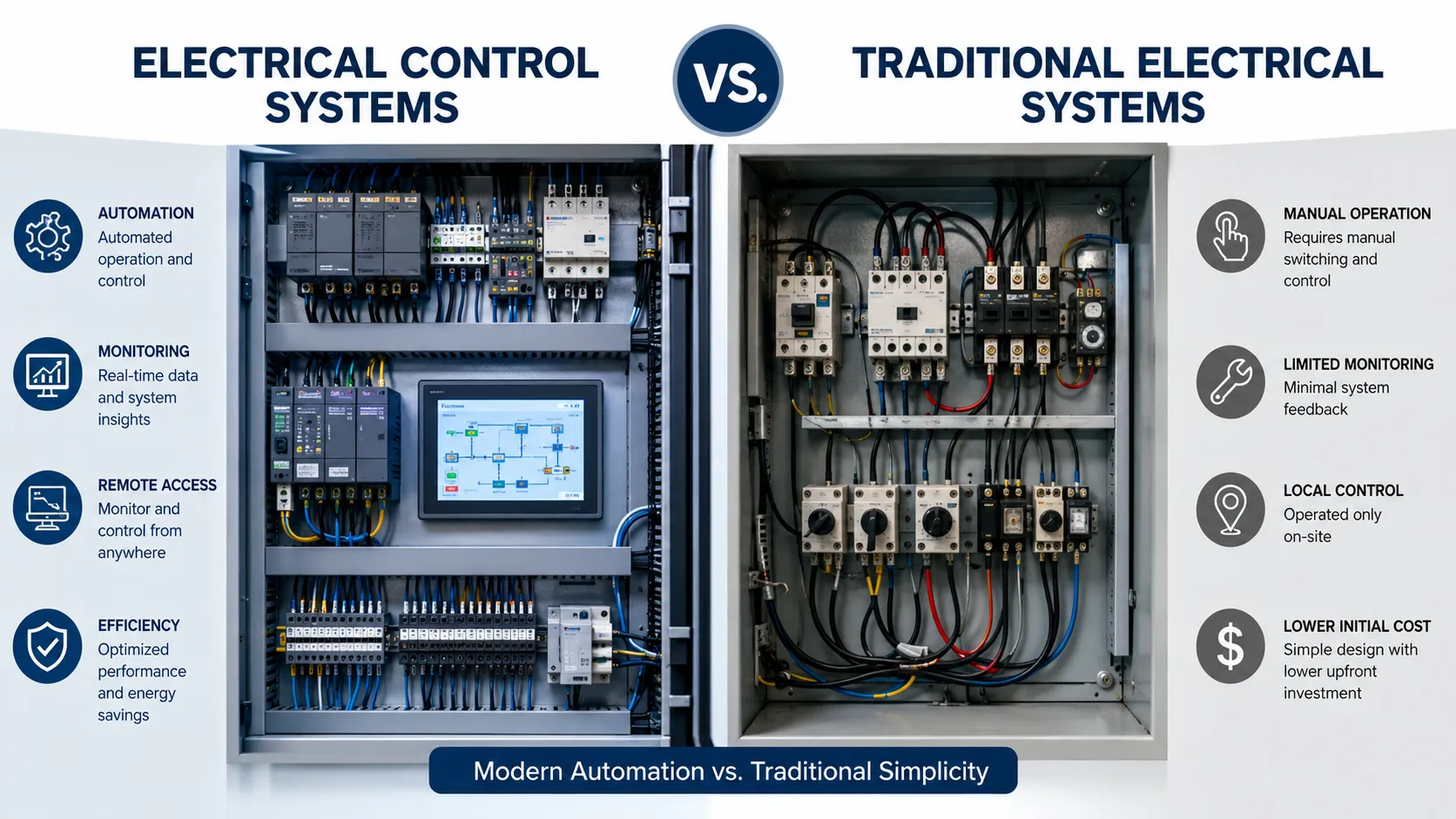

Electrical systems are essential to modern homes, commercial buildings, industrial facilities, and infrastructure. However, not all electrical systems operate in the same way. Traditional electrical systems typically rely on manual controls and straightforward wiring, while electrical control systems use advanced components to automate, monitor, and regulate electrical equipment.
Understanding the difference between these two approaches can help property owners, facility managers, contractors, and businesses determine which solution is best suited to their needs.
What Is a Traditional Electrical System?
A traditional electrical system generally refers to an electrical setup where power is distributed and equipment is operated using conventional switches, breakers, relays, and hardwired connections.
For example, a basic lighting system may use a wall switch to turn lights on and off. An electrical motor might be started or stopped manually using a switch or starter.
Traditional systems can be reliable and relatively simple, particularly for smaller applications. However, they typically provide limited automation, monitoring, and remote-control capabilities.
Common Components of Traditional Electrical Systems
Traditional electrical installations may include:
- Circuit breakers and fuses
- Electrical switches
- Contactors and basic relays
- Hardwired control circuits
- Manual motor starters
- Conventional lighting controls
- Distribution panels
- Transformers
These components can effectively handle many basic electrical requirements, but they may require more manual intervention as system complexity increases.
What Is an Electrical Control System?
An electrical control system is designed to control, automate, monitor, and coordinate electrical equipment and processes.
Instead of relying entirely on manual operation, these systems can use programmable logic controllers (PLCs), sensors, variable frequency drives (VFDs), relays, human-machine interfaces (HMIs), and other control components.
For example, an industrial ventilation system could use temperature sensors to detect changing conditions and automatically adjust fan speed. A manufacturing process could use sensors and PLC programming to coordinate motors, conveyors, pumps, and other equipment.
Electrical control systems are particularly valuable when equipment needs to operate according to specific conditions, schedules, sequences, or safety requirements.
Key Differences Between Electrical Control Systems and Traditional Electrical Systems
Although both systems distribute and control electrical power, their capabilities can be significantly different.
1. Manual Operation vs. Automation
One of the biggest differences is the level of automation.
Traditional electrical systems often require an operator to manually switch equipment on or off. Electrical control systems can automate these actions based on programmed instructions, sensor inputs, timers, or operating conditions.
For businesses, automation can reduce repetitive manual tasks and provide more consistent equipment operation.
2. Monitoring Capabilities
Traditional electrical systems generally offer limited information about how equipment is operating.
Modern electrical control systems can incorporate sensors and monitoring devices that collect information such as:
- Temperature
- Pressure
- Motor speed
- Voltage
- Current
- Equipment status
- Energy consumption
This information can help operators identify abnormal conditions and respond before they develop into larger problems.
3. Flexibility and Programmability
Traditional systems are often based on fixed wiring and physical connections. Making significant changes may require rewiring components.
Control systems that use PLCs and programmable devices can be modified through software. This can make it easier to change operating sequences, timing, or equipment responses without completely redesigning the electrical control panel.
The exact level of flexibility depends on the equipment and system architecture.
4. Remote Control
Many traditional electrical systems are controlled locally.
Modern electrical control systems can be designed to support remote monitoring and control. Depending on the application, operators may be able to view equipment status or make adjustments through an HMI, supervisory control and data acquisition (SCADA) system, building automation system, or other networked interface.
Remote capabilities can be particularly useful for large facilities or equipment located in difficult-to-access areas.
5. Safety Features
Both traditional and modern electrical systems can incorporate safety mechanisms, but control systems can provide more sophisticated monitoring and interlocking capabilities.
For example, a control system may prevent a motor from starting if a safety condition has not been met. Emergency stops, overload protection, safety relays, sensors, and other devices can also be integrated into an appropriately designed system.
Safety design should always follow applicable electrical codes, standards, and manufacturer requirements.
6. Troubleshooting and Diagnostics
Finding the cause of a problem in a conventional hardwired system can sometimes require tracing individual wires and components.
Electrical control systems may provide diagnostic information through PLCs, HMIs, drives, or monitoring software. Fault codes and equipment status information can help technicians identify potential problems more efficiently.
However, advanced systems can also introduce additional components and software that require specialized troubleshooting skills.
Comparison at a Glance
| Feature | Traditional Electrical Systems | Electrical Control Systems |
|---|---|---|
| Operation | Primarily manual | Manual, automatic, or programmable |
| Automation | Limited | Extensive |
| Monitoring | Basic | Advanced |
| Programming | Minimal | Programmable |
| Remote Access | Usually limited | Often available |
| Diagnostics | Primarily manual | Integrated diagnostic capabilities |
| Flexibility | Lower | Higher |
| System Complexity | Generally lower | Can be higher |
| Best Use | Simple electrical applications | Automated and complex applications |
Where Are Electrical Control Systems Used?
Electrical control systems are commonly used in environments where multiple pieces of equipment need to work together or where automatic operation is important.
Applications can include:
- Manufacturing facilities
- Industrial machinery
- HVAC systems
- Pumping systems
- Water and wastewater facilities
- Commercial buildings
- Conveyor systems
- Motor control applications
- Building automation
- Energy management systems
- Process control systems
In these environments, electrical control systems can coordinate equipment while providing operators with greater visibility into system performance.
Advantages of Traditional Electrical Systems
Traditional electrical systems remain appropriate for many applications.
Simplicity
A basic electrical installation can be easier to understand, operate, and maintain when sophisticated automation is unnecessary.
Lower Initial Complexity
Simple systems may require fewer components and less programming than an automated control system.
Straightforward Maintenance
For basic installations, electricians familiar with conventional wiring can often diagnose and repair problems without specialized programming tools.
Similar Link: Mechanical Services vs. HVAC Services: What's the Difference?
Advantages of Electrical Control Systems
Electrical control systems offer several benefits when automation and system coordination are required.
Improved Efficiency
Automated operation can allow equipment to run according to actual demand rather than relying entirely on manual operation.
Better Process Control
Sensors, controllers, and programmed sequences can provide more precise control over equipment and processes.
Enhanced Visibility
Operators can receive information about equipment status, faults, and operating conditions, depending on the system design.
Scalability
A properly designed control system can often accommodate additional equipment or functionality more easily than a basic hardwired system.
Potential Energy Savings
Automation can help reduce unnecessary equipment operation. For example, a control system can adjust motor speed or HVAC operation according to demand. Actual energy savings depend on system design, equipment, operating conditions, and programming.
Are Electrical Control Systems Better Than Traditional Electrical Systems?
Not necessarily. The right choice depends on the application.
A traditional electrical system may be the better option for a simple installation where equipment only needs basic on/off control. Adding advanced automation to a small and straightforward application could create unnecessary complexity and expense.
An electrical control system may be more appropriate when a facility needs automation, precise control, equipment coordination, remote monitoring, or detailed operational data.
The goal is not simply to choose the more technologically advanced option. The goal is to select an electrical architecture that meets the application's operational, safety, maintenance, and budget requirements.
What to Consider Before Upgrading an Electrical System
Businesses considering an upgrade should evaluate several factors.
Existing Equipment
Determine whether current motors, panels, wiring, sensors, and other equipment can integrate with the proposed control system.
Operational Requirements
Identify which processes need automation and which functions can remain manual.
Future Expansion
Consider whether additional equipment or automation will be required in the future.
Maintenance Requirements
Advanced control systems may require technicians with PLC, HMI, VFD, networking, or automation experience.
Safety and Compliance
Electrical modifications should be properly engineered and installed according to applicable codes, standards, and local requirements.
Total Cost
Look beyond the initial installation price. Maintenance, downtime, energy consumption, system upgrades, training, and equipment replacement can all affect the long-term cost of an electrical system.
Choosing the Right Electrical System
Traditional electrical systems and modern electrical control systems serve different purposes. Conventional systems can provide dependable and straightforward electrical operation, while control systems add automation, monitoring, programmability, and coordination.
For simple applications, traditional electrical controls may be sufficient. For industrial, commercial, or complex applications where automation and real-time control are important, an electrical control system may provide significantly greater functionality.
A qualified electrical professional can evaluate the existing installation, operational requirements, safety considerations, and future needs to determine the most appropriate solution.
Final Thoughts
The difference between electrical control systems and traditional electrical systems largely comes down to automation, programmability, monitoring, and system complexity.
Traditional electrical systems remain useful for straightforward applications, while Electrical Control Systems Hawaii solutions are increasingly important for facilities that require automated processes, equipment coordination, operational visibility, and greater control.
Understanding these differences makes it easier to plan an electrical installation or determine whether upgrading an existing system could improve efficiency, reliability, and operational control.






















Sign in to leave a comment.