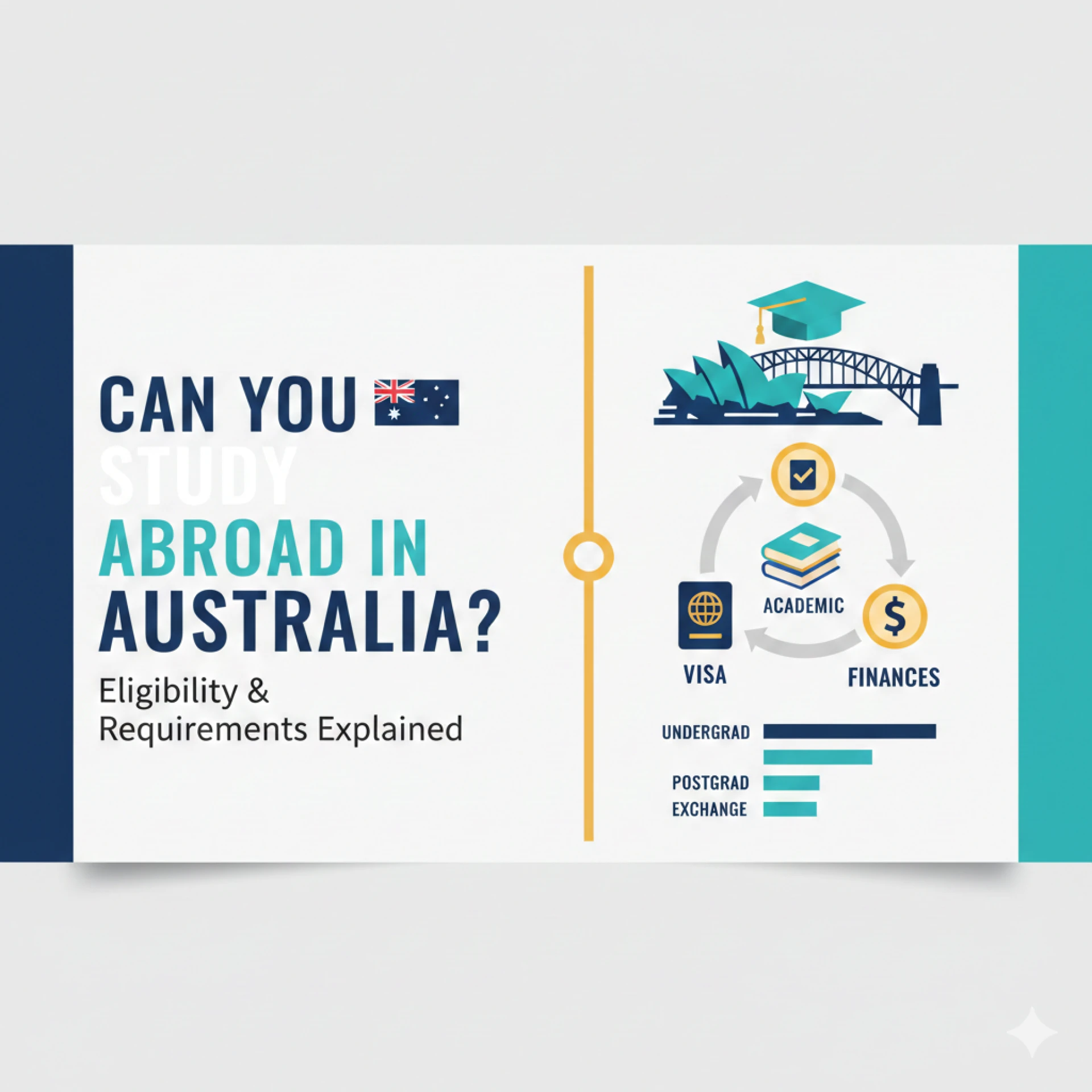

Many students dream of choosing to study abroad in Australia because of its world-class universities, global career opportunities, and welcoming environment. But before applying, it is important to understand the eligibility criteria, admission requirements, and visa process. Whether you are planning undergraduate, postgraduate, diploma, or vocational studies, knowing the exact requirements will help you prepare confidently. In this guide, we explain everything you need to know — from academic qualifications to Australia student visa rules — in a simple and structured way.
Why Choose Australia for Higher Education?
Australia has become one of the top destinations for international education. Institutions like The University of Melbourne, The University of Sydney, The Australian National University, and Monash University consistently rank among the world’s best.
The University of Melbourne
The University of Sydney
The Australian National University
Monash University
Key Benefits of Studying in Australia
- Globally recognized degrees
- Strong post-study work opportunities
- Multicultural and safe environment
- Advanced research facilities
- Flexible course options
Students can choose from universities, TAFEs, and vocational colleges across major cities like Sydney, Melbourne, Brisbane, and Perth.
Eligibility to Study Abroad in Australia
Eligibility depends on your course level and university, but the general requirements remain similar.
1. Academic Qualifications
For undergraduate programs:
- Completion of 12th grade (or equivalent)
- Minimum percentage as required by the university
- Subject prerequisites for specific courses
For postgraduate programs:
- Recognized bachelor’s degree
- Required GPA or percentage
- Relevant academic background
Some programs may also require:
- Portfolio (for design/architecture)
- Work experience (for MBA programs)
- Entrance tests (if applicable)
2. English Language Requirements
International students must prove English proficiency.
Accepted tests include:
- IELTS (Academic)
- TOEFL iBT
- PTE Academic
Minimum scores vary by course and university. For example:
- Undergraduate: IELTS 6.0–6.5 overall
- Postgraduate: IELTS 6.5–7.0 overall
Meeting English language requirements is essential for admission approval.
3. Australia Student Visa Requirements
To officially begin your journey, you must apply for an Australia student visa (Subclass 500).
Basic Student Visa Requirements:
- Confirmation of Enrolment (CoE) from an Australian institution
- Genuine Student (GS) requirement statement
- Proof of financial capacity
- Overseas Student Health Cover (OSHC)
- English proficiency proof
- Valid passport
The student visa allows:
- Full-time study
- Part-time work (as per visa conditions)
- Stay duration based on course length
Applying early ensures smooth processing.
Financial Requirements to Study in Australia
When planning to study in Australia for international students, financial preparation is critical.
You must show proof of funds covering:
- Tuition fees (first year)
- Living expenses
- Travel costs
- Health insurance
Average annual costs:
- Tuition fees: AUD 20,000–45,000 (varies by program)
- Living expenses: AUD 24,000+ per year (approximate guideline)
Scholarships are available at many institutions to support international students.
Documents Required for Admission
Prepare the following documents:
- Academic transcripts and certificates
- English test scorecard
- Statement of Purpose (SOP)
- Letters of Recommendation (if required)
- Passport copy
- Resume (for PG programs)
Ensure documents are properly certified and translated if necessary.
Who Can Apply?
You can apply if you:
- Meet academic entry requirements
- Satisfy English proficiency criteria
- Have sufficient financial proof
- Obtain a valid offer letter
- Meet health and character requirements
Students from diverse academic backgrounds successfully apply each year.
Intakes in Australia
Most universities offer two major intakes:
- February (Primary intake)
- July (Secondary intake)
Some institutions also offer November intakes for selected programs. It is advisable to apply 4–6 months in advance.
Step-by-Step Admission Process
- Research universities and courses
- Check eligibility criteria
- Take English proficiency test
- Submit university application
- Receive offer letter
- Accept offer and pay deposit
- Receive CoE
- Apply for Australia student visa
- Arrange accommodation and travel
Planning early increases your admission chances.
Conclusion
Choosing to study abroad in Australia can transform your academic and professional future. With clear eligibility guidelines, transparent admission processes, and strong student support systems, Australia remains one of the most accessible global study destinations. If you meet academic, English, and financial requirements, you are well on your way to starting your journey.
Take the next step today — research your preferred university, prepare your documents, and begin your application process with confidence.
Frequently Asked Questions (FAQs)
1. What is the minimum percentage required to study in Australia?
It depends on the university and course. Most undergraduate programs require 60–70% or equivalent.
2. Is IELTS mandatory to study in Australia?
In most cases, yes. However, some universities accept alternative tests like TOEFL or PTE.
4. Can international students work while studying?
Yes. Students can work part-time during study periods as per visa conditions.
5. How long does the visa process take?
Processing time varies but generally takes 4–8 weeks, depending on documentation and application volume.
If you are ready to begin your journey to study abroad, start preparing today and make Australia your next academic destination.


























Sign in to leave a comment.