
Today's businesses aren't short on data — they're overwhelmed by it. Data flows from every application, transaction, and user interaction, but it rarely flows together. These isolated streams create a fragmentation problem that ETL is designed to fix.
What is ETL?
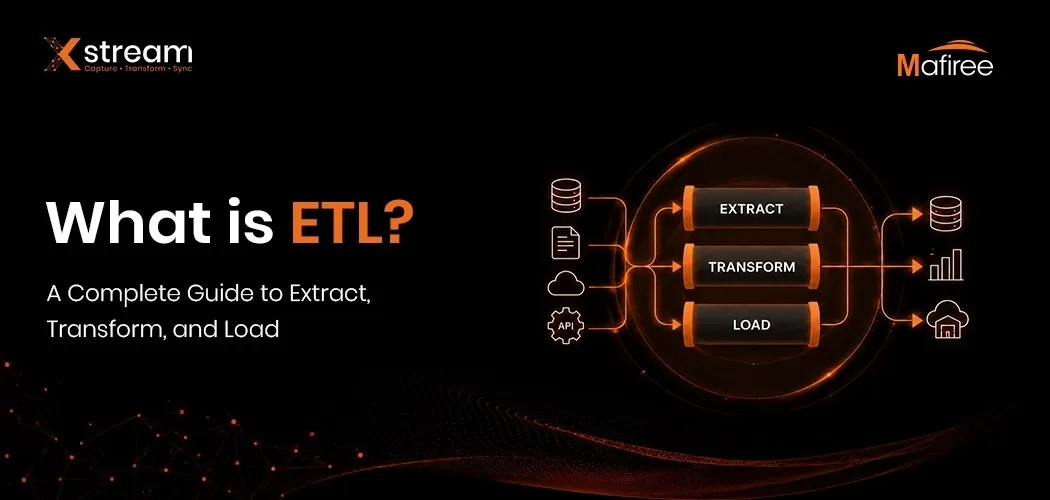
ETL — Extract, Transform, Load — is a data integration process that pulls data from multiple sources, refines it into a usable form, and delivers it to a target destination like a data warehouse, analytics platform, or real-time system. The three steps break down simply: data is first extracted from databases, APIs, applications, and logs; then cleaned, validated, and restructured during transformation; and finally loaded into warehouses, dashboards, or live systems where it can be acted upon.
Why It Matters
Picture a payment being made on an app. In that same moment, the transaction lands in a database, the user's behavior is logged as an event, and a fraud detection system records signals separately. All this data exists — but across different systems, in different formats, at different speeds. No single system has the full picture. ETL acts as the connector, gathering data from all these sources, aligning them into a coherent view, and making the combined result instantly available for analysis. The outcome isn't just a payment record — it's a complete story of what happened, who was involved, and whether anything looks suspicious.
Data Ingestion: Moving from Periodic to Continuous
Legacy systems relied on bulk extraction — scheduled jobs and periodic queries that pulled large volumes of data at set intervals. Modern pipelines work differently. Using Change Data Capture (CDC), database updates are tracked through change logs the moment they happen. Application events are streamed in real time, and system actions are pushed into pipelines instantly. Only changed data moves forward, keeping ingestion lightweight, continuous, and non-disruptive to production systems.
Transformation: Where Data Becomes Trustworthy
Raw data arriving from multiple systems is rarely clean or consistent. Timestamps may be stored in different formats, identifiers may not match across systems, duplicates appear, and important context is often absent. Transformation is the stage where these problems are resolved — data is cleaned to remove errors, standardized into common structures, and enriched by combining it with related datasets. A standalone transaction record has limited value; paired with user behavior, location, and historical patterns, it becomes genuine insight. This stage ultimately determines whether data can be relied upon at all.
From Batch Loading to Real-Time Delivery
Historically, data was loaded in batches — hourly runs, nightly jobs, sometimes even less often. That cadence no longer fits how modern systems operate. Decisions need to be made instantly, and systems are expected to react in real time. Modern ETL pipelines push data forward the moment it's processed. Dashboards refresh continuously, alerts fire as events unfold, and downstream systems respond without delay. The fundamental shift is from data that informs decisions after the fact to data that drives action as it happens.
The Role of CDC in Real-Time ETL
Change Data Capture is a cornerstone technology in modern ETL. Instead of scanning entire databases repeatedly, CDC captures only inserts, updates, and deletes as they occur. This approach reduces database load, speeds up synchronization, and enables real-time analytics without heavy infrastructure overhead. It also lowers pipeline costs and improves overall efficiency. CDC is particularly valuable in environments built on MySQL, PostgreSQL, Oracle, and other enterprise-grade transactional databases.
How ETL Pipelines Are Structured
A production ETL pipeline is far more than a simple script. It is a distributed, fault-tolerant system composed of multiple layers: ingestion layers that capture incoming changes, parallel processing engines that apply transformations at scale, orchestration systems that manage execution order and handle failures, and storage layers optimized for querying. Every component is built to sustain high volume, recover from failure, and maintain throughput without interruption.
Challenges and the Road Ahead
Scaling ETL is not without difficulty. Pipelines must handle growing data volumes, frequent schema changes, and strict performance and reliability requirements. Poorly designed pipelines become bottlenecks rather than enablers. Looking forward, ETL is evolving from a background process into a core operational foundation. Future pipelines will be intelligent, self-adaptive, and always on — with data continuously ready for use. Continuous data flow is no longer a competitive edge; it is fast becoming the baseline expectation.
























Sign in to leave a comment.