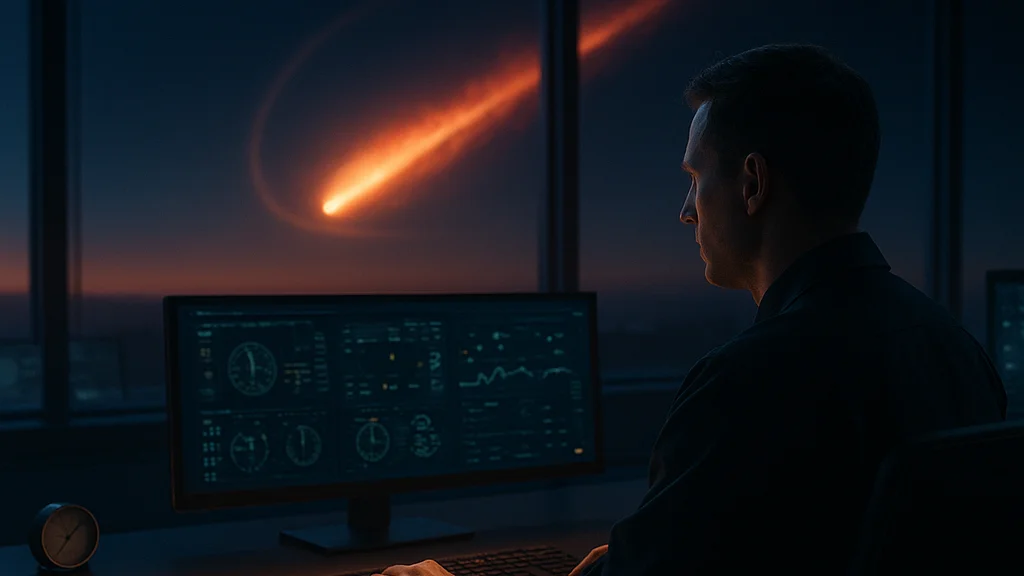

A 1,300-pound NASA probe falling back through Earth’s atmosphere is not ordinary lunch-break news. It is the kind of headline that hijacks attention across chat apps, group texts, office Slack channels, and home screens in seconds. For remote workers, that matters more than many managers admit. A dramatic science event, especially one described as an “uncontrolled plunge,” can fracture concentration faster than a bullet train leaving platform, because it combines uncertainty, public risk, and live updates. Even when the actual danger to any one person is very low, the psychological effect is immediate, curiosity rises, feeds refresh, and planned work begins to splinter into fragments.
The NASA object at center of discussion has been covered in recent WriteUpCafe reporting, including NASA’s 1,300-Pound Probe Makes Uncontrolled Earth Atmosphere Plunge in 2026 and NASA’s 1,300-Pound Probe Plunges Uncontrolled Through Earth’s Atmosphere. Those reports focus on event itself. My concern here is different, practical, and very relevant to distributed teams, freelancers, and knowledge workers, how to keep judgment clear and output steady when a high-drama global story lands in middle of workday.
Remote work rewards autonomy, but autonomy has sharp edges. There is no office rhythm to absorb disruption, no colleague quietly pulling you back to task, no meeting room door closing out noise. You need your own protocol. Kaizen teaches that small systems beat bursts of willpower, and Zen reminds us that attention is not endless, it is cultivated. A news shock like this NASA reentry is useful case study, because it shows how quickly external uncertainty can become internal chaos. If you handle this well, you can handle product launches, market rumors, outage alerts, and the next viral crisis too.
High-intensity news does not only consume time, it consumes decision quality. The first loss is rarely minutes, it is sequence.
The goal is not to ignore reality. It is to respond with discipline, verify facts, set boundaries, and continue meaningful work. That is what this guide will do, step by step.
Why a space headline can wreck a remote workday
People often underestimate how much productivity depends on cognitive stability rather than raw effort. A breaking science story with words like “uncontrolled” and “plunge” activates monitoring behavior. You want updates, context, maps, official statements, expert commentary, and reassurance. Each check feels small. In aggregate, it becomes a pattern of self-interruption, and self-interruption is expensive. Research cited for years by productivity analysts has shown that task switching carries recovery cost, especially for analytical work. Even when exact recovery times vary by study design, the direction is consistent, fragmented attention lowers output quality and increases completion time.
News events with uncertain timing are uniquely disruptive because they do not resolve on a clean schedule. A probe reentry may happen within a broad window, and agencies may update estimates as tracking improves. NASA statements, media reports, and commentary from space analysts can shift through day. That means your brain does not get closure. It keeps a background process running. For a remote worker writing reports, coding, designing, selling, or planning, this background process competes with foreground work every few minutes.
There is also social contagion. One message arrives, “Are you seeing this?” Another says, “Could debris hit somewhere populated?” A team thread starts. Someone posts a screenshot from Reuters or the Associated Press. Soon, discussion becomes ambient office noise recreated digitally. Unlike a physical workplace, remote environments let that noise follow you into every device, every room, every hour. Home, which should support deep work, becomes command center for distraction.
- Trigger 1: uncertain timing creates repeated checking behavior
- Trigger 2: emotionally loaded language increases vigilance
- Trigger 3: group chats amplify fear and curiosity
- Trigger 4: social media rewards novelty, not proportion
- Trigger 5: remote work lacks natural containment unless you create it
Seen this way, the NASA probe story is not only aerospace news. It is an attention stress test. If you can structure your response here, you build a reusable method for every future disruption.
What we know about the NASA probe, and why facts matter for focus
Before talking tactics, it helps to ground attention in verified information. The broad outline reported by major outlets such as Reuters and the Associated Press is that a NASA spacecraft component or probe of roughly 1,300 pounds was expected to make an uncontrolled reentry through Earth’s atmosphere, with much of it likely to burn up, though some debris could potentially survive depending on design and conditions. That combination, low individual risk but dramatic framing, is exactly what fuels compulsive scrolling. The event is real, the uncertainty is real, and the probability of harm to any specific person remains very small according to the way such reentries are generally assessed by agencies and experts.
This distinction is crucial for productivity. Anxiety grows in information vacuum, but it also grows in information overload. You need enough verified fact to calibrate your response, not endless commentary. NASA, space-tracking experts, and established wire services are useful because they prioritize updates with sourcing. By contrast, algorithmic feeds often merge speculation, recycled graphics, and stale data into one stream. That is how a 10-minute check becomes 70 minutes of low-value consumption.
For remote teams, factual discipline is operational discipline. If a manager posts an unverified map, employees may pause work unnecessarily. If a freelancer chases every rumor, billable time evaporates. If a customer-facing team reacts emotionally instead of proportionally, clients feel instability. The best response is simple, choose a small set of trusted sources by name, check them at set intervals, and avoid open-ended browsing.
Verification is productivity tool. When facts are stable, attention can be stable too.
There is another benefit. Facts reduce drama inflation. An uncontrolled reentry sounds cinematic, but aerospace history shows that reentries of satellites, rocket bodies, and spacecraft hardware are not unheard of. What makes this story notable is public visibility and timing, not proof that everyone should abandon normal work. Calm begins with proportion. Proportion begins with source hygiene.
- Identify two trusted sources by name, for example NASA updates and Reuters reporting.
- Set fixed check times, such as once every 90 minutes.
- Capture one sentence summary in your notes, so you do not re-read same coverage.
- Return to planned task list immediately after check.
- If no material update exists, do not continue browsing.
This method sounds almost too modest. That is why it works. Zen practice is often not dramatic, only repeatable.
The remote worker’s response protocol: a step-by-step system
When a headline like this lands, most people rely on mood. Mood is weak structure. Better is protocol. I recommend a five-part response system that can be completed in under ten minutes and protects the next four hours of work. Think of it as kintsugi for attention, not pretending the crack did not happen, but repairing it with visible care and stronger form.
1. Stop the reflex loop
The moment you notice repeated checking, pause all feeds. Close social tabs, mute nonessential channels for 45 minutes, and write down what you believe is happening in one sentence. This externalizes uncertainty. Once thought is on page, it stops circling with same intensity.
2. Define actual relevance
Ask one concrete question, does this event change any decision I must make in next two hours? For almost all remote workers, answer is no. That does not mean story is trivial. It means your immediate deliverables remain same. This distinction restores agency.
3. Protect your highest-value block
Next, choose one task that requires most concentration, proposal draft, code review, financial model, client strategy, editing pass. Work on it for a single uninterrupted sprint of 50 to 75 minutes. Put phone out of reach. If you use status indicators, set one that signals focus, not absence.
4. Create a news window
Schedule a short update check after sprint ends. Ten minutes is enough. If there is a major verified development, you will see it. If not, you have avoided dozens of micro-distractions without losing situational awareness.
5. Debrief and reset
After update window, note whether event now requires action. If not, restart work. If yes, define action narrowly, such as informing family, adjusting travel, or updating team. The key is to convert vague concern into bounded task.
- Total setup time: about 7 to 10 minutes
- Protected focus block: 50 to 75 minutes
- News check window: 10 minutes
- Decision rule: no action without verified change
I have seen versions of this system work for outage days, market crashes, earthquake alerts, and major election nights. The principle is same, contain uncertainty before it colonizes schedule. A bullet train reaches speed because friction is engineered down. Your workday needs same design.
How managers should handle team chatter without killing morale
Leaders often make one of two mistakes during a fast-moving public event. They either ignore it completely, which makes them seem detached, or they overreact, flooding channels with commentary and turning a temporary distraction into organizational weather. Better management is quieter and more precise. A distributed team does not need performative concern. It needs a short factual note, a clear expectation, and permission to stay focused.
If you lead people, send one message in main channel. Acknowledge that many have seen the NASA probe reentry reports. State that you are monitoring only verified updates from named sources. Clarify that work priorities remain unchanged unless a local safety issue emerges. Then give a process, not a lecture, for example, “Please keep non-work discussion to one thread and mute it if you need uninterrupted focus.” This keeps social energy contained without shaming curiosity.
Managers should also remember geography. Remote teams may span countries and time zones. A worker in Tokyo, another in Toronto, and another in São Paulo will experience different media cycles and different local anxieties. One person may be heading into evening, another into peak work hours. Uniform empathy matters, but so does local autonomy. Team members should know whether they are expected to continue normal operations or make temporary adjustments.
There is practical value in channel architecture too. Create one temporary thread for updates, not ten scattered conversations. Discourage reposting of unsourced social graphics. If someone is visibly distracted, move from public correction to direct support. Ask what deliverable is at risk and help them protect one next action. Productivity is rarely rescued by abstract motivation. It is rescued by sequence.
For organizations that want to build stronger habits beyond this event, WriteUpCafe’s broader productivity coverage can be useful, including the Productivity topic page. The lesson is larger than one NASA headline. Every remote team needs a disruption protocol before next disruption arrives.
Freelancers and solo workers face a different risk: invisible drift
Employees at least have meetings, deadlines, and colleagues creating some external structure. Freelancers, consultants, creators, and independent contractors often do not. That freedom is powerful, but it can hide drift. You tell yourself you are “keeping up with important news,” yet by afternoon your invoiceable work has barely moved. Because no one is watching, the loss feels softer, almost unreal. Then evening arrives, and the stress bill comes due.
For solo workers, a NASA reentry story can trigger three common productivity traps. First is pseudo-work, reading article after article because it feels informative. Second is protective procrastination, delaying difficult client tasks under cover of uncertainty. Third is schedule spill, where a daytime distraction pushes real work into night, damaging recovery and next day performance. This cycle is familiar to many freelancers, especially those already balancing multiple clients and irregular income.
The fix is to make value visible. Start by defining your minimum successful day in numbers, not feelings. That might be 1,200 words drafted, two client revisions delivered, one pitch sent, or three billable hours completed before any open-ended news consumption. Once number is set, use it as gate. No broad browsing until minimum target is done. This feels strict, but it protects your economic core.
- Write down today’s revenue-critical task first.
- Estimate time required in one focused block.
- Finish that block before checking broad commentary.
- Log actual time lost to news, in minutes.
- Review at end of day, without judgment, and adjust tomorrow.
Independent workers who need more structure can also borrow systems from adjacent disciplines such as freelancing and personal development. If relevant, the WriteUpCafe Freelancing and Personal Development topic pages offer frameworks that pair well with event-day focus management. Kaizen applies perfectly here, one small correction repeated beats one dramatic vow to “stop being distracted.”
Current 2026 reality: why this matters more now than it did a few years ago
The remote work environment of 2026 is more mature than the emergency setups of early decade, but it is also more saturated. More tools, more notifications, more cross-platform messaging, more ambient media. Many teams now operate hybrid-by-default or remote-first, and that means public events spread through work systems almost instantly. A science headline no longer stays in science corner. It enters project channels, AI summaries, browser sidebars, smartwatch alerts, and video meeting small talk within minutes.
There is another 2026 factor, the public has become more accustomed to live-tracked infrastructure and space events. Rocket launches, satellite deployments, debris discussions, and atmospheric reentries receive broader coverage than before. Commercial space activity, government missions, and amateur tracking communities have all increased visibility around orbital hardware. More visibility is not bad. It does mean, however, that workers now face more “attention spikes” tied to technical events they once would never have noticed.
Meanwhile, employers are measuring outcomes more carefully. In many sectors, there is less tolerance for vague busyness and more emphasis on documented progress. That creates a paradox. Workers have more flexibility over their environment, yet less room for unstructured distraction. A day consumed by updates about a NASA probe is not just lost time, it may become missed service levels, delayed approvals, or weaker client trust.
Reports from major outlets in 2026 also move faster because wire stories are rapidly republished, summarized, clipped, and debated. The same factual nugget appears in dozens of forms, giving illusion of new information when it is mostly repetition. This is dangerous for attention because novelty signal stays high while informational yield drops. Remote professionals need stronger filters now than they did even three or four years ago.
2026 productivity challenge is not lack of information. It is surplus without hierarchy.
That is why event-day discipline should be treated as professional skill, not personality trait. Calm is trainable. So is selective attention.
What to do for the rest of today: a practical plan you can use now
If the NASA probe reentry is unfolding today and your schedule already feels bent out of shape, do not try to save day with heroic effort. Repair it in sequence. Start with next 15 minutes, then next 90, then remainder of afternoon. Good recovery is incremental. In Japan, many efficient systems look graceful from distance because they are built from tiny precise actions. Your workday is same.
Begin by clearing inputs. Close every tab not needed for your current assignment. Put one trusted source aside for later, named and intentional, not random feed. Then list three items only: one must-finish task, one should-finish task, and one maintenance task. This reduces the panic of a long backlog and gives your mind a clean lane. If your energy is shaken, do not start with hardest task fragment. Start with smallest meaningful unit of hardest task, first paragraph, first spreadsheet section, first code function, first client email outline. Momentum beats rumination.
- Next 15 minutes: close tabs, mute channels, define three tasks
- Next 60 minutes: complete smallest meaningful unit of most important task
- Next 10 minutes: check one trusted update source by name
- Next 30 minutes: finish or advance second task
- End of day: record what distracted you and what protected focus
If you work with others, send one concise status update after first focus block. Something like, “Saw the reentry coverage, monitoring verified updates only, still on track to deliver draft by 3 p.m.” This reassures team and reduces back-and-forth. If you work alone, send same message to yourself in task manager or notebook. Clarity spoken outward becomes clarity felt inward.
Finally, protect evening. Do not let daytime drift become midnight compensation. Unless the event creates real local consequences, end work at planned time. Rest is not indulgence, it is maintenance. Zen practice values empty space because empty space allows form to appear. Your calendar needs that same respect.
The broader lesson: productivity under uncertainty is a competitive advantage
A NASA probe making an uncontrolled plunge through atmosphere is dramatic, unusual, and worth following through credible reporting. Yet the deeper professional lesson is not about space hardware. It is about how modern workers metabolize uncertainty. The people who perform best are not those who feel no distraction. They are those who notice distraction early, verify facts, bound its reach, and return to sequence with minimal drama.
This matters for careers. Clients remember reliability during noisy days. Teams trust colleagues who can stay calm without becoming indifferent. Managers value people who can separate signal from spectacle. Freelancers protect income when they can convert a chaotic news cycle into a structured work rhythm. These are not soft traits. They are operational assets.
Kintsugi offers useful image here. A crack does not erase usefulness, and repair need not hide disturbance. A disrupted day can still become strong day if repaired intentionally. Maybe you lost first hour to headlines. Fine. Rebuild second hour with discipline. Maybe team chat went noisy. Fine. Create one source thread and move on. Maybe your mind keeps drifting back to updates. Fine. Schedule next check, then return to craft. Productivity is not perfection. It is recovery speed plus quality of attention after interruption.
As coverage of the NASA reentry continues through verified outlets such as Reuters, the Associated Press, and NASA statements, keep perspective. Follow facts, not adrenaline. Protect your best work block. Communicate simply. Finish what matters. In remote work, this is quiet mastery, not flashy, not loud, but dependable as train arriving on time.
That is expert tip most people miss. Big headlines feel exceptional, but your response should be routine. Build routine now, and next disruption will meet prepared mind rather than open door.




















Sign in to leave a comment.