

Introduction
Security requirements are evolving rapidly across the United Arab Emirates. From commercial buildings and residential communities to airports, hotels, healthcare facilities, and government properties, organizations are looking for smarter ways to protect people, assets, and sensitive information. Traditional security methods such as keys, access cards, and PINs remain useful, but they can be lost, shared, copied, or forgotten. This is where a modern facial recognition system in UAE provides a powerful alternative.

A facial recognition system uses advanced cameras, biometric technology, and intelligent software to identify or verify individuals based on their facial characteristics. When properly designed and deployed, it can provide fast, convenient, and contactless authentication while supporting broader security and access-control strategies.
For businesses operating in Dubai, Abu Dhabi, Sharjah, and other parts of the UAE, facial recognition can be integrated with doors, gates, visitor management platforms, surveillance systems, and other security technologies. The result is a more connected approach to managing who enters a facility, when they enter, and whether they are authorized to access specific areas.
What Is a Facial Recognition System?
A facial recognition system is a biometric security solution that analyzes a person’s facial features to verify or identify them. A camera captures an image of the individual’s face, while specialized software analyzes measurable characteristics and compares them with information stored in an authorized database.
Depending on the system configuration, facial recognition may be used for one-to-one verification or one-to-many identification. Verification confirms whether a person is who they claim to be, while identification searches a database to determine who the person may be.
Modern solutions can use artificial intelligence and machine-learning technologies to improve recognition performance under different lighting conditions, viewing angles, and environmental situations.
For organizations, this technology can turn access control from a card-based process into a more intelligent and automated security experience.
How Does Facial Recognition Technology Work?
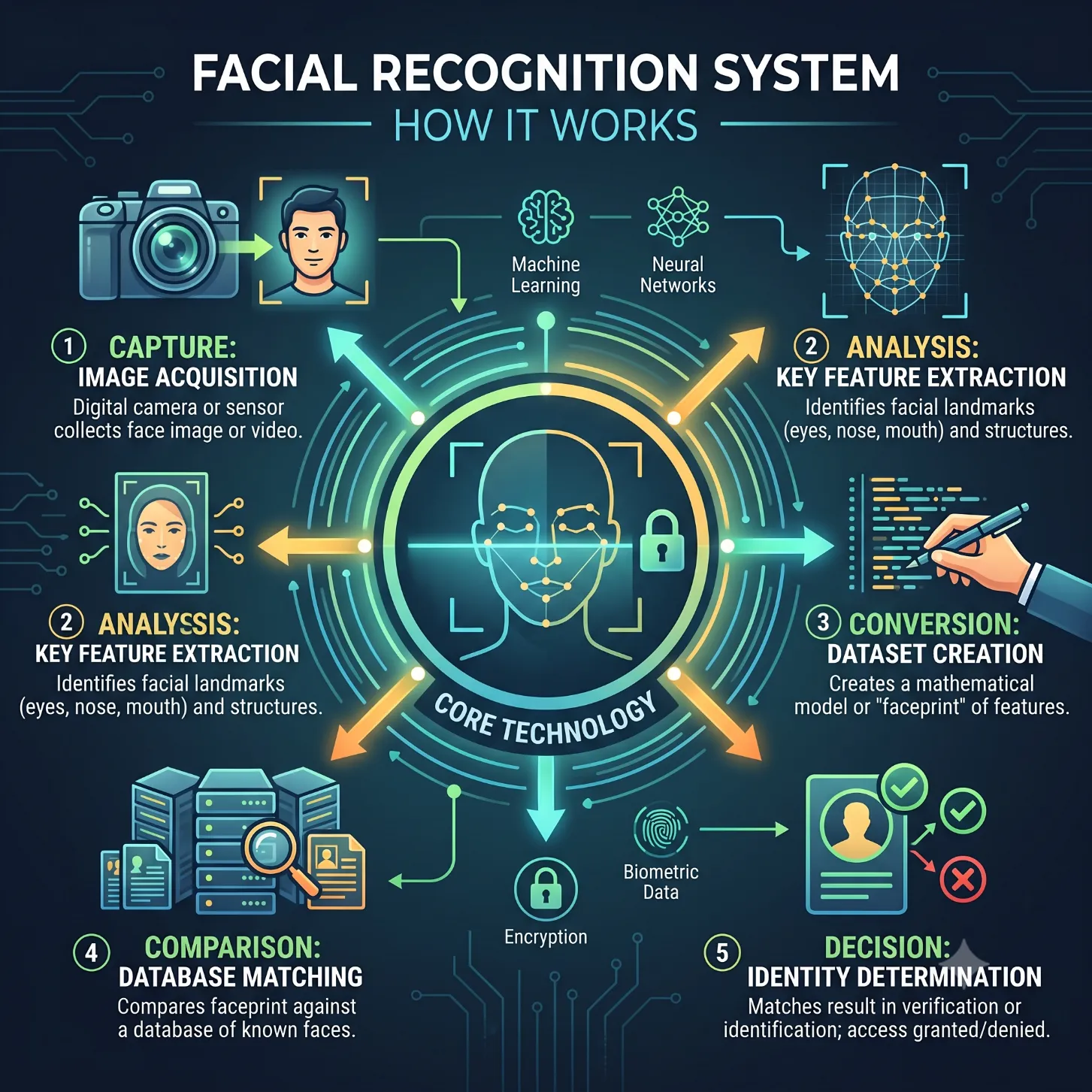
A typical facial recognition software solution follows several stages.
1. Face Detection
The camera first detects a human face within its field of view. This allows the system to distinguish a face from other objects in the environment.
2. Image Analysis
The software analyzes facial characteristics such as the positioning and relationships between different facial features. Advanced systems can use sophisticated algorithms to create a digital representation of the face.
3. Identity Matching
The captured facial information is compared against authorized records or a predefined database. The system then calculates whether there is a sufficient match.
4. Authentication or Access Decision
If the individual is successfully authenticated, the system can trigger an integrated device such as an electronic door lock, turnstile, or gate. If authentication fails, access can remain restricted and the event may be recorded for security monitoring.
This automated process can take place within seconds, helping reduce queues and improving the overall flow of people.
Types of Facial Recognition Solutions
The UAE market includes different forms of facial recognition technology designed for different operational requirements.
Facial Recognition Devices
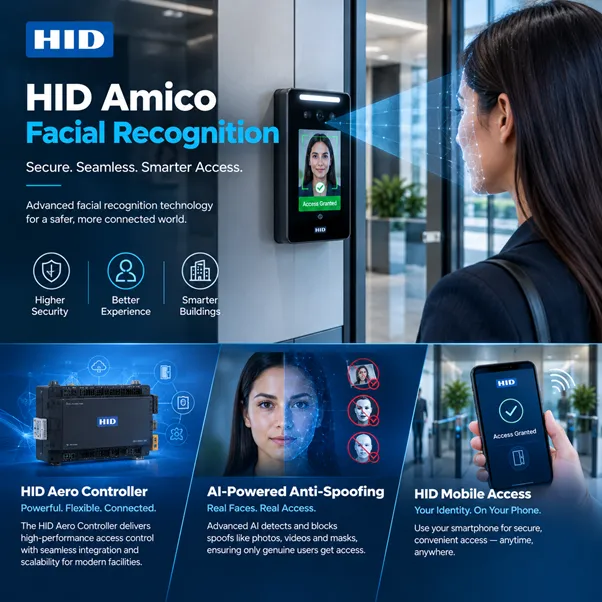
A facial recognition device typically combines a camera, processing capability, display, and biometric recognition technology in a single unit. These devices are commonly installed at entrances, employee access points, reception areas, and restricted zones.
Some devices can also support additional authentication methods, such as cards or PINs, providing organizations with flexible security options.
Facial Recognition Software
Facial recognition software is the intelligence behind the solution. It processes facial images, performs biometric matching, manages users, and can provide access records and reporting.
Software can often be integrated with existing security infrastructure, allowing organizations to build a centralized access-management environment.
Integrated Facial Recognition Systems
For larger facilities, facial recognition can be combined with access control, CCTV, visitor management, alarms, and other security technologies. This integrated approach provides security teams with a broader view of activity across a property.
Why Is Facial Recognition Important for UAE Businesses?
The UAE is known for its advanced infrastructure, smart-city initiatives, and strong focus on technological innovation. Businesses therefore increasingly expect security systems to be efficient, intelligent, and scalable.
A facial recognition system UAE solution can help organizations address several practical security challenges.
First, it reduces dependence on physical credentials. Employees do not necessarily need to carry access cards for every entry point when biometric authentication is available.
Second, it can improve convenience. Contactless facial authentication can allow authorized users to pass through access points without touching a scanner or entering a PIN.
Third, it provides useful access records. Organizations can monitor authorized entry events and use reporting capabilities to improve security management.
Most importantly, facial recognition can become part of a broader security strategy rather than functioning as an isolated device.
Key Features to Look for in a Facial Recognition System
Selecting the right solution requires more than choosing a camera with facial recognition capabilities. Businesses should consider the complete technology ecosystem.
High-Accuracy Biometric Recognition
Recognition accuracy is one of the most important factors. A professional solution should be capable of distinguishing authorized users reliably while minimizing false acceptance and false rejection.
Fast Authentication
In high-traffic environments, slow authentication can create queues. A fast biometric access control system helps users move through entrances efficiently without compromising security.
Contactless Operation
Contactless authentication is especially useful in locations where convenience, hygiene, and smooth movement are important.
Multiple Authentication Options
Organizations may benefit from systems supporting facial recognition alongside cards, PINs, fingerprints, or other credentials. Multiple options can provide additional flexibility.
Access Control Integration
The facial recognition solution should be compatible with doors, electronic locks, turnstiles, barriers, and other access-control equipment.
Visitor Management Integration
Integrating facial recognition with a visitor management system can help automate visitor authentication and improve the experience at reception and controlled entrances.
Real-Time Monitoring and Reporting
Security teams should have access to relevant logs and reports. This can help organizations understand access activity and investigate unusual events when necessary.
Scalable Architecture
A small office may need only one device, while a large organization could require hundreds of access points. A scalable solution can grow as the business expands.
Strong Data Protection
Because facial recognition involves biometric information, organizations should carefully evaluate how data is collected, processed, stored, protected, and accessed. Businesses should select solutions and deployment practices appropriate to applicable UAE requirements and their own privacy and security policies.
Major Benefits of Facial Recognition Systems
Enhanced Security
Biometric authentication provides a security layer that is difficult to replicate in the same way as a physical access card or password. This can help organizations strengthen restricted-area access.
Improved Convenience
Employees and authorized users can authenticate themselves without searching for an access card or remembering a PIN. This creates a smoother entry experience.
Faster Access
High-speed recognition can reduce delays at entrances, particularly in busy offices, residential communities, hotels, and commercial facilities.
Reduced Credential Sharing
Unlike conventional cards that can potentially be handed to another person, facial authentication is linked to the individual’s biometric characteristics.
Better Access Visibility
Digital records can provide security teams with useful information about access events, supporting monitoring and auditing processes.
Reduced Administrative Work
Automated authentication can reduce some of the routine work associated with issuing, replacing, and managing physical access credentials.
Contactless Authentication
Users can gain access without touching a reader, which can be valuable in modern workplaces and high-traffic environments.
Applications of Facial Recognition in the UAE
The flexibility of facial recognition makes it suitable for a wide range of industries.
Corporate Offices
Businesses can use facial recognition for employee entrances, restricted departments, server rooms, and other sensitive areas.
Residential Communities
Residential developments can use facial recognition access control to manage authorized entry to buildings, parking facilities, and selected common areas.
Hotels and Hospitality
Hotels can explore facial recognition for controlled staff areas and other authorized-access applications while maintaining a smooth guest experience where appropriate.
Airports and Transportation
Transportation environments require efficient identity verification and passenger movement. Biometric technologies can support selected processes where properly authorized and integrated.
Healthcare Facilities
Hospitals and clinics can use biometric access solutions to help control access to staff-only zones, laboratories, pharmaceutical storage, and other restricted areas.
Educational Institutions
Schools, colleges, and universities can use access-control technology to manage authorized entry to administrative offices, laboratories, and other controlled areas.
Government Facilities
Government buildings often require multiple levels of security. Facial recognition can be incorporated into layered access-control environments for authorized personnel.
Data Centers
Data centers contain highly sensitive infrastructure. Combining facial recognition access control with other security measures can provide an additional authentication layer for critical areas.
Facial Recognition and Other Security Systems
The real value of facial recognition often comes from integration.
For example, a business could connect a facial recognition device with an electronic door lock, CCTV camera, visitor management platform, and centralized security software. When an authorized employee approaches an entrance, the system can authenticate the individual and grant access while recording the event.
Facial recognition can also work alongside Access Control Barriers and Traffic Management Barriers to create controlled vehicle and pedestrian entry environments. Depending on the application, organizations can design systems that manage both people and vehicles through coordinated security infrastructure.
This integrated approach can improve visibility and reduce the need for disconnected security processes.
Choosing a Professional Facial Recognition Provider in the UAE
The technology itself is only one part of a successful security project. The provider’s expertise can have a major impact on system performance.
A professional facial recognition system provider in UAE should understand the organization’s security objectives, site conditions, traffic patterns, integration requirements, and future expansion plans.
Before installation, the provider should assess factors such as camera placement, lighting, entrance design, network infrastructure, user volume, and required access levels.
After installation, proper configuration, testing, training, maintenance, and technical support are equally important. Businesses should also establish appropriate policies for biometric data management and access permissions.
Choosing a solution based solely on price can create problems later. A professional assessment helps ensure that the selected technology is suitable for the actual environment.
The Future of Facial Recognition Technology in the UAE
Facial recognition is becoming increasingly connected with artificial intelligence, cloud platforms, smart buildings, and integrated security ecosystems. As organizations continue to modernize their infrastructure, biometric authentication is likely to play a larger role in intelligent access management.
Future systems may provide greater integration between identity verification, visitor management, building automation, security monitoring, and analytics.
However, technological advancement should always be balanced with responsible data management. Organizations should prioritize transparency, security, appropriate access permissions, and compliance with applicable laws and regulations when implementing biometric solutions.
Conclusion
A facial recognition system in UAE can provide businesses and organizations with a modern approach to identity verification and access control. By combining biometric authentication, intelligent software, cameras, and integrated security infrastructure, organizations can improve security while creating a faster and more convenient user experience.
From corporate offices and residential communities to healthcare facilities, data centers, hospitality properties, and government buildings, facial recognition has a wide range of practical applications. Its benefits include enhanced security, contactless authentication, faster access, reduced credential dependence, and improved visibility into access activity.
The most effective solution is not simply the one with the latest technology. It is the system that is correctly designed, professionally installed, properly maintained, securely managed, and aligned with the organization’s operational requirements.
For UAE businesses looking to modernize their security infrastructure, investing in a professionally designed facial recognition access control system can be an important step toward a smarter, more connected, and future-ready facility.
Frequently Asked Questions
1. What is a facial recognition system?
A facial recognition system is a biometric technology that uses cameras and specialized software to detect, analyze, and match facial characteristics for identity verification or identification. It can be integrated with access-control systems to allow authorized individuals to enter protected areas.
2. Is facial recognition suitable for businesses in the UAE?
Yes. Facial recognition can be used across many UAE business environments, including offices, hotels, residential communities, healthcare facilities, educational institutions, data centers, and other controlled-access locations. The appropriate deployment depends on the organization’s requirements and applicable regulations.
3. What are the main benefits of facial recognition access control?
Key benefits include faster authentication, contactless entry, reduced reliance on physical credentials, improved access monitoring, enhanced security, and easier management of authorized users.
4. Can facial recognition integrate with existing access-control systems?
Yes. Many professional solutions can integrate with electronic locks, turnstiles, barriers, visitor management platforms, CCTV systems, and centralized security software. Compatibility should be confirmed before selecting the equipment.
5. How should businesses choose a facial recognition provider in the UAE?
Businesses should consider the provider’s technical experience, product quality, integration capabilities, installation expertise, after-sales support, scalability, cybersecurity practices, and ability to design a solution around the specific site’s requirements. Data protection and applicable UAE requirements should also be considered during planning and deployment.
Facial Recognition System
Facial Recognition Device
Facial Recognition Software






























Sign in to leave a comment.