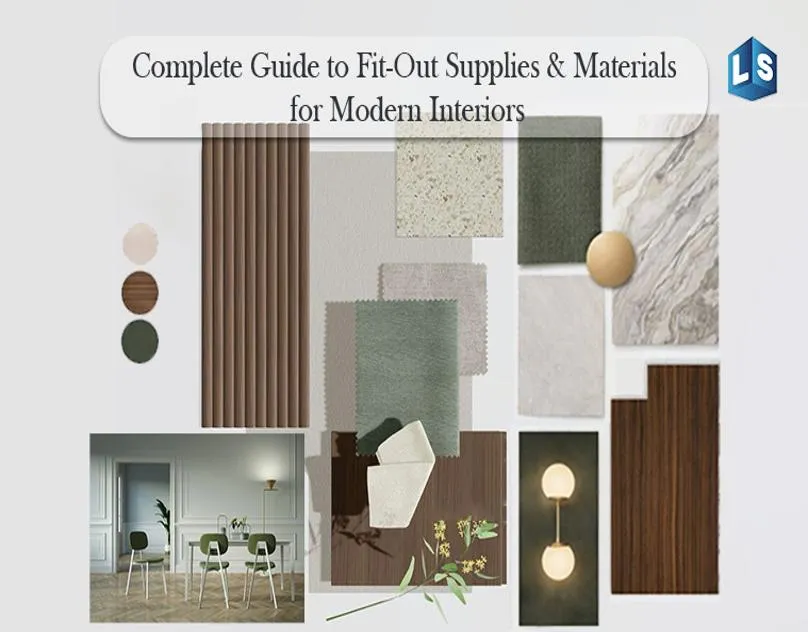

Most interior projects begin with a vision. A mood board. A set of reference images. A clear idea of how the finished space should look and feel. What they sometimes begin without is an equally clear idea of how to make that vision structurally sound, physically durable, and economically sensible over the long term.
That's where fit-out material specification comes in — and where the gap between projects that deliver on their promise and those that quietly fall short of it is most consistently found.
This isn't a guide to the most fashionable materials or the latest design trends. It's a practical, grounded look at the materials that form the working core of quality interior fit-out — what they are, what they do, and how to think about choosing them with both the design vision and the real-world performance requirements firmly in mind.
Fit-Out Materials: The Layer That Makes Everything Else Work
Strip back any well-executed interior and what you find beneath the surface finishes and visible design elements is a set of material decisions that made the whole thing possible. The substrate behind the wall panel. The laminate on the furniture face. The acoustic liner behind the ceiling. The edge strip on the joinery. None of these are what the occupant sees when they walk into the space. All of them are why the space continues to look and perform the way it does after months and years of use.
Fit-out materials are the products used to complete an interior once the structural phase of construction is finished. They include surface laminates, structural boards, acoustic treatment products, and precision finishing materials — and the quality of the choices made across these categories determines the quality of the interior in a more fundamental way than almost any other specification decision.
Working with a supplier that offers a comprehensive, well-specified range of fit-out supplies and materials is not simply a procurement convenience. It is a prerequisite for delivering results that hold up.
The Core Material Categories — What They Are and What They Contribute
Decorative Laminates — When the Surface Has to Work as Hard as It Looks
Surface materials in any interior fit-out carry a dual obligation: they need to look right and they need to stay looking right under the conditions the space will actually impose on them. In many project types — commercial offices, retail environments, hospitality venues, busy residential kitchens — those conditions are considerably more demanding than they appear.
High-pressure laminates are the surface specification that meets both obligations reliably. The HPL manufacturing process creates a material composite with hardness, thermal tolerance, and surface resilience that alternatives produced at lower pressures or through simpler processes cannot match. The result is a surface that resists the daily accumulation of heat, impact, scratching, and staining that degrades lesser materials visibly and progressively.
The design range available within the HPL category is broad enough to accommodate virtually any aesthetic brief — from the understated and minimal to the richly textured and expressive — without requiring any compromise between appearance and durability. For specifiers who need both, HPL consistently delivers both.
Wood-Effect Panels and Laminates — Resolving the Timber Specification Dilemma
Every designer working in interiors eventually encounters the timber specification dilemma: clients consistently want the warmth and character of natural wood, and solid timber consistently brings costs, maintenance demands, and practical complications that make it difficult to specify responsibly at the scale most fit-out projects require.
Engineered wood laminates and panels resolve this dilemma more effectively than any previous generation of products has managed. Advances in manufacturing have produced wood-effect surfaces with grain accuracy, tonal depth, and tactile quality that genuinely rival the real material in finished interiors. The practical benefits of the engineered alternative — dimensional stability, moisture resistance, cost efficiency, and low maintenance — remain fully intact.
For wardrobes, office furniture, restaurant panelling, hotel room joinery, and any application where a natural timber aesthetic is the design goal, engineered wood products offer the specification that satisfies both the client's visual expectations and the project's practical requirements.
MDF and Moisture-Resistant Fibreboards — Versatility That No Other Substrate Matches
If a single material were to be nominated as the structural backbone of modern interior fit-out, MDF would be a strong candidate for the title. Its presence in fitted kitchens, custom storage solutions, office partitions, display units, and bespoke joinery pieces across virtually every project type and sector reflects the straightforward fact that it meets the needs of those applications better than its alternatives.
The properties that make it so consistently useful are well understood: a surface uniformity that accepts any finish without grain interruption; a density that supports clean machining, precise routing, and consistent fixing; a dimensional predictability that means finished pieces behave as specified after installation. Together these characteristics make MDF the default substrate choice for the full breadth of interior furniture and millwork applications.
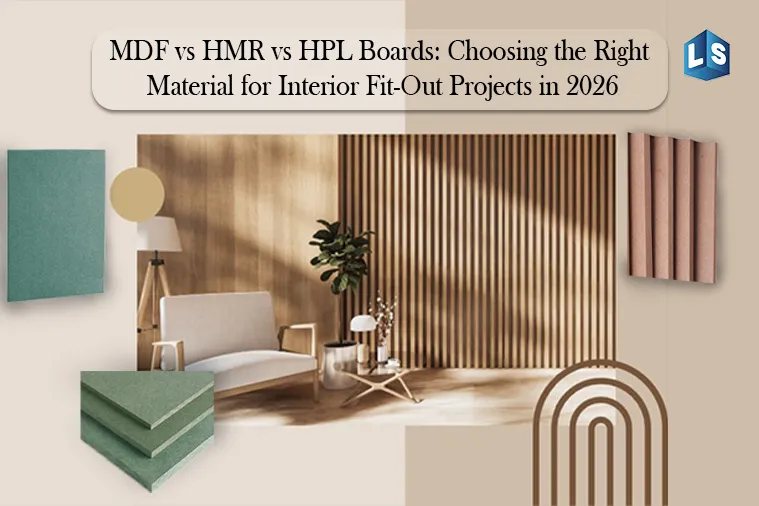
Moisture-resistant fibreboard grades extend the same capability into environments where standard MDF is unsuitable — bathrooms, commercial kitchens, laundry facilities, and retail spaces subject to humidity variation. The substrate family as a whole covers the range of interior applications comprehensively and reliably.
Film-Faced Plywood — Structural Integrity for Applications That Demand It
Not all fit-out applications are primarily about surface appearance. Some are fundamentally about structural performance — about whether a material can carry a load, resist moisture penetration at the core level, and maintain its integrity across years of hard use in demanding conditions.
Film-faced plywood exists precisely for these applications. The phenolic resin film applied to both panel faces creates a surface that is sealed against moisture, resistant to abrasion, and harder than the untreated alternatives. The cross-laminated core provides rigidity and load capacity that flat-pressed sheet materials cannot replicate at equivalent thicknesses. The combination is a material genuinely engineered for environments where performance requirements are non-negotiable.
High-load storage, flooring underlays, construction formwork, and intensive commercial fit-out environments all benefit from a specification that doesn't require compromise between structural capability and durability. Film-faced plywood provides both.
Acoustic Panels and Liners — Bringing Sound Quality Into the Design Conversation
Ask anyone who has worked in a poorly acousticised open-plan office, stayed in a hotel with inadequate corridor sound separation, or tried to hold a private conversation in a healthcare waiting room without acoustic treatment, and the case for proactive acoustic specification makes itself. These are not minor inconveniences. They are design failures with real consequences for the people using the space.
The persistent challenge with acoustic specification has historically been the perception that it requires a visual trade-off — that effective acoustic treatment means aesthetic compromise. That perception is no longer accurate. Contemporary acoustic panels and sound-absorbing wall liners are designed with the full interior context in mind, available in finishes, profiles, and configurations that integrate naturally into any contemporary scheme.
Specifying acoustic treatment as a deliberate, designed element of the fit-out — rather than an afterthought introduced in response to occupant complaints — is how projects deliver acoustic quality as an outcome. The difference in both cost and result between proactive and reactive acoustic specification is substantial.
Edge Banding — The Detail That Separates Finished Work from Unfinished Work
There is a category of quality indicator in interior fit-out that experienced practitioners check almost instinctively — not because it's the most visible element of the work, but because it tells them something reliable about the standard of everything else. Edge banding is one of those indicators.
The functional role of edge banding is to seal the exposed cut edges of boards and panels against moisture ingress and physical damage — protecting the substrate at its most vulnerable points and extending the operational life of the finished piece meaningfully. The aesthetic role is to complete the visual surface, producing the flush, unified profile that reads as intentional craftsmanship rather than functional assembly.
When edge banding is specified correctly, matched carefully to the face material, and applied with precision, it effectively disappears into the finished piece. That invisibility is the mark of work done properly. When it is absent, poorly matched, or carelessly applied, it announces itself — and casts doubt on the quality of everything around it.
Cut-to-Size Supply — Where Project Precision Starts
The precision of an interior fit-out is partly a function of design and craftsmanship — and partly a function of whether the materials arriving on site are actually the right dimensions for the job. When they aren't, the gap is filled by on-site cutting, material waste, accumulated measurement error, and the kind of installation inefficiency that slows projects and compromises results.
Cut-to-size material supply eliminates that gap at the source. Materials arrive pre-dimensioned to the exact specifications of the project, ready for installation without further adjustment. The practical consequences are straightforward: waste is reduced, installation is faster, dimensional accuracy improves, and the finished result more closely reflects the precision of the design intent.
For large-volume commercial projects the efficiency and cost benefits are material. For precision-sensitive residential and bespoke work, it is simply the right way to source materials for a job that demands exactness.
A Practical Framework for Making Better Specification Decisions
Strong fit-out material specification is a skill built on a consistent set of habits and principles. These are the ones that reliably produce better outcomes:
Define the performance envelope before selecting products. What conditions will this material face? What loads, what moisture levels, what traffic intensity, what cleaning requirements? Answers to these questions define the minimum performance requirements any material in that application must meet. Products that don't meet those requirements don't belong in the specification, regardless of other attributes.
Calculate total cost across the fit-out lifecycle. A material's purchase price is one component of its total cost. Maintenance frequency, repair probability, and replacement timing are others — and they often matter more over a five or ten-year horizon than the upfront price differential between options. Specifications built on lifecycle cost analysis consistently outperform those built on purchase cost minimization.
Give acoustic quality the same design attention as visual quality. The acoustic environment of a space shapes the experience of its occupants as directly as any visual element — often more so. Treating acoustic specification as a secondary technical matter, to be addressed with whatever budget remains after the visual design is costed, produces spaces that look as intended and feel considerably worse.
Protect the finishing details from value engineering. Edge banding, surface precision, and cut accuracy are the places where the overall quality standard of a fit-out is most directly expressed. Decisions that compromise these details to recover costs elsewhere produce results that experienced observers notice immediately — and that occupants experience daily.
Source from suppliers whose standards match your own. Materials come from supply chains, and supply chains vary enormously in their consistency, reliability, and capacity to support project requirements at short notice. A supplier with genuine fit-out expertise, consistent stock quality, and the flexibility to handle custom specifications is a project asset whose value is most apparent under pressure.
Where These Materials Find Their Applications
Fit-out materials operate across every sector of the interior built environment:
- Residential projects — Where the quality of fitted kitchens, bedrooms, bathrooms, and bespoke living spaces is felt by occupants in the most direct and daily way possible
- Commercial offices — Where the fit-out communicates organizational identity, supports operational productivity, and sets the physical conditions for the daily working experience of every person in the building
- Retail environments — Where surface quality, visual consistency, and material durability are directly connected to how customers perceive and engage with a brand
- Hospitality venues — Where the physical environment is experienced as part of the product offering, and where material deterioration translates directly into guest experience decline
- Healthcare and educational facilities — Where specific obligations to users — hygiene performance, acoustic quality, physical safety, and maintenance sustainability — translate into non-negotiable material specification requirements
Final Thoughts
Fit-out material specification is the point where design ambition, practical engineering, and long-term value either come together or begin to diverge. The projects that continue to deliver — that hold their quality, satisfy their occupants, and justify the investment made in them — are consistently the ones where the material decisions were made carefully, sourced reliably, and executed without the kind of corner-cutting that looks like savings on a spreadsheet and shows up as disappointment in the finished space.
The vision at the start of a project is what inspires it. The materials specified during fit-out are what make it last.
Those two things deserve equal attention.
Originally published on: LS Trading and Contracting W.L.L.


























Sign in to leave a comment.