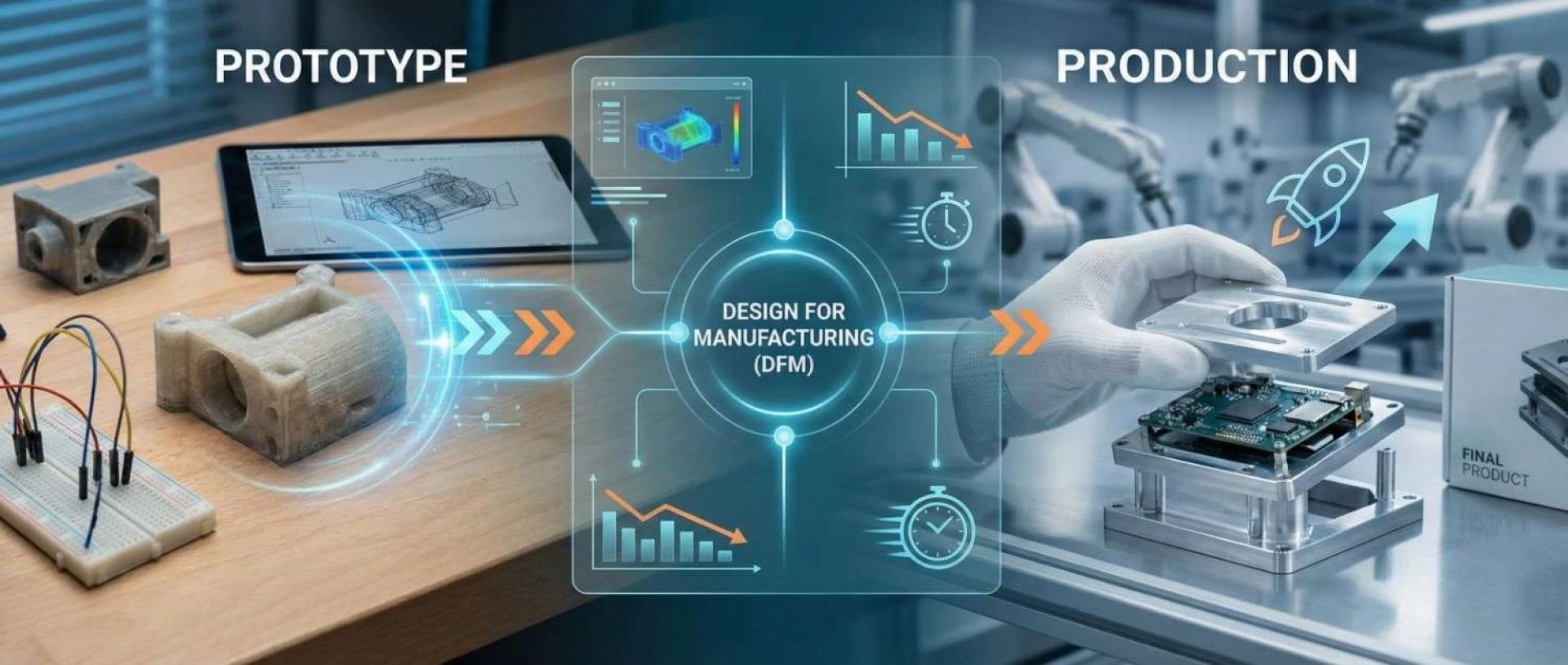

The 70% Reality Check
Here is a statistic that keeps engineering leaders awake at night: 70% to 80% of a product’s total lifecycle cost is determined during the design phase.
By the time a prototype hits the manufacturing floor, the economic fate of that product is largely sealed. If the design isn't optimized for production before it leaves the digital drawing board, no amount of supply chain negotiation or factory efficiency can fully recover the lost margin. In an industry where speed-to-market is the primary differentiator, the traditional "design-then-build" approach is no longer just inefficient it is an existential risk.
The Shift: From "Over the Wall" to Concurrent Engineering
Historically, product development followed a siloed path. Design engineers focused on functionality and aesthetics, then "threw the design over the wall" to manufacturing engineers who scrambled to figure out how to build it. This disconnect leads to the dreaded "engineering change order" (ECO) loop a cycle of rework that bleeds budget and stalls launch dates.
Today, the most successful firms in the Architecture, Engineering, and Construction (AEC) and manufacturing sectors are adopting a Design for Manufacturing (DFM) mindset. DFM is not just a review step; it is a holistic strategy that integrates manufacturing constraints, material properties, and assembly processes into the very earliest stages of design.
The Economics of Early Optimization
The impact of DFM on the bottom line is quantifiable and dramatic. Research indicates that the cost of correcting a design error increases by a factor of 10 at each subsequent stage of development. A glitch that costs $100 to fix in the CAD model might cost $1,000 to fix during prototyping and $10,000 or significantly more once tooling has been cut.
This is where professional mechanical design services play a pivotal role. By engaging with specialized design partners early, companies can leverage:
- Material Selection Optimization: Identifying materials that meet performance specs but are cheaper or faster to source.
- Component Consolidation: Redesigning complex assemblies into single molded or machined parts to reduce bill of materials (BOM) complexity.
- Standardization: Utilizing off-the-shelf components to avoid the high costs of custom fabrication.
Accelerating Launch via Digital Validation
Time-to-market is the second currency of the manufacturing world. The gap between a functional prototype and a production-ready unit is often where schedules die. DFM bridges this gap by replacing physical trial-and-error with digital certainty.
Leading mechanical engineering design services now employ advanced simulation tools like Finite Element Analysis (FEA) and Computational Fluid Dynamics (CFD) as standard parts of the DFM process. These virtual stress tests predict how a design will behave under real-world conditions before a single physical prototype is built.
For instance, rather than building five physical prototypes to test thermal dissipation, a DFM-focused engineering team can simulate hundreds of variations digitally in a fraction of the time. This capability, offered by firms like Tesla Mechanical Designs, enables "virtual prototyping," significantly shortening development cycles.
Bridging the Gap: What to Look for in a Design Partner
Transitioning from a rough prototype to mass production requires a specific set of technical capabilities. It’s not enough to just have a 3D model; you need a manufacturing-ready data package.
When evaluating partners to assist with this transition, look for those offering comprehensive solutions that include:
- Drafting & GD&T: Precise 2D drawings with Geometric Dimensioning and Tolerancing ensure that the manufacturer knows exactly what "perfect" looks like.
- Reverse Engineering: The ability to take legacy parts, scan them, and create optimized CAD models for modern manufacturing methods.
- Tooling Design Support: Understanding how the design impacts the molds, jigs, and fixtures required for production.
Specialized providers, such as Tesla Mechanical Designs, structure their product design and development specifically to handle this 'Prototype to Production' journey. Their expertise spans from initial 3D CAD modeling and sheet metal design to complex machinery and automation design, ensuring that the "buildability" of a product is verified long before production begins.
Actionable Takeaways for Engineering Leaders
If you are looking to integrate DFM into your next product launch, consider these immediate steps:
- Engage Early: Bring mechanical design services experts into the conversation during the concept phase, not after the prototype is finished.
- Simulate Everything: Insist on FEA or CFD analysis to validate designs digitally, reducing the reliance on costly physical iterations.
- Audit for Simplicity: Challenge every part in your BOM. If a component doesn't move, can it be combined with another?
- Standardize Tolerances: Avoid "tight tolerance creep." Only specify high-precision tolerances where they are absolutely critical to function; loose tolerances elsewhere save money.
Conclusion: The Future is Predictive
The line between design and manufacturing is vanishing. As we look toward the future, technologies like AI-driven Generative Design and Digital Twins will further automate DFM principles, enabling real-time manufacturing optimizations as engineers design.
However, technology is only a tool. The real competitive advantage lies in the strategic decision to partner with expert mechanical engineering design services that understand the nuance of turning a great idea into a profitable product. By prioritizing manufacturability from day one, you don't just cut costs you build a faster, more resilient path to market.
Sign in to leave a comment.