Stop the Scrap: The ROI of Precision Sheet Metal Modeling
In the United States alone, construction rework drains the industry of approximately $177 billion annually, with "bad data" and "miscommunication" responsible for nearly half of these avoidable costs (Autodesk & FMI, 2024). For Architecture, Engineering, and Construction (AEC) professionals, this statistic isn't just a number; it is the sound of profit margins evaporating on the shop floor.
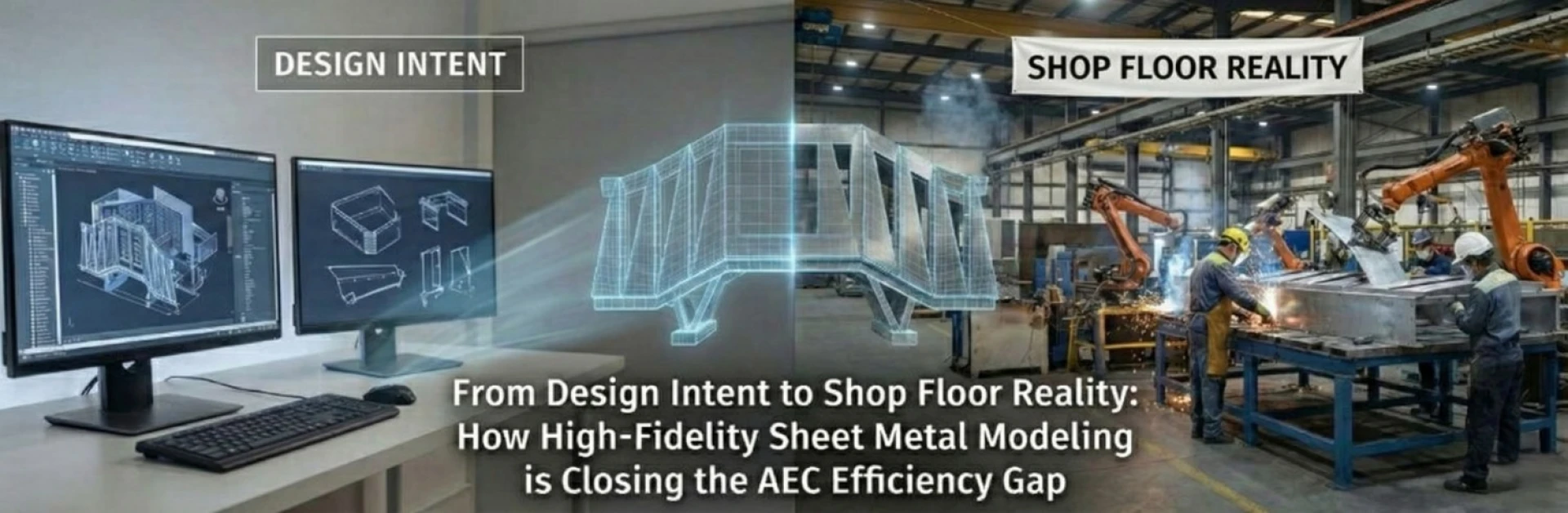
While the broader manufacturing sector has seen productivity skyrocket by 760% since 1947, the construction industry has languished, with only 6% growth over the same period. The missing link? A failure to bridge the chasm between "design intent" and "fabrication reality." As we move through 2025, advanced Sheet Metal Modeling services are emerging as the critical infrastructure to close this gap, transforming static drawings into dynamic, data-rich assets that drive efficiency from the architect’s desk to the CNC laser.
The High-Fidelity Imperative: Moving to LOD 400
In traditional workflows, a gap exists between the engineering drawings provided by design teams (often at Level of Development 200 or 300) and the precision required for fabrication. A structural "placeholder" model might show a duct or enclosure's general location, but it lacks the metallurgical DNA bend radii, K-factors, and material behaviors necessary for production.
High-fidelity modeling (LOD 400) is the antidote to this ambiguity. By incorporating Product Manufacturing Information (PMI) directly into 3D models using software like SolidWorks, Inventor, or Revit, firms can preemptively resolve issues that would otherwise halt production.
The Data Advantage: According to the Aberdeen Group, top-performing manufacturers who leverage detailed 3D modeling environments report profit margins 21% higher than those relying on 2D visuals. Furthermore, these digital-first firms can launch products an average of 99 days earlier. For AEC projects involving complex HVAC systems, architectural cladding, or industrial enclosures, this acceleration is not a luxury; it is a competitive necessity.
DfMA: Engineering Profitability Before the First Cut
The most transformative trend in 2025 is the aggressive adoption of Design for Manufacture and Assembly (DfMA). This methodology shifts the focus from "drawing what we want" to "modeling what can be built efficiently."
Sheet metal is unforgiving; a design that ignores material elasticity or tool access limitations will inevitably fail. Advanced modeling services, like those offered by Tesla Mechanical Designs, integrate DfMA principles during the modeling phase, analyzing designs for manufacturability before a single sheet of steel is ordered.
The Economic Impact: Research from DFMA.com indicates that rigorous application of DfMA principles can yield startling efficiencies:
- 50% reduction in total product costs
- 42% decrease in labor costs
- 60% reduction in assembly time
By digitally simulating the bending, welding, and assembly processes, engineers can consolidate parts, replacing complex welded assemblies with single, precision-bent components, thereby slashing inventory management overhead and assembly risk.
The Zero-Waste Mandate and the "Dark Factory"
Sustainability in AEC is no longer just about LEED certification; it is about material efficiency. The global sheet metal fabrication services market, projected to reach $18.5 billion by 2025 (Straits Research), is under increasing pressure to reduce scrap.
Here, the model's precision dictates the project's sustainability. A study published in ResearchGate highlights that BIM-based clash detection and precise quantity estimation can prevent 40-45% of construction waste that would traditionally be generated by on-site modifications and error correction.
Looking ahead, high-precision models are the fuel for "Dark Factories," fully automated production environments where AI-driven robotics fabricate 24/7. These systems require perfect input data; a 2D drawing is insufficient. Only a parametric 3D model, validated for NC (Numerical Control) compatibility, can drive the automated lasers and press brakes that define modern fabrication.
Actionable Takeaways for AEC Leaders
To harness the power of advanced sheet metal modeling, AEC professionals and fabrication managers should implement the following "Digital Audit" for their upcoming projects:
- Demand DFM Reports Early: Do not wait for shop drawings to discover manufacturability issues. Require DFM analysis during the design development phase to identify cost-saving opportunities (e.g., standardizing gauges or bend angles).
- Verify Software Interoperability: Ensure your modeling partners can seamlessly convert between architectural BIM platforms (Revit) and mechanical fabrication tools (SolidWorks, Inventor). This "digital thread" prevents data loss during translation.
- Audit for Global Standards: If your project involves international supply chains, confirm that your modeling team is fluent in relevant standards (e.g., ANSI, ISO, BS) to avoid costly redesigns for compliance.
- Prioritize the "Flat Pattern": In sheet metal, the flat pattern derived from the 3D model is the single source of truth for cost estimation. Ensure your K-factor calculations are specific to the material and tooling being used.
Conclusion: The Era of Digital Fabrication
The future of the AEC industry lies in the convergence of construction and manufacturing. As we witness the rise of Digital Twins and AI-driven fabrication, the humble sheet metal model has evolved from a simple drawing into a complex database that dictates cost, schedule, and sustainability.
By partnering with specialized modeling services that understand the nuance of the shop floor, AEC firms can finally break the cycle of rework and inefficiency. In a market where miscommunication causes 26% of all rework, clarity is the ultimate commodity. Precise modeling doesn't just describe the future, it builds it.

























Sign in to leave a comment.