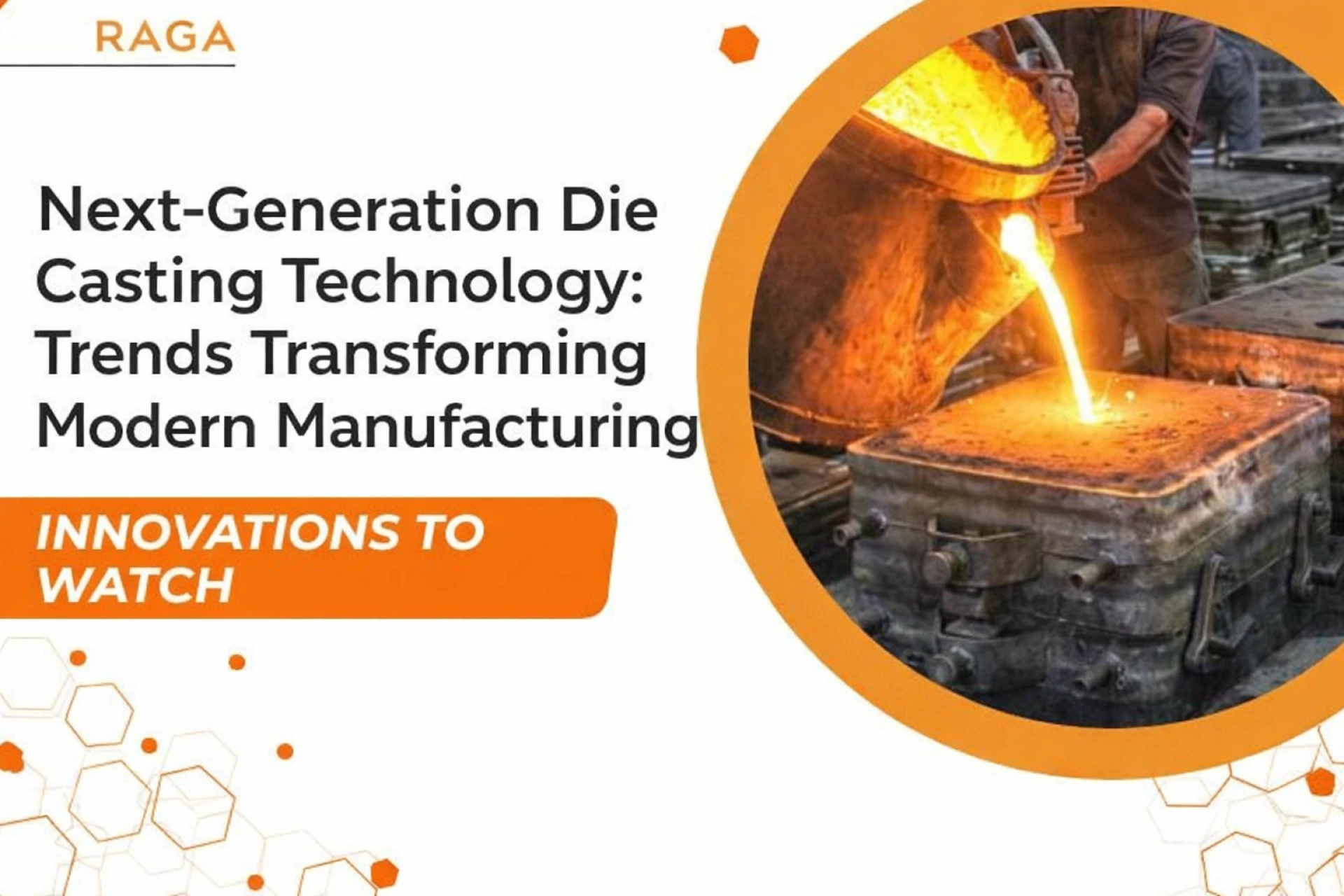

Die Casting Technology continues to evolve rapidly, playing a crucial role in the global manufacturing ecosystem. From automotive and aerospace to electronics and industrial equipment, manufacturers rely on die casting for producing precise, durable, and high-quality metal components. As innovation accelerates, the future of Die Casting Technology is being shaped by smarter processes, advanced materials, automation, and sustainability initiatives.
This article explores the key developments that are redefining die casting and how companies like RAGAGROUP are aligned with these industry-wide advancements.
Understanding Die Casting Technology
What Is Die Casting?
Die casting is a manufacturing process in which molten metal is injected into a steel mould (die) under high pressure. This method enables the production of complex shapes with tight tolerances, excellent surface finish, and consistent quality—ideal for high-volume production.
Where Is Die Casting Used?
Die Casting Technology is widely adopted across industries such as:
- Automotive (engine components, transmission parts)
- Aerospace (lightweight structural components)
- Consumer electronics (frames and housings)
- Industrial machinery and medical equipment
Its versatility makes it a backbone of modern manufacturing.
Advancements in Materials and Alloys
High-Performance Aluminium and Magnesium Alloys
New aluminium and magnesium alloys are significantly improving the strength-to-weight ratio of die-cast components. These materials offer enhanced corrosion resistance, better thermal conductivity, and reduced weight—making them ideal for electric vehicles and aerospace applications.
Composite Material Integration
Composite materials are also entering the die casting space, combining metal strength with lightweight characteristics. These materials help manufacturers achieve better performance while meeting strict efficiency and durability standards.
Innovations in High-Pressure Die Casting (HPDC)
Process Precision and Control
Modern HPDC systems provide improved control over metal flow and solidification. Optimised injection parameters help reduce defects such as porosity and shrinkage, resulting in stronger and more reliable cast parts.
Quality Improvement Techniques
Technologies like vacuum-assisted die casting and advanced cooling systems enhance part density and mechanical properties. These improvements make Die Casting Technology more reliable for critical applications.
Automation and Smart Manufacturing
Robotics in Die Casting Operations
Automation is transforming die casting facilities. Robotic systems now handle part removal, trimming, inspection, and finishing processes. This ensures consistent output quality while reducing dependency on manual labour.
Enhanced Safety and Efficiency
Automated die casting cells not only improve productivity but also create safer working environments by minimizing human exposure to high-temperature operations.
Industry 4.0 and Digital Integration
IoT and Real-Time Monitoring
Industry 4.0 has introduced smart sensors and IoT systems into Die Casting Technology. These tools monitor temperature, pressure, and cycle time in real time, enabling predictive maintenance and process optimization.
Digital Twin Applications
Digital twin technology allows manufacturers to simulate die casting operations virtually. By identifying potential issues before production, companies can reduce waste, improve efficiency, and lower operational costs.
Additive Manufacturing and Hybrid Solutions
3D Printing in Tooling
Additive manufacturing supports Die Casting Technology by enabling rapid production of mould inserts and tooling components. This reduces lead times and enhances design flexibility.
Hybrid Manufacturing Approaches
Combining die casting with 3D printing allows manufacturers to produce complex geometries that were previously difficult or impossible to achieve using traditional methods alone.
Sustainability and Eco-Friendly Practices
Energy-Efficient Manufacturing
Modern die casting machines are designed to consume less energy while maintaining high output. Optimised processes help reduce emissions and operational waste.
Use of Recycled Materials
Recycled aluminium and eco-friendly alloys are increasingly used in Die Casting Technology, supporting circular manufacturing and meeting global sustainability goals.
Conclusion
The future of Die Casting Technology is driven by innovation, precision, and sustainability. With advancements in materials, automation, digitalization, and environmentally responsible practices, the industry is becoming more efficient and future-ready. Businesses aligned with these trends—such as RAGAGROUP—are well-positioned to deliver high-quality die-cast solutions that meet evolving global demands.




















Sign in to leave a comment.