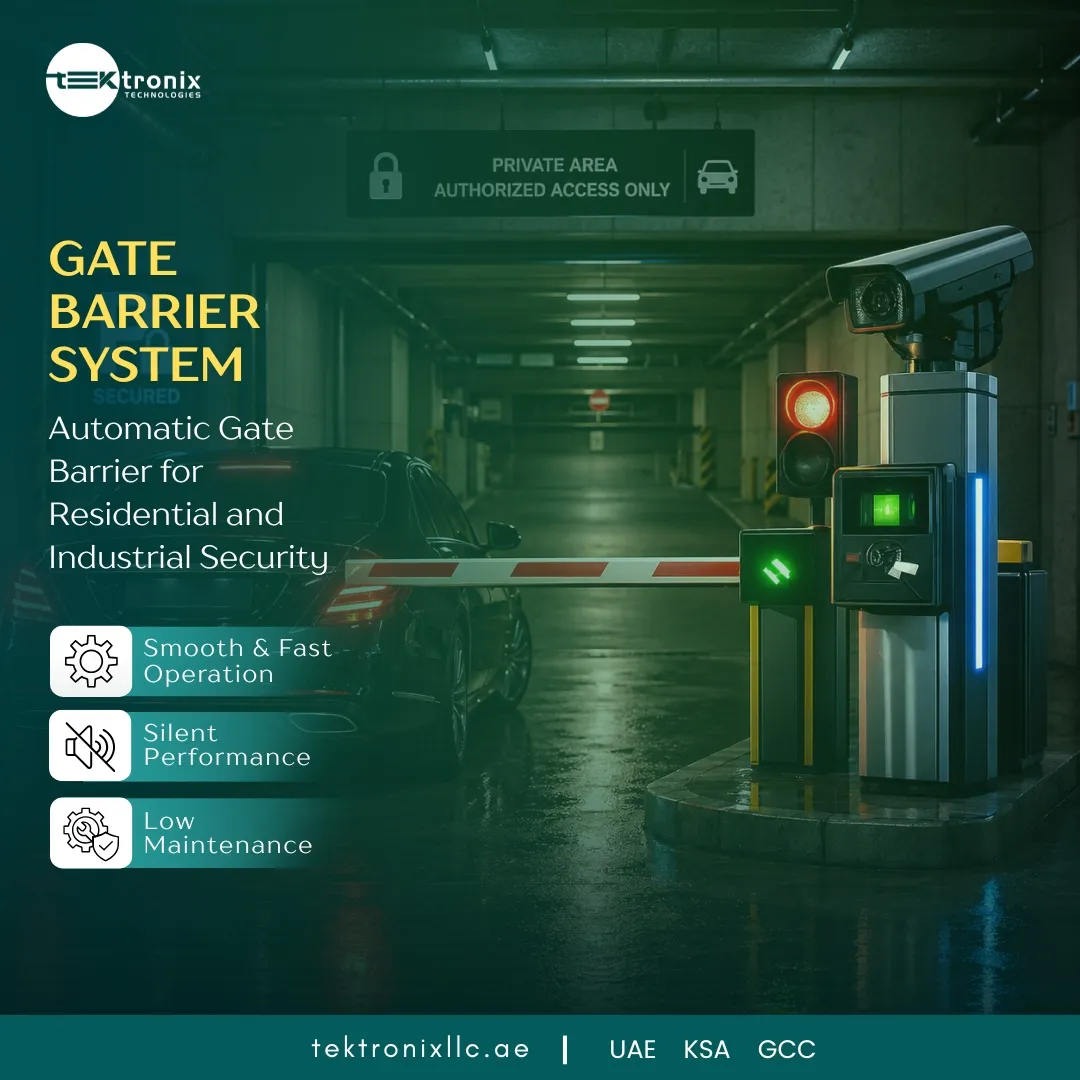

Every secure facility, commercial complex, and public infrastructure project in the UAE today relies on a reliable Gate Barrier System to manage, monitor, and control vehicular entry and exit. From the towering skyscrapers of Downtown Dubai to the sprawling industrial zones of Sharjah and the government campuses of Abu Dhabi, automated barrier technology has become the foundation of physical perimeter security across the Emirates. As the UAE accelerates its smart city agenda, the demand for advanced, AI-integrated vehicle access control solutions has grown exponentially — making it essential for businesses, developers, and facility managers to understand what these systems offer and how to deploy them effectively. 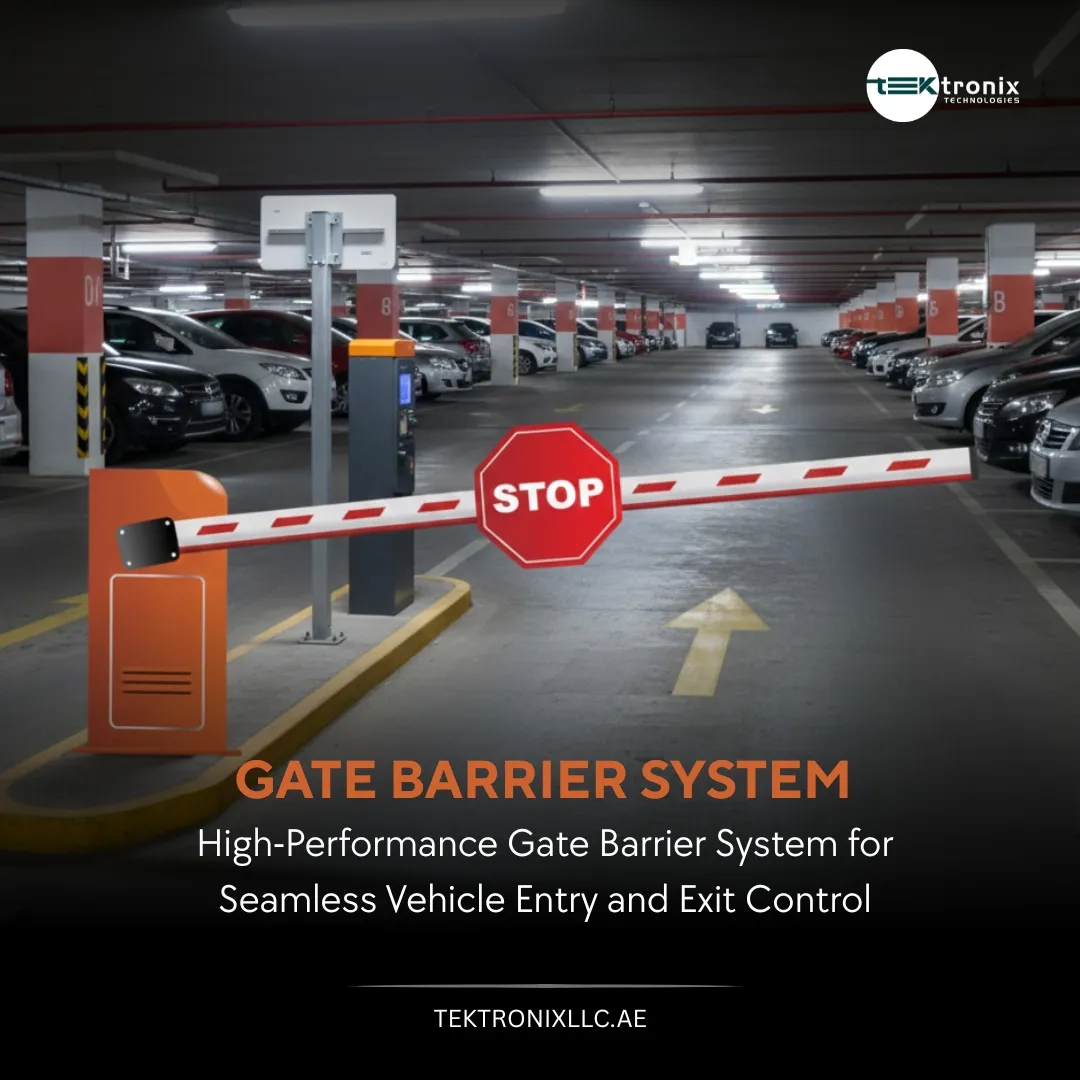
What Is a Gate Barrier System and Why Does It Matter?
A Gate Barrier System is an electromechanical access control solution that regulates the movement of vehicles at entry and exit points by deploying a motorised arm commonly called a boom or barrier arm that rises and lowers on command. These systems serve as the first physical line of defence for any secured environment, working in tandem with ANPR (Automatic Number Plate Recognition) cameras, RFID readers, intercom units, loop detectors, and centralised management software to create a fully automated vehicle access ecosystem.
Unlike pedestrian access control, vehicle barrier management must account for high-speed approach, varying vehicle dimensions, payload weight, and the need for rapid throughput in busy environments such as car parks, toll plazas, and gated communities. This makes the engineering requirements for a robust Boom Barrier System significantly more demanding than standard access control hardware. The choice of barrier type, motor power, arm length, opening speed, and safety features must all be calibrated to the specific operational context of each deployment site.
Types of Gate Barrier Systems Used Across the UAE
The UAE's diverse built environment — spanning luxury residential communities, busy commercial districts, heavy-industry zones, and critical government infrastructure — has driven demand for multiple categories of barrier technology. Understanding the differences between each type is the first step toward selecting the right solution for your facility.
Intelligent Gate Barriers
Intelligent Gate Barriers represent the most advanced tier of the access control barrier market. These systems incorporate AI-driven decision engines, real-time cloud connectivity, and multi-protocol integration capabilities. They can distinguish between authorised and unauthorised vehicles without human intervention, adapt opening and closing logic based on time-of-day schedules or occupancy thresholds, and generate live operational dashboards that give security managers complete visibility across multi-site deployments. For enterprise clients across the UAE — including free zone authorities, DEWA substations, and private hospital campuses — intelligent barriers deliver the automation and auditability that modern security governance demands.
Vehicle Access Barriers
Vehicle Access Barriers are the broadest category, covering any hardware designed specifically to stop, slow, or permit vehicular movement. This category ranges from light-duty residential barriers with 3-metre arms and 3-second cycle times to heavy-duty industrial crash-rated barriers capable of stopping a 7.5-tonne vehicle at 50 km/h. In the UAE context, vehicle access barriers are typically deployed in two configurations: single-lane (one barrier per direction) for smaller facilities, and dual-lane (paired entry and exit barriers) for high-throughput environments such as shopping mall car parks and corporate campus entrances.
Boom Barrier System
The Boom Barrier System is the most widely deployed configuration in the region, characterised by its horizontal boom arm that pivots at the pivot head to open vertically to 90 degrees. Boom barriers are valued for their compact footprint, mechanical simplicity, and proven reliability in high-cycle environments. Models rated for over three million operational cycles are available for 24/7 deployment at busy facilities. The boom arm itself can range from 3 metres to 6 metres in length and may incorporate LED lighting strips, counterweights, and articulated sections for sites where vertical clearance is limited. Modern boom barriers are also compatible with solar power systems — an increasingly popular option for outdoor UAE deployments where grid connectivity is limited.
Toll Gate Barriers
Toll Gate Barriers are engineered for the demanding, continuous-operation environments of highway toll plazas, bridge access points, and municipal road management schemes. These barriers must process thousands of vehicle transactions per hour while maintaining sub-second response times and near-zero downtime. In the UAE, the Roads and Transport Authority (RTA) and Abu Dhabi Department of Municipalities and Transport (DMT) both operate extensive tolling infrastructure — and the private facilities that connect to these networks (such as petrol stations, border crossing zones, and logistics hubs) similarly require toll-rated barrier hardware that can integrate with payment gateways and automated vehicle classification systems.
Parking Gate Barrier
The Parking Gate Barrier is perhaps the most commercially prevalent barrier type in the UAE, found at virtually every basement car park, multi-storey parking structure, and surface lot across the country. Parking barriers work in conjunction with ticketing machines, proximity card readers, UHF RFID antennas, and licence plate recognition cameras to create end-to-end parking management ecosystems. For property developers and facilities management companies, a well-designed parking barrier installation directly affects tenant satisfaction, revenue generation, and security compliance. Smart parking systems that integrate barrier control with mobile payment apps and real-time occupancy displays are becoming the expected standard for Grade-A commercial real estate across Dubai, Abu Dhabi, and Sharjah.
Gate Barrier System UAE: Nationwide Adoption and Regulatory Context
The scale of Gate Barrier System UAE deployment reflects the country's commitment to intelligent, technology-driven infrastructure. Federal-level initiatives, including the UAE Smart Government programme and individual emirate-level smart city strategies, have mandated the use of automated access control at all new government-affiliated construction projects above a defined floor area threshold. This has created a thriving market for barrier systems that meet both international safety standards (IEC 60335-2-103 for automatic doors and barriers) and UAE-specific fire and civil defence requirements issued by the Ministry of Interior.
Private sector adoption has mirrored this momentum. Insurance underwriters operating in the UAE increasingly require documented evidence of automated perimeter control — including vehicle barrier systems — as a condition of commercial property coverage. This regulatory and commercial pressure has converted what was once a discretionary investment into a baseline operational requirement for any serious business operating in the region.
Gate Barrier System Dubai: Smart Access for the World's Most Dynamic City
Dubai's position as a global business hub, luxury retail destination, and tourist gateway makes it the single largest market for Gate Barrier System Dubai deployments in the region. The city's skyline is studded with developments — from Jumeirah residential communities and DIFC financial towers to Dubai Silicon Oasis tech parks and Jebel Ali industrial free zones — each requiring a customised vehicle access strategy. Dubai Airports, which handled over 86 million passengers in its pre-pandemic peak, operates one of the most complex vehicle access management ecosystems in the world, incorporating layered barrier systems across cargo, staff, and public vehicle zones.
For corporate facilities within the emirate, the Roads and Transport Authority (RTA) smart mobility framework has created a compatible ecosystem that allows barrier systems linked to Dubai's Salik toll network and Nol card infrastructure. Tektronix Technologies has delivered barrier and access control installations across prominent Dubai locations including Business Bay, Al Quoz industrial areas, Dubai Investments Park, and multiple JLT office towers — with each project designed to meet the specific throughput, aesthetic, and integration requirements of the client.
Gate Barrier System Abu Dhabi: Securing the Capital's Critical Infrastructure
Abu Dhabi's infrastructure profile — defined by energy installations, government campuses, and flagship cultural and commercial districts — demands vehicle access solutions that combine high security with graceful integration into premium architectural environments. Gate Barrier System Abu Dhabi deployments span the full spectrum: from the high-security perimeter controls of ADNOC refineries and ADDC electrical substations, to the visitor-friendly smart parking systems at Yas Island entertainment destinations and Louvre Abu Dhabi.
The Abu Dhabi Department of Municipalities and Transport (DMT) enforces specific technical guidelines for vehicle access control at commercial and mixed-use developments within the emirate. These guidelines address arm length, safety edge specifications, loop detector placement, and emergency override requirements — all of which must be factored into system design before installation. Working with an experienced local integrator ensures compliance from the outset, avoiding costly remedial work after handover.
Gate Barrier System Sharjah: Industrial Strength Access for a Growing Economy
Sharjah's expanding manufacturing base, logistics networks, and educational institutions have created substantial demand for Gate Barrier System Sharjah solutions across the emirate. Industrial zones including SAIF Zone, Hamriyah Free Zone, and Sharjah Airport International Free Zone (SAIF) require heavy-duty barrier installations capable of managing the continuous flow of freight vehicles, container trucks, and staff cars often around the clock and seven days a week.
Educational campuses Sharjah hosts the highest concentration of universities in the UAE — present a different but equally demanding barrier application: managing thousands of student and staff vehicles during peak morning and afternoon periods while maintaining clear emergency vehicle access corridors at all times. Smart barrier systems with pre-programmed schedule logic, mobile app integration for staff pre-authorisation, and cloud-based reporting have transformed what was once a manual gatehouse function into a fully automated, data-rich access management operation.
Key Technical Features of a Modern Gate Barrier System
Selecting the right Intelligent Gate Barriers solution for your facility requires evaluating a detailed set of technical specifications. Here are the critical features that distinguish enterprise-grade barrier systems from commodity hardware:
- Opening Speed & Cycle Rate: High-traffic installations require barriers that complete a full open-close cycle in under 1.5 seconds. Industrial-rated models achieve sub-0.9-second cycles, while standard boom barriers typically operate at 3–6 seconds per cycle.
- Arm Length & Counterbalancing: Available in 3 m, 4 m, 5 m, and 6 m configurations. Longer arms require hydraulic counterbalancing or articulated arm designs to maintain structural integrity and prevent motor overload.
- Safety Systems: Mandatory in UAE deployments — includes inductive loop detectors, infrared safety beams, rubber safety edges, and anti-crushing logic to prevent the barrier arm from closing on a vehicle or pedestrian.
- ANPR & RFID Integration: Licence plate recognition cameras and UHF RFID readers provide hands-free, touchless vehicle authentication — the preferred configuration for post-COVID UAE facilities prioritising hygiene and speed.
- Power Backup & UPS Compatibility: All mission-critical UAE installations require uninterruptible power supply integration to maintain barrier operation during power outages — a civil defence and business continuity requirement.
- Remote Management & API Integration: Cloud-connected barrier controllers allow security teams to open, close, lock, and monitor barriers from any device. Open APIs enable integration with HR systems, visitor management platforms, and CCTV VMS solutions.
- Crash Rating & Anti-Ram Certification: For high-security sites — government buildings, data centres, critical national infrastructure — crash-rated barriers certified to PAS 68, IWA 14, or ASTM F2656 standards are required to stop hostile vehicle attacks.
Sector-by-Sector Applications: Where Barrier Systems Deliver the Greatest Value
Residential Gated Communities
Premium compounds and gated villa communities across Dubai, Abu Dhabi, and Sharjah use Vehicle Access Barriers integrated with intercom systems, facial recognition cameras, and resident mobile apps to create fully automated entry experiences. Visitors are pre-registered digitally, and delivery vehicles are managed through time-limited access passes — eliminating the need for a staffed guardhouse for routine access events.
Commercial & Mixed-Use Developments
Grade-A office towers, retail malls, and hospitality venues rely on Parking Gate Barrier infrastructure to manage thousands of vehicle movements daily. Integrated ticketing, payment, and occupancy management systems built around barrier hardware turn car parking into a profit centre and a measurable component of the tenant experience.
Logistics & Warehousing
Logistics hubs, customs bonded warehouses, and last-mile distribution centres use Boom Barrier System installations with ANPR-based automatic truck identification to eliminate manual check-in delays and create digital audit trails of every vehicle that enters or exits the facility — a critical requirement for clients operating under JAFZA, DAFZA, or Hamriyah Free Zone regulatory frameworks.
Government & Critical Infrastructure
Ministries, municipalities, and critical national infrastructure operators require Toll Gate Barriers and crash-rated perimeter barriers that meet the UAE Ministry of Interior's security specifications. These installations form part of a layered defence strategy that includes CCTV, access control, and manned security — with the barrier system serving as the physical enforcement layer that stops unauthorised vehicles at the perimeter.
Why Tektronix Technologies Is the UAE's Preferred Barrier System Partner
Tektronix Technologies brings over a decade of hands-on experience delivering Gate Barrier System installations across the UAE from single-barrier residential gate upgrades to multi-site, enterprise-grade vehicle access ecosystems spanning hundreds of lanes. As a UAE-licensed systems integrator with manufacturer-certified engineers and an established after-sales support infrastructure, Tektronix delivers end-to-end project ownership: site survey, system design, civil works coordination, hardware supply, software configuration, commissioning, staff training, and ongoing preventive maintenance.
The company's project portfolio spans diverse sectors including real estate development, oil and gas, healthcare, education, retail, and government with landmark installations at developments across Dubai Investment Park, Abu Dhabi's Al Reem Island, and Sharjah's SAIF Zone. Tektronix holds certified partnerships with globally recognised barrier hardware brands and maintains an in-house spare parts inventory to guarantee rapid response times typically under 4 hours for critical system faults within Dubai and Abu Dhabi.
Tektronix Technologies holds all relevant UAE trade licences for the supply and installation of electromechanical security systems. The company's engineering team carries manufacturer-level product certifications and has completed projects for client’s subject to UAE Civil Defence, MOI, and free zone authority approval requirements. Client references, project case studies, and technical product datasheets are available on request.
Conclusion
The UAE's relentless pace of urban development, its world-class infrastructure ambitions, and its increasingly sophisticated security standards have made the Gate Barrier System an indispensable component of modern facility management. Whether you are managing a luxury residential compound in Dubai, a government campus in Abu Dhabi, a logistics hub in Sharjah, or a high-footfall commercial development anywhere across the Emirates, the right vehicle access barrier solution will improve security, operational efficiency, and the overall experience of everyone who enters your facility.
From standard Boom Barrier System installations for car parks to crash-rated Intelligent Gate Barriers for critical infrastructure — the breadth of available technology means there is a solution precisely matched to every operational environment and budget. The key is partnering with a UAE-experienced integrator who can translate your site's specific requirements into a system that works reliably, integrates seamlessly, and continues to perform for years to come.
FAQs
1. What is the difference between a Boom Barrier System and an Intelligent Gate Barrier?
A Boom Barrier System refers specifically to the mechanical configuration — a motorised pivot unit that raises and lowers a horizontal arm to control vehicle passage. Intelligent Gate Barriers is a broader functional category that describes barriers — which may be boom-type, rising kerb, or sliding gate — equipped with AI decision engines, real-time cloud connectivity, ANPR integration, and advanced analytics. In essence, all intelligent barriers have a physical barrier mechanism, but not all boom barriers are intelligent. For high-security or high-throughput UAE sites, the intelligent variant is the recommended choice as it minimises human intervention, generates audit data, and can adapt access rules dynamically without on-site reconfiguration.
2. How long does it take to install a Gate Barrier System in a UAE facility?
Installation timelines for a Gate Barrier System UAE deployment vary significantly by scope. A standard single-lane Parking Gate Barrier with a pre-wired electrical supply and existing loop detector conduits can typically be installed, configured, and commissioned in one to two days. A full multi-lane enterprise installation — incorporating ANPR cameras, server-based management software, UPS systems, and integration with existing building management or HR platforms — typically requires two to six weeks, depending on civil works readiness and IT infrastructure availability. Engaging a systems integrator early in the design stage of a new development is the most cost-effective approach, as it allows barrier infrastructure to be incorporated into the structural MEP drawings from the outset.
3. Are Toll Gate Barriers and Parking Gate Barriers the same technology?
They share core mechanical principles but are engineered for very different operational profiles. Toll Gate Barriers are designed for maximum throughput — processing hundreds or thousands of vehicles per hour continuously — and must integrate with payment systems, vehicle classification sensors, and RTA or DMT-regulated tolling protocols. They are typically rated for millions of operational cycles and require minimal downtime for maintenance. Parking Gate Barrier systems prioritise integration with ticketing, payment terminals, occupancy sensors, and revenue management software, and are designed for car park-specific traffic patterns where vehicles stop, collect/validate a ticket, and then proceed. While both use boom arms, their motor ratings, controller architecture, and software integration layers differ substantially.
4. What safety standards apply to Vehicle Access Barriers installed in the UAE?
All Vehicle Access Barriers installed in the UAE must comply with IEC 60335-2-103, the international standard for the safety of electric automatic door and barrier systems. Additionally, installations must meet UAE Civil Defence requirements for emergency access override — typically a manual release mechanism and a designated emergency vehicle lane or fail-safe open configuration. For high-security sites, crash-rated barriers must carry certification to PAS 68 (UK), IWA 14-1 (ISO), or ASTM F2656 (USA) standards, which are internationally recognised and accepted by UAE government and free zone authorities. Free zone operators such as JAFZA, DAFZA, and KIZAD may impose additional technical requirements that supplement national standards.
5. Can a Gate Barrier System be integrated with existing CCTV and access control systems in Dubai, Abu Dhabi, or Sharjah?
Yes — and this integration is strongly recommended for any UAE facility seeking to create a unified security operations posture. Modern Gate Barrier System Dubai, Gate Barrier System Abu Dhabi, and Gate Barrier System Sharjah installations routinely interface with ONVIF-compatible IP cameras, Wiegand or OSDP access control panels, HR and visitor management platforms, and building management systems via open REST APIs or manufacturer SDKs. This integration enables automated workflows — for example, an ANPR camera identifies a registered vehicle, the barrier opens automatically, and the access event is simultaneously logged in the HR system and flagged on the CCTV VMS. For facilities with existing legacy hardware, Tektronix Technologies' engineering team conducts compatibility assessments to determine the optimal integration path without requiring a complete infrastructure replacement.






























Sign in to leave a comment.