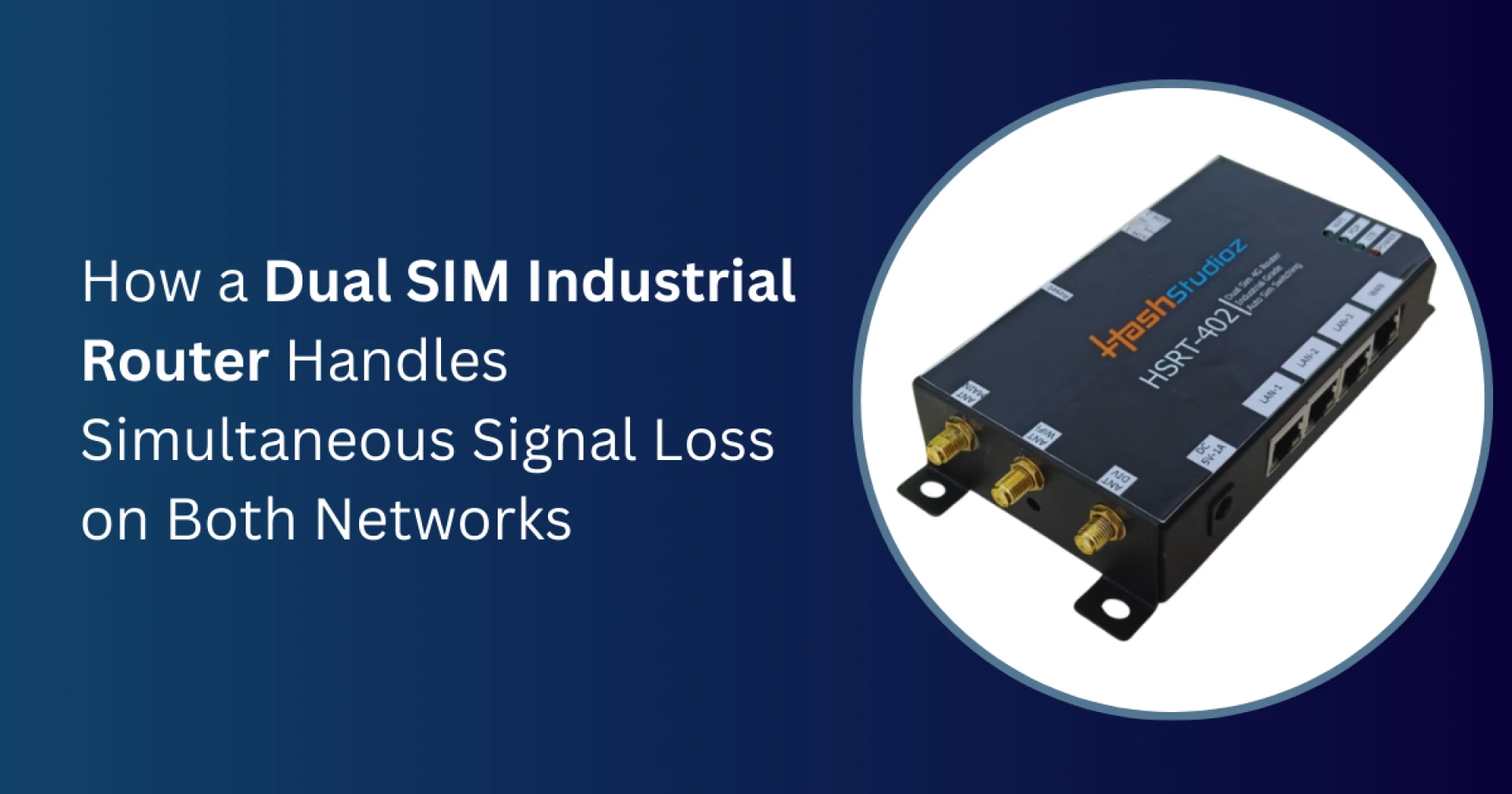

Industrial networks rely on strong connectivity. Applications such as remote monitoring, SCADA systems, and automation depend on continuous data flow. Network outages can cost significant time and money. For example, unplanned downtime in industrial environments can cost anywhere from USD 5,000 to USD 50,000 per minute depending on the sector and severity of outage.
To improve reliability, many deployments use devices like a Dual SIM Industrial Router or Dual SIM 4G LTE Industrial Router. These devices maintain two separate cellular links to avoid single points of failure. But what happens when both cellular links lose signal at once? Can the system still operate? How does the router behave? This article answers these questions from a technical perspective.
Understanding Dual SIM Routers and Failover
1. What Is a Dual SIM Industrial Router?
A Dual SIM Industrial Router is a connectivity device designed for mission-critical environments. It supports two SIM cards connected to different network operators. The router continuously monitors both links. If the primary network fails, traffic shifts to the secondary path automatically. This provides redundancy and improves overall reliability.
A Dual SIM 4G LTE Industrial Router specifically uses 4G LTE cellular networks. It combines industrial-grade hardware with advanced failover logic to keep systems connected even under adverse conditions.
2. Why Dual SIM Matters
Industrial sites often face varied network challenges:
1. Remote locations with weak signal: Industrial sites in remote areas often suffer inconsistent cellular coverage. Dual SIM routers automatically switch networks, maintaining connectivity when one carrier’s signal drops or becomes unreliable.
2. Network congestion: During peak usage hours, cellular networks may become congested, increasing latency or packet loss. Dual SIM capability enables seamless failover to a less congested network, preserving performance.
3. Scheduled maintenance by carriers: Mobile operators regularly perform maintenance that can temporarily disrupt service. Dual SIM routers minimize downtime by switching to an alternate carrier without manual intervention or system restart.
4. Harsh weather or physical interference: Extreme weather, electromagnetic interference, or physical obstructions can degrade signal quality. Dual SIM devices improve resilience by selecting the network with better real-time conditions.
These issues can degrade or cut off connectivity temporarily. Dual SIM routers handle such disruptions better than single-SIM devices.
Standard Failover Mechanisms
Before addressing simultaneous dual network loss, let’s overview how redundancy normally works.
1. Continuous Health Monitoring
Continuous health monitoring allows the router to regularly evaluate each cellular link using metrics such as ICMP ping success, latency, packet loss, and signal quality indicators like RSSI and SINR. These ongoing checks enable the router to detect whether a connection is healthy or degraded and respond appropriately to maintain reliable connectivity.
2. Automatic Failover
When the router detects that the primary link fails or degrades beyond a threshold, it switches to the backup SIM. The process is automatic and requires no human action. Some industrial routers can switch in under 300 milliseconds.
3. Optional Load Balancing
Advanced models allow both SIMs to be active and distribute traffic based on policies. This reduces load on any single network and improves overall throughput.
Simultaneous Loss on Both Networks: What Happens?
Simultaneous signal loss on both SIMs is rare, but real. It can occur due to:
- Large regional outages
- Severe weather affecting multiple towers
- Electromagnetic interference
- Natural disasters
- Backhaul failures on multiple operators
In such cases, the router must transition from failover logic to outage management behavior.
Outage Detection and Response
1. Link Status Failure Detection
When the router loses signal on both SIMs, both health checks will fail. The router enters a full outage state. In this state, the router generally performs these actions:
- Marks both links as unavailable
- Stops traffic routing
- Initiates reconnection attempts
- Logs diagnostics for later analysis
2. Event Logging and Notification
Industrial routers record failure events. Many also send alerts to central management systems. These logs include:
- Time of failure
- Duration of outage
- Signal levels before and after loss
This helps engineers diagnose network issues later.
3. Local Traffic Retention and Caching
While both links are down, routers may buffer critical data locally. This prevents data loss and allows transmission when a connection returns.
Example: A remote sensor cluster may cache measurement data for several minutes if the router detects a connectivity outage.
4. Retry Logic and Backoff
Routers implement controlled reconnection behavior. They periodically check for restored signal rather than trying constantly. Different routers use various backoff strategies such as:
- Fixed interval retries
- Exponential backoff
- Priority checks for specific carriers
These strategies reduce unnecessary overhead during prolonged outages.
Strategies to Manage Dual Network Outages
Since a Dual SIM Industrial Router cannot create connectivity, engineers design systems to reduce the impact of total network loss. Common strategies include:
1. Tertiary Backup Connections
In addition to dual cellular links, tertiary backup connections such as wired broadband, satellite, LoRaWAN, or private LTE/5G networks can be used to improve resilience. These alternative paths ensure continued communication when both primary cellular connections fail. For example, oil pipeline remote monitoring systems often rely on satellite links as a backup when carrier networks are unavailable, ensuring uninterrupted monitoring in isolated areas.
2. Edge Computing for Local Decisions
During network outages, edge hardware can continue making local decisions to maintain operations. Local PLCs keep automation tasks running, alarm thresholds trigger on-site responses, and local UI panels allow operators to work offline. This significantly reduces reliance on centralized systems when connectivity is lost.
3. Network Diversity Planning
Using SIMs from carriers with very different infrastructure patterns minimizes simultaneous outages. Carrier diversity reduces the statistical chance of correlated failures affecting both networks.
4. Intelligent Policies for Failback
When both links recover, routers must intelligently decide which connection to activate. Policies may prioritize the fastest link, select the lowest-cost option, or retain the last known good link until signal quality improves. These strategies prevent oscillation and unnecessary switching.
Technical Example: Water Treatment Monitoring
A water treatment facility deployed a Dual SIM 4G LTE Industrial Router to connect its remote pump sensors.
After deployment:
1. Network uptime improved to 99.8%.
2. The router switched automatically between carriers during poor coverage windows.
3. On two occasions, both carriers lost coverage due to tower maintenance. During these periods:
- Data was buffered locally for 8 minutes.
- Once carriers restored signal, the buffered data uploaded automatically.
This behavior demonstrates how routers manage outages and ensure minimal data loss.
Design Considerations for Extreme Outages
Engineers must design with full outage scenarios in mind. Key technical concerns include:
1. Session Persistence
Protocols such as TCP rely on continuous connectivity, so network failures require careful session handling by routers. Connections must be cleanly terminated and gracefully reestablished once connectivity returns. Some systems use dynamic DNS or virtual IP addresses to simplify reconnections and maintain application continuity after outages.
2. Security During Outage
Even when offline, routers must continue enforcing firewall rules, securely storing VPN credentials, and protecting internal networks from exposure. Industrial routers typically include built-in firewalls, VPN support, and encrypted communication layers to maintain security at all times.
Reliability Metrics and Industrial Stats
Industry data shows how redundancy helps:
1. Dual SIM redundancy can cut communication downtime by up to 80% compared with single SIM setups.
2. Industrial cellular connectivity uptime frequently exceeds 99.99% with dual network paths.
3. The industrial cellular router market is expected to grow from USD 0.9 B in 2023 to USD 2.1 B by 2028 at a CAGR of 18.5% as dual SIM features become standard.
These stats highlight why industrial planners prefer dual connectivity.
Conclusion
A Dual SIM Industrial Router, particularly a Dual SIM 4G LTE Industrial Router , greatly enhances network reliability by automatically switching traffic when one network fails. However, simultaneous outages on both networks can still occur. In such cases, the router detects failures on both paths, logs event details, attempts reconnection intelligently, and buffers critical data locally. Engineers mitigate these scenarios by implementing additional backup connections, edge logic, and intelligent policies, ensuring that industrial systems continue operating with minimal data loss or disruption even during total cellular outages.





























Sign in to leave a comment.