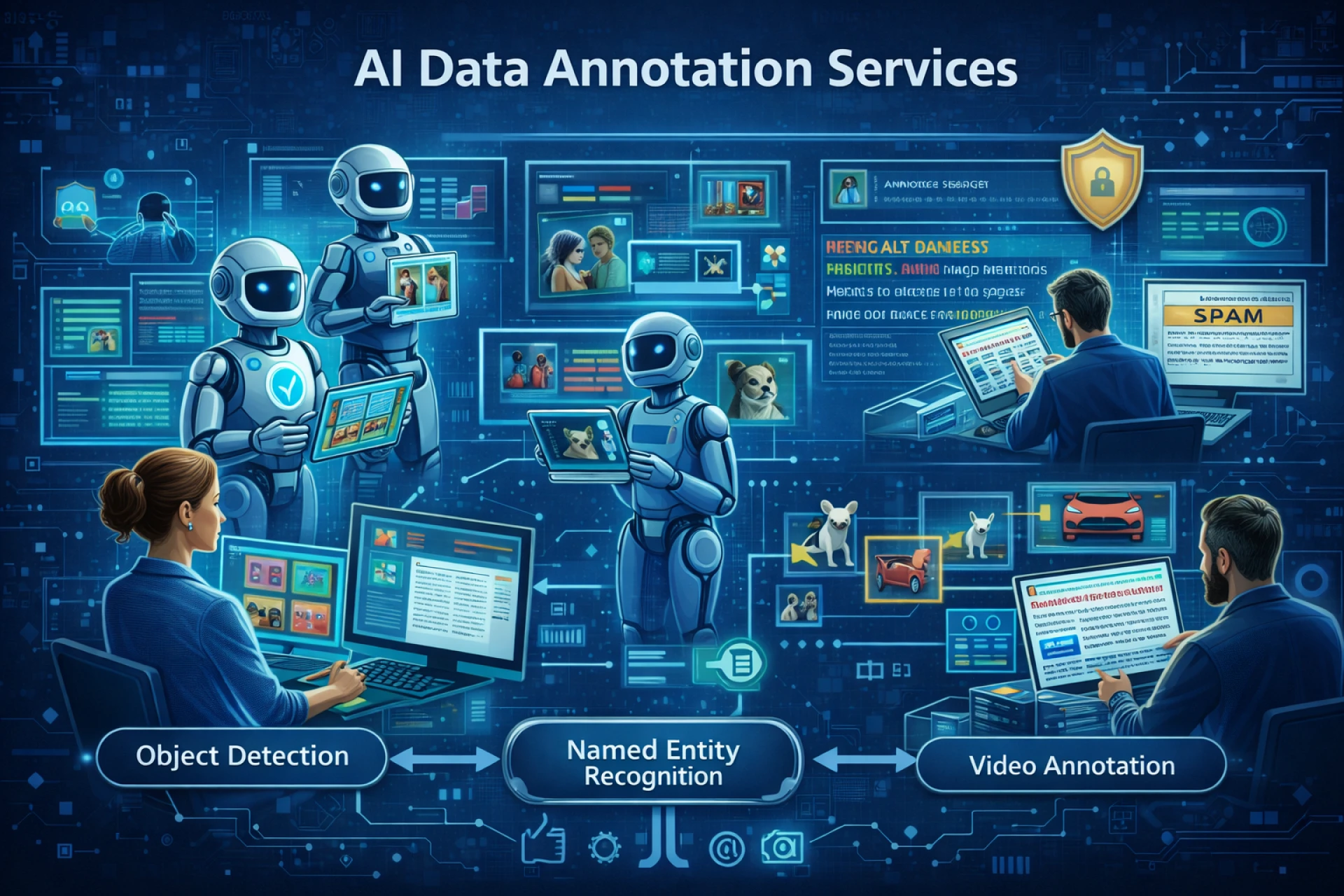

How AI Data Collection Companies Solve the Biggest AI Data Challenges
AI Data Collection Company services have become a crucial part of modern artificial intelligence development. As organizations across industries adopt AI technologies, the need for high-quality datasets has increased significantly. From autonomous vehicles to conversational assistants and healthcare analytics, AI systems depend heavily on accurate and diverse data to perform effectively.
However, collecting and preparing data for AI models is far more complex than simply gathering large volumes of information. Companies face several major challenges, including data scarcity, bias in datasets, scalability limitations, and strict privacy regulations. These challenges can significantly affect the performance, fairness, and reliability of AI systems.
An experienced AI Data Collection Company helps organizations overcome these barriers by designing structured data pipelines, sourcing diverse datasets, ensuring compliance with regulations, and scaling data collection efficiently. By combining human expertise with advanced tools, these companies transform raw information into valuable training datasets that power modern AI systems.
In this article, we explore how AI data collection providers address the biggest challenges in the AI ecosystem and why their role is becoming increasingly important in building reliable and responsible AI technologies.
Why AI Development Depends on Quality Data
Artificial intelligence models learn from examples. The quality, diversity, and structure of those examples directly determine how well the AI system performs in real-world situations. Machine learning algorithms analyze patterns within training datasets to make predictions, recognize objects, understand language, or automate decisions.
An AI Data Collection Company plays a key role in preparing these datasets. Instead of relying on unstructured or incomplete information, organizations require carefully curated datasets that represent real-world conditions. This often includes collecting data from multiple sources, cleaning it, annotating it, and validating its accuracy.
For instance, voice assistants require audio datasets containing various accents and languages. Computer vision systems rely on millions of labeled images and videos showing objects in different environments. Natural language processing models depend on massive text datasets that reflect diverse writing styles and cultural contexts.
Without proper data preparation, AI systems may produce unreliable outputs or fail to perform effectively in new situations. This is why companies developing AI products increasingly rely on specialized data collection partners.
How Data Scarcity Impacts AI Projects
One of the biggest challenges in AI development is data scarcity. While large amounts of digital data exist, not all of it is suitable for training machine learning models. In many cases, the required data simply does not exist in sufficient quantity or quality.
For example, a healthcare AI system designed to detect rare diseases may struggle because very few medical images or patient records are available for training. Similarly, autonomous vehicle systems require large datasets of uncommon road scenarios such as extreme weather conditions or rare traffic incidents.
An AI Data Collection Company helps solve this problem by designing targeted data acquisition strategies. These strategies may involve collecting new data from real-world environments, crowdsourcing data from global contributors, or generating synthetic datasets that simulate rare scenarios.
Data augmentation techniques are also commonly used. These methods create variations of existing data, allowing AI models to learn from a broader set of examples. By addressing data scarcity, AI developers can build models that perform more accurately and reliably.
Reducing Bias in AI Training Data
Bias in AI datasets is a major concern for organizations deploying artificial intelligence systems. If training data lacks diversity, the resulting AI models may produce unfair or inaccurate outcomes.
For example, facial recognition systems trained primarily on limited demographic groups may struggle to recognize individuals from underrepresented populations. Similarly, language models trained on biased text sources may generate outputs that reflect those biases.
An AI Data Collection Company helps reduce these risks by carefully designing datasets that represent diverse populations, environments, and use cases. Data diversity is essential for creating AI systems that perform consistently across different regions and demographics.
Quality control processes also play a vital role in bias reduction. Data collection teams analyze datasets to identify imbalances or missing categories and adjust the dataset accordingly. Human reviewers may also evaluate AI outputs during training to ensure fairness and accuracy.
By addressing bias early in the development process, organizations can build AI systems that are more inclusive and trustworthy.
Scaling AI Datasets for Large Models
Modern AI models require enormous amounts of training data. Large language models, computer vision systems, and recommendation engines often rely on datasets containing millions or even billions of data points.
Scaling datasets to this level presents both technical and logistical challenges. Collecting data from multiple sources, maintaining consistency, and ensuring quality across large datasets can be extremely complex.
An AI Data Collection Company provides the infrastructure and expertise needed to scale data collection efficiently. These companies often use distributed workforces, automated labeling tools, and cloud-based data management platforms to handle large volumes of data.
Scalable data pipelines allow organizations to continuously collect, process, and update datasets as AI systems evolve. This ensures that models remain accurate and up to date as new information becomes available.
Scalability is especially important for industries such as autonomous vehicles, e-commerce, and digital assistants, where AI systems must adapt to rapidly changing environments.
Ensuring Data Privacy and Regulatory Compliance
Another major challenge in AI development is protecting sensitive information. Many datasets used for AI training contain personal or confidential data, which must be handled carefully to comply with privacy laws.
An AI Data Collection Company must follow strict data protection guidelines when gathering and processing information. These guidelines vary by region but typically require organizations to safeguard personal data and obtain proper consent from individuals.
Data anonymization is one of the most common techniques used to protect privacy. This process removes identifiable information from datasets before they are used for training AI models.
Encryption, access controls, and secure storage environments also help ensure that sensitive data remains protected. Organizations must implement these security measures to comply with regulations such as GDPR in Europe or other global privacy standards.
By prioritizing privacy and compliance, AI data providers help organizations build trustworthy AI systems while avoiding legal risks.
Key Challenges and Solutions in AI Data Collection
| AI Data Challenge | Impact on AI Systems | How AI Data Collection Companies Solve It |
| Data scarcity | Limited model accuracy | Targeted data acquisition and synthetic datasets |
| Dataset bias | Unfair or inaccurate predictions | Diverse data sourcing and quality audits |
| Scalability issues | Difficulty training large models | Automated pipelines and distributed data teams |
| Privacy concerns | Legal and compliance risks | Data anonymization and secure data frameworks |
The Growing Importance of Data Infrastructure
As artificial intelligence continues to expand across industries, the infrastructure required to support data collection is becoming increasingly sophisticated. Organizations must manage vast amounts of information while maintaining high standards for accuracy, privacy, and security.
An AI Data Collection Company typically provides end-to-end solutions that include data sourcing, annotation, validation, and dataset management. These services allow businesses to focus on building AI models while ensuring that their training data remains reliable and compliant.
Advanced technologies such as automated annotation tools, synthetic data generation, and AI-assisted data labeling are also improving efficiency. These innovations help reduce the time and cost required to build large datasets.
The combination of human expertise and automation is shaping the future of AI data pipelines.
Final Thoughts
Artificial intelligence systems are only as powerful as the data used to train them. While AI technologies continue to evolve, the challenges associated with data collection remain complex and multifaceted. Data scarcity, dataset bias, scalability limitations, and privacy regulations all influence the success of AI projects.
An AI Data Collection Company plays a vital role in addressing these challenges by providing structured data pipelines, diverse datasets, and robust compliance frameworks. These services enable organizations to build AI models that are accurate, fair, and scalable.
As industries increasingly rely on data-driven technologies, the demand for specialized data collection expertise will continue to grow. Companies that invest in high-quality data infrastructure today will be better positioned to develop intelligent systems that deliver meaningful real-world impact.
FAQs
What does an AI data collection company do?
An AI Data Collection Company gathers, prepares, and manages datasets used to train artificial intelligence models across applications such as computer vision, natural language processing, and speech recognition.
Why is data collection important for AI systems?
AI models learn from data. High-quality datasets help machine learning algorithms recognize patterns, improve predictions, and perform accurately in real-world environments.
How do AI data providers reduce bias in datasets?
They collect data from diverse sources, review dataset distribution, and conduct quality checks to ensure that training data represents multiple populations and scenarios.
What types of data are collected for AI training?
Common types include images, videos, text, audio recordings, sensor data, and structured datasets used for machine learning models.
How do AI data collection companies handle privacy concerns?
They use techniques such as data anonymization, encryption, secure storage systems, and strict access controls to protect sensitive information.
Can AI models be trained without large datasets?
Small datasets can be used for certain applications, but most advanced AI systems require large and diverse datasets to achieve high accuracy.
What industries benefit from AI data collection services?
Industries such as healthcare, automotive, finance, retail, robotics, and technology rely heavily on data collection services to build and improve AI systems.























Sign in to leave a comment.