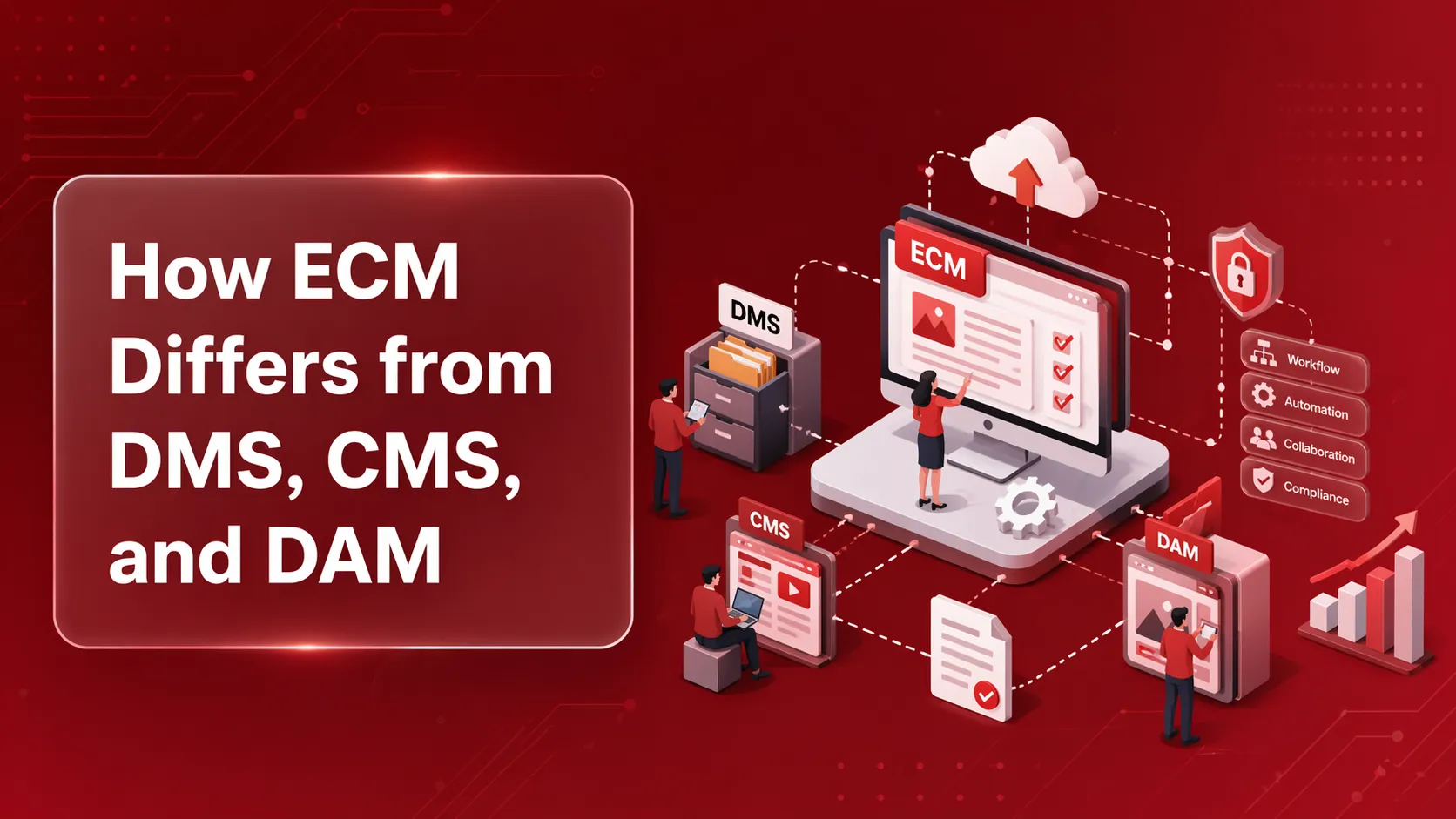

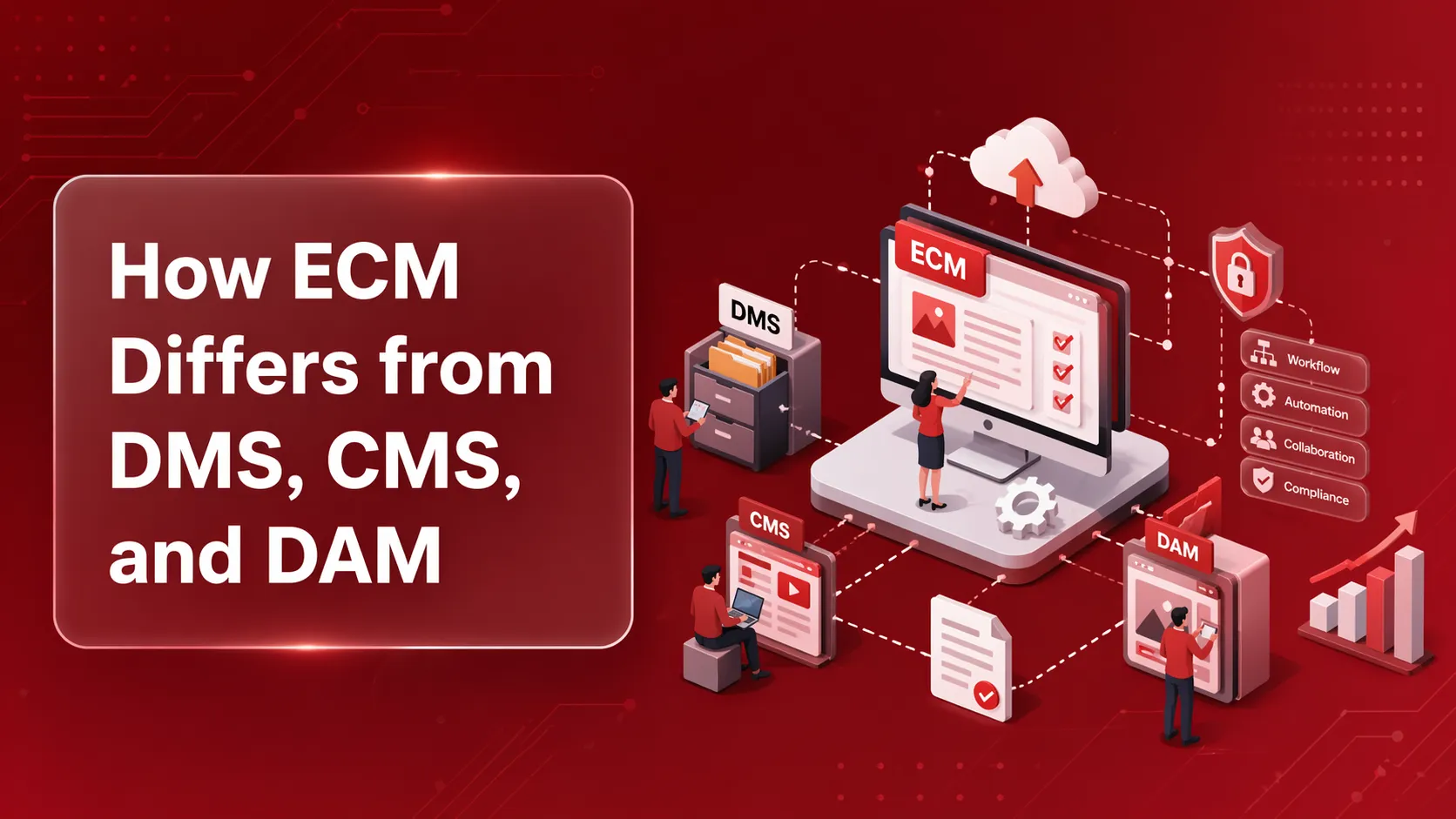
Enterprise Content Management (ECM) is often confused with Document Management Systems (DMS), Content Management Systems (CMS), and Digital Asset Management (DAM). While all four deal with content, they serve very different purposes. ECM acts as an overarching system that manages all types of organisational content across its entire lifecycle, from creation to storage, processing, compliance, and disposal. In contrast, DMS focuses on document storage, CMS handles web content publishing, and DAM manages rich media like images and videos. In short, ECM is the broadest and most strategic approach, while the others are specialised tools within that ecosystem.
Understanding ECM: The broader framework
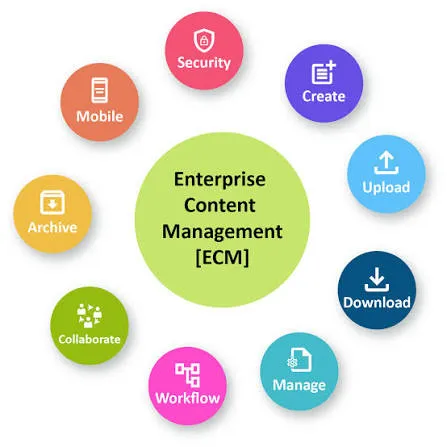
ECM is designed to manage enterprise-wide content across departments, systems, and processes. It does not focus on a single type of content or a single function. Instead, it integrates multiple capabilities into one unified platform.
An ECM system typically includes:
- Document and records management
- Workflow automation
- Content classification using metadata
- Compliance and retention policies
- Audit trails and governance
- Integration with ERP, CRM, and business applications
The goal is not just to store content but to control how it flows, who accesses it, and how it supports business operations.
What is DMS, and how does it differ from ECM
A Document Management System (DMS) focuses specifically on managing documents such as PDFs, Word files, spreadsheets, and scanned records.
What DMS does well:
- Stores documents in a central repository
- Tracks versions and revisions
- Enables search and retrieval
- Supports basic approval workflows
Where DMS falls short:
DMS typically lacks advanced capabilities for enterprise-wide governance, integration, and lifecycle automation. It handles documents well but does not manage broader content types or complex workflows across multiple systems.
Key difference:
- DMS = Document storage and retrieval
- ECM = Full lifecycle management of all enterprise content
Think of DMS as a subset of ECM.
What is CMS, and how does it differ from ECM
A Content Management System (CMS) is designed to create and manage website content. It is commonly used by marketing and content teams.
What CMS focuses on:
- Web page creation and editing
- Blog publishing
- Media uploads
- Website design and templates
- Content scheduling
Limitations of CMS:
CMS platforms are not built for managing internal documents, compliance workflows, or enterprise-level governance.
Key difference:
- CMS = Front-end content publishing
- ECM = Back-end content control and governance
CMS helps you communicate with your audience. ECM helps you manage your internal operations.
What is DAM, and how does it differ from ECM
Digital Asset Management (DAM) systems specialise in managing rich media files such as images, videos, audio files, and design assets.
What DAM does well:
- Organises large volumes of media files
- Provides tagging and categorisation
- Supports preview and rendering
- Manages usage rights and licensing
- Enables sharing across marketing teams
Limitations of DAM:
DAM systems focus only on digital assets and do not manage documents, workflows, or compliance processes across the enterprise.
Key difference:
- DAM = Media asset management
- ECM = Enterprise-wide content and process management
DAM can be a component within an ECM strategy, especially for marketing-heavy organisations.
How these systems fit together
Rather than replacing one another, DMS, CMS, and DAM often coexist within a broader ECM ecosystem.
Here’s how they typically align:
- CMS handles website and external content
- DAM manages digital media assets
- DMS manages structured documents
- ECM integrates all of them and governs the entire lifecycle
In mature organisations, ECM serves as the backbone connecting these systems and ensuring consistency, security, and compliance.
Why ECM is becoming essential for modern enterprises
As organisations grow, content becomes more complex. Documents, emails, media files, and data are spread across multiple systems, creating inefficiencies and risks.
Without ECM, businesses often face:
- Duplicate or outdated content
- Lack of visibility into document status
- Manual and delayed workflows
- Compliance and audit challenges
- Security risks due to poor access control
- Fragmented systems that don’t communicate
ECM addresses these challenges by centralising content management and automating processes.
At this stage, organisations often engage expert enterprise content management consulting to design a unified strategy that aligns with their operational goals and regulatory requirements.
A well-implemented ECM solution eliminates silos and ensures that content flows efficiently across departments.
Practical examples to clarify the difference
Scenario 1: Contract management
- DMS stores contract files
- CMS publishes contract-related content externally
- DAM stores contract-related visuals or branding assets
- ECM manages the entire lifecycle from drafting and approval to renewal and archiving
Scenario 2: Marketing operations
- CMS manages website content
- DAM stores images and videos
- DMS stores campaign documentation
- ECM connects all content with workflows, approvals, and compliance tracking
Scenario 3: Compliance and audits
- DMS provides document access
- ECM ensures audit trails, version history, and retention policies
Only ECM delivers the level of control required for regulatory environments.
Choosing the right approach for your business
The choice between ECM, DMS, CMS, and DAM depends on your business needs.
- If your focus is on website content - CMS
- If your focus is on document storage - DMS
- If your focus is on media assets - DAM
- If your focus is enterprise-wide content control - ECM
- Most growing organisations eventually need ECM because it provides a unified approach to managing all types of content.
Final thoughts
- Understanding the differences among ECM, DMS, CMS, and DAM is critical to building a scalable digital strategy. While each system has its role, ECM stands out as the most comprehensive solution, bringing together content, workflows, compliance, and governance within a single framework.
For organisations aiming to improve efficiency, reduce risk, and scale operations, ECM is not just an upgrade; it’s a strategic necessity.






















Sign in to leave a comment.