
By the Engineering Team at Butler Technologies, Inc.
In the world of product design, "touch" is usually binary. A button is either pressed (On) or not pressed (Off).
But the real world isn't binary. It is analog.
A musician doesn't just press a piano key; they strike it with intensity. A warehouse robot doesn't just grab a box; it needs to know if it is gripping too hard. A hospital bed needs to know not just if a patient is there, but how their weight is distributed to prevent bedsores.
To capture this nuance, engineers rely on Force Sensing Resistors (FSRs).
Unlike bulky load cells or strain gauges, FSRs are paper-thin, flexible, and surprisingly cost-effective. But how do they actually translate physical pressure into digital data? Here is the engineering breakdown of the technology we print every day at Butler Technologies.
The Physics: "The Harder You Press, The Easier It Flows"
At its simplest, an FSR is a variable resistor.
Think of a water hose with a kink in it. When the hose is kinked (no pressure), no water flows. As you un-kink it (apply pressure), water starts to rush through.
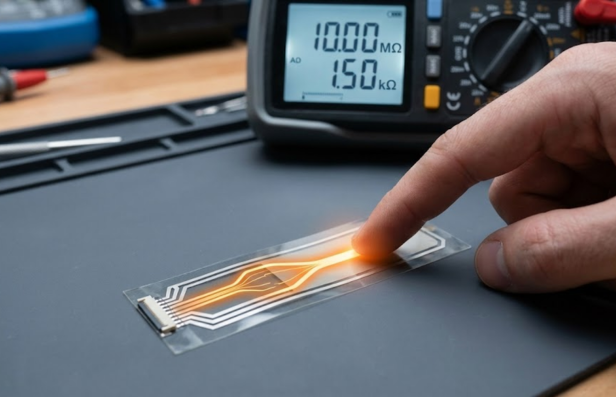
- No Touch (High Resistance): In its resting state, the FSR acts as an open circuit. It has near-infinite electrical resistance (millions of Ohms). No current can pass.
- Touch (Low Resistance): As force is applied to the sensor, the resistance drops dramatically.
- Max Pressure: At full saturation, the resistance is nearly zero, allowing maximum current to flow.
This inverse relationship (Force ↑ = Resistance ↓) allows a microcontroller to read the voltage change and determine exactly how hard the user is pressing.
The Anatomy: Inside a Printed FSR
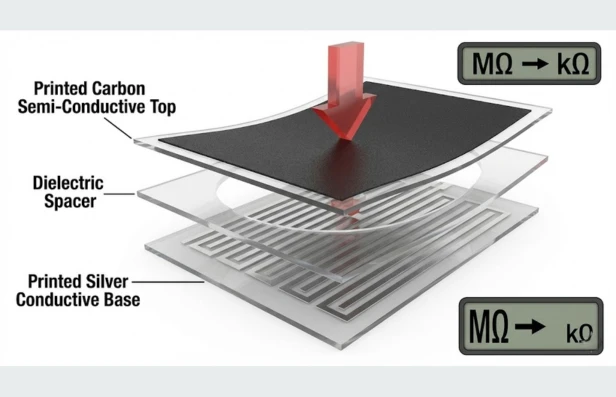
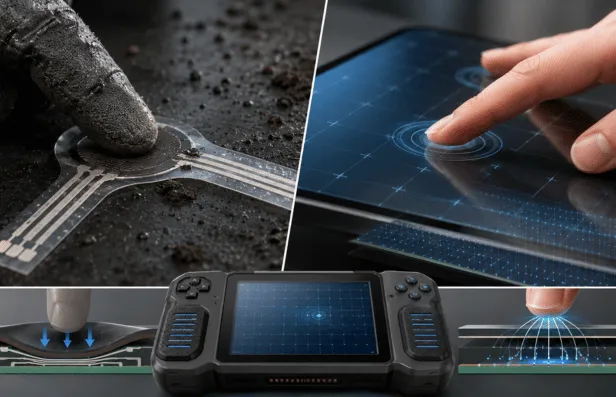
While they function like complex sensors, the construction of a printed FSR is elegant. It is typically a "sandwich" of two thin polymer films (usually PET) separated by a spacer.
1. The Conductive Base (The Fingers)
On the bottom layer, we screen print a specific pattern of conductive silver ink. This usually looks like a set of interdigitating fingers (two combs facing each other but not touching).
2. The Semi-Conductive Top (The Ink)
On the top layer, we print a proprietary carbon-based ink. This ink is unique—it is resistive but conductive on a microscopic level.
3. The Actuation
When you press down on the sensor:
- The top carbon layer is pushed down through the spacer.
- It bridges the gap between the silver "fingers" on the bottom layer.
- The more surface area of carbon that touches the silver, the more conductive pathways are created, and the lower the resistance becomes.
FSR vs. Load Cell: Which Do You Need?
A common question we receive at BTI is: "Should I use a printed FSR or a traditional Load Cell?"
The answer depends on whether you need Precision or Detection.
Choose a Load Cell If:
You need a precise scale. (e.g., "This package weighs exactly 4.52 lbs"). Load cells are highly linear and accurate, but they are heavy, rigid, and expensive.
Choose a Printed FSR If:
You need to detect presence, relative force, or need a thin form factor. (e.g., "Is the user gripping the drill handle?" or "Is the patient leaning too far to the left?").
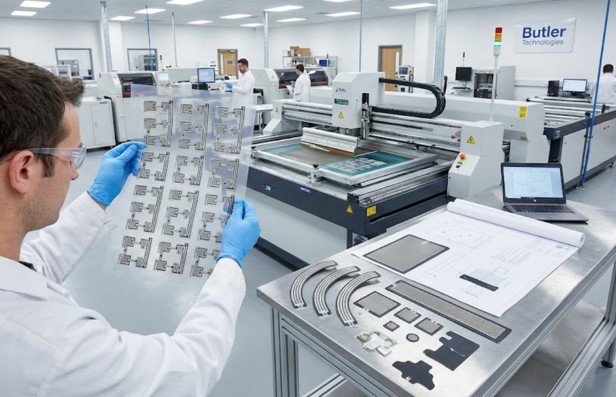
- The BTI Advantage: Because we print FSRs, we are not limited to standard shapes. We can print a curved FSR for a joystick, a donut-shaped FSR for a medical valve, or a large matrix for a seat cushion.
Real-World Applications of Printed FSRs
The flexibility of this technology allows it to go where rigid sensors cannot.
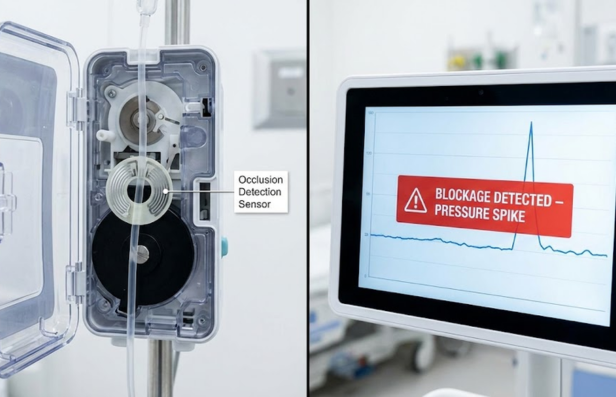
- Medical Devices: Occlusion sensors in IV pumps (detecting a blockage in the line) or smart insoles that map foot pressure for diabetics.
- Automotive: "Occupancy detection" sensors in car seats that tell the airbag system whether an adult or a child is sitting there.
- Industrial HMI: "Dead Man's Switches" on power tools that ensure the machine cuts power the moment an operator releases their grip.
- Inventory Management: Smart bin mats that alert the warehouse system when a parts bin is empty (light) versus full (heavy).
Engineering Your Custom Solution
The beauty of printed electronics is scalability. We can prototype a custom FSR design in our lab and scale that same process to print 10,000 units on our production floor.
If you are looking to integrate force sensing into a device where space, weight, or flexibility is a constraint, start your engineering consultation with BTI today. Our team can help you characterize the resistance curve you need and select the right substrate to ensure your sensor performs reliably in the field.
Don't settle for "On/Off" when your product needs to feel the difference.


























Sign in to leave a comment.