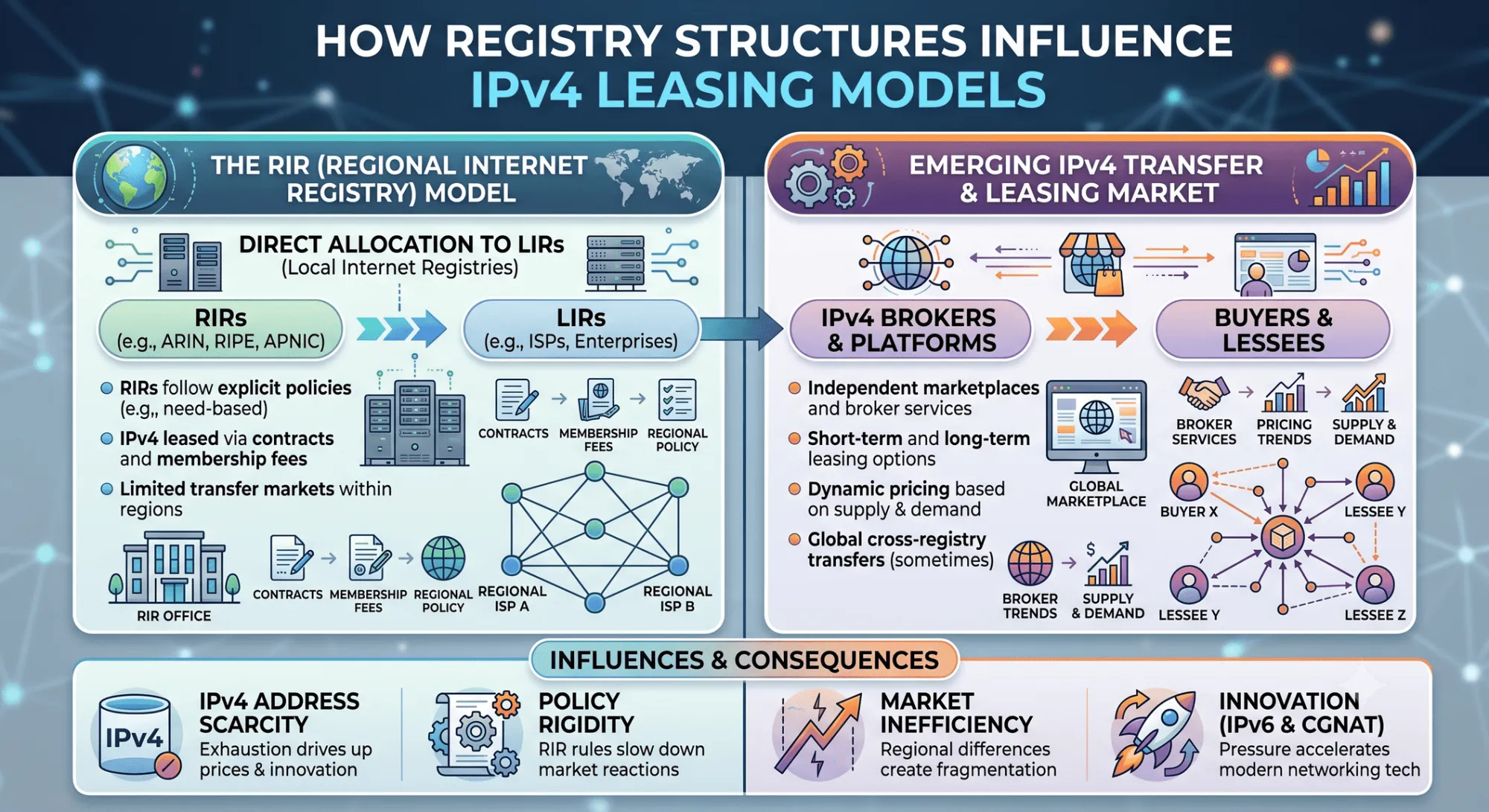

IPv4 leasing has become a major part of the modern internet infrastructure economy. As IPv4 addresses remain scarce, organizations increasingly rely on leasing instead of ownership. But what often goes unnoticed is how much the underlying registry structure shapes how these leasing markets work, how prices are set, and even who can participate.
To understand IPv4 leasing, you first need to understand the role of Internet number registries—because they quietly define the rules of the game.
The Role of Internet Registries
IPv4 addresses are managed globally through a hierarchical system of Internet Registries:
- IANA (Internet Assigned Numbers Authority) at the top
- RIRs (Regional Internet Registries) such as:
- ARIN (North America)
- RIPE NCC (Europe, Middle East, parts of Central Asia)
- APNIC (Asia-Pacific)
- LACNIC (Latin America)
- AFRINIC (Africa)
These organizations allocate IP address blocks to ISPs, enterprises, and other entities. Over time, as IPv4 exhaustion became a reality, these registries adapted policies that now heavily influence secondary market activity—including leasing.
What IPv4 Leasing Actually Means
IPv4 leasing is the temporary rental of IP address space from a holder (often a company or broker) to a user who needs it.
Instead of purchasing an address block permanently, organizations lease it for a fixed period, often with renewal options. This model emerged because:
- IPv4 addresses are no longer freely available from RIRs
- Buying large blocks can be expensive
- Many organizations only need temporary or scalable usage
But leasing doesn't happen in a vacuum—it must align with registry policies.
How Registry Structures Shape Leasing Models
1. Policy Restrictions Define What Leasing Can Look Like
RIRs don’t explicitly “run” leasing markets, but they enforce policies that indirectly shape them.
For example:
- Some RIRs require justification of use for address space registration.
- Others require registration of “use rights” changes in their databases.
- Transfers must often be approved and logged through the registry.
This means leasing must be structured in a way that does not violate the registry’s definition of rightful control.
2. Transfer Policies Enable Secondary Markets
IPv4 leasing is closely tied to address transfers, which are formally recognized by most RIRs.
These transfers:
- Allow ownership-like control changes between entities
- Create legal pathways for brokers to operate
- Enable leasing companies to maintain pools of addresses
Without transfer mechanisms in registry policies, leasing would be far riskier and less standardized.
3. Regional Differences Create Market Fragmentation
Each RIR has its own policy framework, which leads to differences in leasing behavior:
- RIPE NCC has relatively mature and structured transfer policies, supporting active leasing ecosystems in Europe.
- ARIN requires stricter justification and inter-regional constraints, which can limit fluid leasing across borders.
- APNIC operates with its own eligibility rules that affect how resources can be reallocated.
This fragmentation creates regional pricing differences and affects global IPv4 liquidity.
4. Registry Compliance Requirements Add Operational Overhead
Leasing providers must ensure:
- Proper WHOIS database updates
- Accurate registration of end users (in many cases)
- Compliance with RIR audit policies
This adds administrative complexity that influences how leasing services are packaged:
- Managed leasing services
- Broker-assisted leasing
- Fully compliant IP brokerage platforms
Without registry enforcement, leasing would likely resemble a simple commodity rental. Instead, it behaves more like a regulated asset market.
5. The “Soft Ownership” Model Exists Because of Registries
IPv4 leasing is unusual because it sits between ownership and rental. This hybrid structure exists due to registry constraints:
- You don’t truly “own” IPv4 space indefinitely in a free-market sense.
- You don’t fully “rent” it without registration obligations.
- Instead, you hold registered usage rights recognized by a registry system.
This is why leasing contracts often include:
- Registry update clauses
- Reassignment conditions
- Return obligations tied to policy compliance
How This Impacts Pricing and Market Behavior
Registry structures indirectly influence pricing in several ways:
- Compliance cost premium: Regions with stricter registry rules often have higher leasing costs.
- Liquidity differences: Easier transfer policies increase supply and reduce volatility.
- Broker dominance: Complex registry requirements favor intermediaries who specialize in compliance.
In short, registry policy is one of the hidden forces behind IPv4 market economics.
The Future: Will Registry Evolution Change Leasing?
As IPv6 adoption grows, IPv4 will remain scarce, but registry policies will continue shaping its lifecycle. Possible future trends include:
- More automated registry transfer systems
- Greater harmonization between RIR policies
- Increased transparency in leasing arrangements
- Potential tightening of justification rules to prevent speculation
However, as long as IPv4 scarcity exists, leasing will remain heavily dependent on registry-defined rules.
Conclusion
IPv4 leasing is not just a market phenomenon—it is a regulatory and administrative construct shaped deeply by registry structures. The policies of IANA and the RIRs determine how addresses move, who can use them, and under what conditions they can be leased.
Understanding these structures is essential for anyone participating in the IPv4 market, because in many ways, registries—not just supply and demand—define the boundaries of the business itself.



























Sign in to leave a comment.