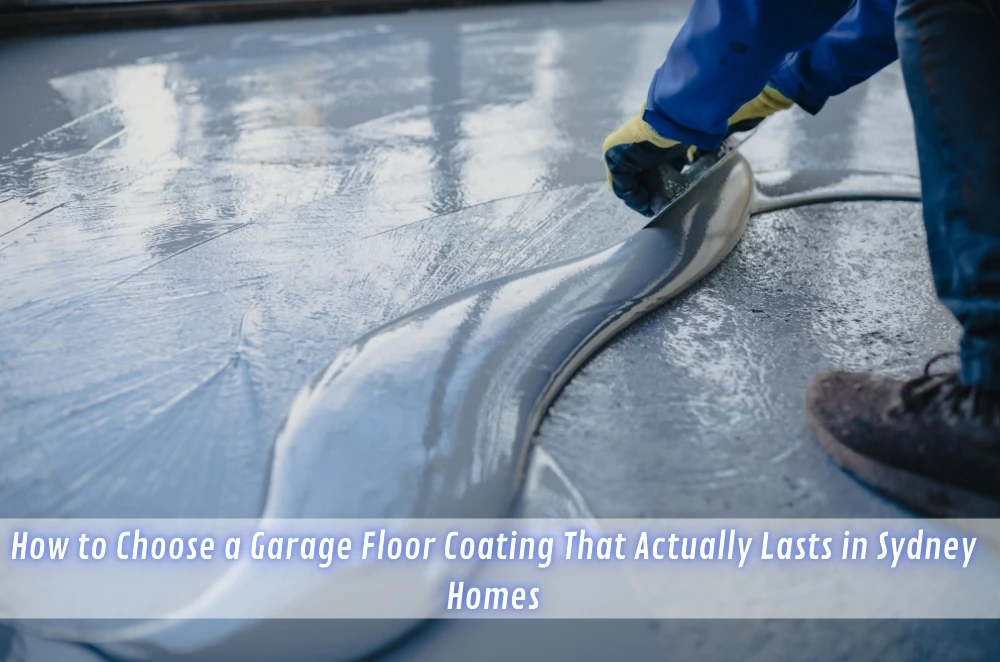

A garage floor takes a unique beating compared with the rest of the house. It deals with hot tyres, grit dragged in from the driveway, occasional spills, and the kind of humidity swings that can make concrete behave unpredictably.
A “good-looking” coating isn’t automatically a durable coating, and the gap between the two usually comes down to decisions made before the first drop of product is mixed.
This guide explains what to look for, what to avoid, and how to make a choice that holds up to real Sydney conditions—whether the garage is a parking space, a workshop, or the unofficial storage room.
What “lasting” actually means for a garage floor
Most homeowners think “lasting” means the coating doesn’t peel. That’s part of it, but a garage floor can fail in quieter ways long before it flakes off.
A coating that lasts should resist hot-tyre pickup, not turn slick when dusty or wet, and keep its finish from wearing thin along the usual tyre paths.
It should also stay bonded through seasonal moisture changes, especially in garages that sit cooler and damper than the living areas.
Finally, “lasting” includes maintainability: if it’s easy to clean and doesn’t trap grime, it will look better for longer with less effort.
The three coating paths and when each makes sense
Garage floor coatings often get lumped together as “epoxy,” but most systems fall into one of three broad approaches.
1) Epoxy systems
Epoxy is popular for a reason: it can provide a thick, durable film with strong adhesion when installed properly.
It tends to be forgiving for decorative finishes (like flakes) and can feel like a major upgrade compared with bare concrete.
The trade-off is that epoxy cure times can be longer, and performance depends heavily on prep and moisture conditions.
2) Fast-cure topcoats (often used with primers/basecoats)
Some systems use a different chemistry for faster curing and better UV stability, then pair it with compatible base layers.
These can suit households that need the garage back quickly, but “fast” doesn’t mean “skip steps,” and rushed installs can still fail.
The key is understanding what product is used where, and why—rather than assuming one label equals better quality.
3) Sealers and paints
Budget products can improve dusting and make cleaning easier in the short term, especially for low-use garages.
They’re also the easiest to recoat later, but they usually don’t handle heavy abrasion, chemical exposure, or tyre heat as well as true coating systems.
If the garage is a workshop or the main parking spot, this path often becomes a false economy.
Surface prep: the part most quotes hide
The coating is only as good as the concrete beneath it, and the concrete is only as reliable as its preparation.
Most failures start with inadequate profiling—if the surface is too smooth, too dusty, or contaminated with oils, the coating may bond poorly even if it looks fine on day one.
Mechanical grinding is a common approach because it opens the concrete surface consistently and helps remove contamination, but it also needs the right equipment and dust control.
Cracks, spalls, and divots should be repaired with materials that match the system, because incompatible fillers can telegraph through the finish or create weak points.
Moisture is the other hidden variable: if the slab is holding water vapour pressure, it can push against the coating over time and cause blistering or delamination.
A trustworthy installer won’t just promise “it’ll be fine”—they’ll explain how moisture risk is assessed and what options exist if the slab is borderline.
Common mistakes homeowners make
Assuming “two coats” tells you anything.
Two coats of what, at what thickness, over what prep, with what primer?
Choosing colour and flake before confirming the system.
Decor is the easy part; performance is the hard part.
Comparing quotes that aren’t scoped the same.
If one quote includes repairs and moisture management and another doesn’t, the cheaper one isn’t necessarily “better value.”
Overlooking slip resistance.
A glossy finish can look great, but garages get dusty, and Sydney rain can follow shoes and tyres inside.
Not asking about recoat windows and long-term care.
Even great coatings can be damaged by harsh degreasers or the wrong cleaning habits.
Decision factors: how to compare installers and systems
When a few options start to look similar, use decision factors that expose what’s actually being delivered.
Start with the intended use.
Parking only is different from a home gym, a workshop, or a space where kids run in and out with wet feet.
A coating that’s perfect for a show-car garage may not be the best choice for a busy household that prioritises grip and easy cleaning.
Ask how the slab will be prepared, in plain language.
Listen for specifics: grinding method, edge work, crack repair approach, how contaminants are handled, and what happens if the slab reveals problems mid-prep.
Clarify the full system: primer/basecoat/topcoat.
A professional finish often involves layers that do different jobs, and the topcoat choice can affect stain resistance, gloss retention, and traction.
Confirm cure time and practical access.
“Dry to touch” is not “ready for tyres.” Make sure the timeline includes when vehicles can return, and what temperature/humidity conditions might change that.
Check warranty language for exclusions.
Warranties often exclude moisture issues or chemical staining; that’s not automatically bad, but it should match what was discussed.
If it helps to see what a complete scope looks like before comparing quotes, the Ultimate Epoxy Floors official page is a handy reference for the questions to ask and the inclusions to confirm.
Look for clear trade-offs, not perfection promises.
A credible provider will tell you what the system does well and what it won’t do, especially around UV exposure near garage doors and the reality of tyre heat.
A simple first-actions plan for the next 7–14 days
Day 1–2: Define how the garage is used today and how you want it to function.
Write down whether it’s parking, storage, gym, workshop, or all of the above.
Day 2–4: Do a quick slab check.
Note any flaking concrete, old paint, oily patches, persistent dampness, or powdery dusting.
Day 4–6: Shortlist questions and request like-for-like quotes.
Ask each provider to quote the same target finish, slip preference, and repair allowance.
Day 6–9: Compare scopes, not totals.
Line up prep method, crack repairs, moisture considerations, layers, cure times, and aftercare instructions.
Day 9–14: Plan access and protect the result.
Schedule around weather and household routines, and decide where cars, bins, and stored items will go during curing.
Operator Experience Moment
On jobs where a garage coating fails early, the pattern is usually the same: the surface looked “clean enough,” but grinding revealed patches of contamination that needed more work than expected.
The best installs are the ones where the prep takes longer than the coating, because that’s where the bond is earned.
When homeowners understand that upfront, they’re less tempted by quotes that sound fast, cheap, and vague.
Local SMB Mini-Walkthrough: a typical Sydney residential scenario
A homeowner in Sydney wants the garage to double as parking and a weekend workshop.
The slab has a few hairline cracks and a dark patch where an old oil leak soaked in.
They choose a finish with added texture for safer footing during wet-weather entry.
Prep includes grinding, crack treatment, and targeted degreasing before any coating goes down.
Curing is scheduled to avoid a humid stretch, with clear “walk on” vs “drive on” timing.
After installation, they swap harsh degreasers for gentler cleaning to protect the top layer.
Practical Opinions
If the slab is questionable, prioritise prep and moisture risk over decorative upgrades.
If the garage is high-traffic, prioritise grip and cleanability over maximum gloss.
If timelines are tight, prioritise realistic curing access over “same-day” promises.
Key Takeaways
- Lasting performance depends more on preparation and slab conditions than on a label like “epoxy.”
- Compare quotes by scope: prep method, repairs, moisture approach, layer system, and cure timing.
- Choose a finish based on use (parking/workshop/gym) and traction needs, not just colour.
- A good decision includes an aftercare plan so the floor stays easy to clean and good-looking.
Common questions we hear from Australian businesses
Q1) Is epoxy always the best option for a residential garage?
In most cases… epoxy is a strong option when prep is done properly and the slab conditions are suitable. The next step is to describe your garage use (parking only vs workshop/gym) and ask for a system recommendation that matches that use, which matters in Sydney where humidity swings can affect curing and moisture behaviour.
Q2) How long before a car can be parked on a newly coated garage floor?
Usually… it’s longer than “dry to touch,” and it varies by system and weather. The next step is to get a written timeline for “walk on” and “drive on,” because Sydney’s cooler nights and humid periods can extend cure times.
Q3) What causes peeling or bubbling later on?
It depends… but common causes include poor surface profiling, contamination (oil/silicone), or moisture vapour pressure from the slab. The next step is to ask how moisture risk will be assessed and what the plan is if the slab shows dampness—important for homes near the coast or in low-lying Sydney suburbs.
Q4) Are decorative flakes worth it, or are they just cosmetic?
Usually… flakes are mainly aesthetic, but they can also help disguise dust and minor marks, and they influence the final texture depending on the topcoat approach. The next step is to request a sample (or description) of the final feel underfoot, since garages in Sydney often get wet-foot traffic during rainy weeks.






















Sign in to leave a comment.