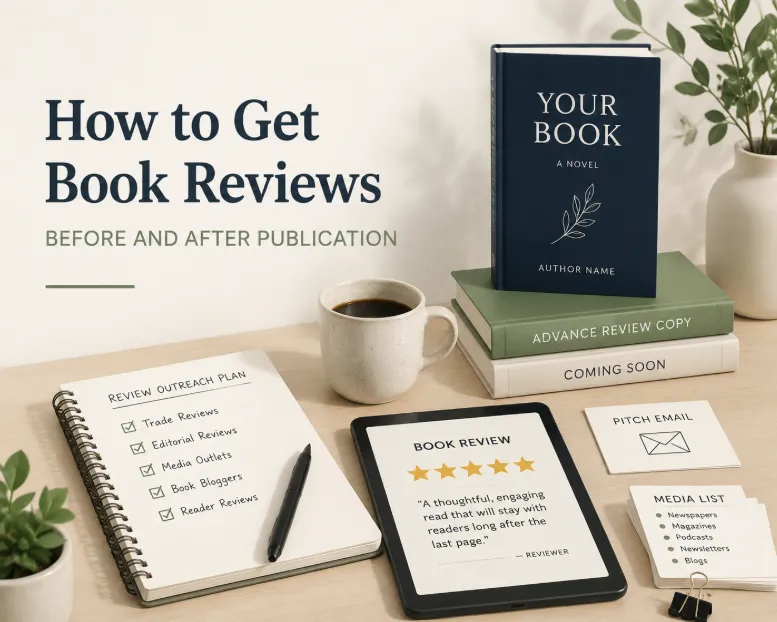


Book reviews can help readers understand what a book offers, give booksellers and librarians useful context, and provide authors with credible material for their websites and publicity campaigns.
However, reviews rarely appear simply because a book has been published. Authors need to identify suitable reviewers, prepare the right materials, begin outreach early, and understand the differences between trade, editorial, media, and reader reviews.
The process must also remain ethical. A genuine review is an independent response to the book, not praise purchased, rewarded, or demanded by the author.
Understand the Different Types of Book Reviews
The term “book review” can refer to several forms of coverage, each serving a different audience and following different submission practices.
Trade Reviews
Trade publications review books primarily for booksellers, librarians, publishing professionals, educators, journalists, and rights buyers. Publishers Weekly, Kirkus Reviews, Booklist, and Library Journal are familiar examples.
These outlets usually have specific submission requirements and long lead times. Some consider books only before publication, while others have separate programs for independent authors and small publishers.
A positive trade review can encourage professional interest in a book, but submitting a title does not guarantee that it will be selected or reviewed favorably.
Editorial Reviews
Editorial reviews are written by professional reviewers, publications, industry services, or subject specialists. They may be commissioned or provided without charge.
Paying for an editorial review is not automatically unethical. The important distinction is that the author is paying for an independent assessment, not a guaranteed positive conclusion.
Before choosing a paid review service, authors should understand who will write the review, where it will appear, whether it will be publicly identified as paid, and whether quotations may be used in marketing materials. They should also check whether publication is guaranteed, whether an unfavorable review can be withheld, and whether the service is recognized by booksellers or librarians.
Kirkus, for example, operates Kirkus Indie, a paid review service for independent authors and publishers. Payment guarantees that the book will receive a review, but it does not guarantee a favorable verdict.
Media Reviews
A newspaper, magazine, literary website, radio program, newsletter, or specialist publication may review a book as part of its editorial coverage.
These reviews are earned rather than controlled by the author. The publication decides whether the book fits its audience, who will review it, when the piece will appear, and what the final assessment will say.
Media reviews may also take different forms. A publication might include the book in a roundup, discuss it within a broader feature, or interview the author instead of publishing a conventional review.
Reader Reviews
Reader reviews appear on retailer platforms, Goodreads, book blogs, newsletters, book-club websites, and social platforms. They can help prospective readers decide whether a book suits their interests.
However, the rules governing these reviews vary across platforms, particularly when a reviewer knows the author or has received a complimentary copy. Authors should never offer payment, gifts, refunds, contest entries, or other rewards in exchange for a positive customer review.
Begin Review Outreach Before Publication
Many authors wait until their book is available before contacting reviewers. By then, some of the strongest prepublication opportunities may already have passed.
Trade publications, print magazines, newspapers, and established review outlets often plan their coverage months in advance. Reviewers need time to receive the book, read it, prepare the review, and fit the piece into an editorial schedule.
The Independent Book Publishers Association recommends approaching major trade and print review outlets several months before publication. Its prepublication promotion guidance also explains that traditional media generally require more notice than online reviewers and genre bloggers.
Authors should create a schedule that works backward from publication day. Research into trade and long-lead outlets may begin six months before release, followed by advance review copy submissions about five months before publication. Specialist publications and established reviewers can be approached around three months before release, with bloggers and online book communities contacted closer to publication.
During launch month, authors can follow up selectively and begin encouraging genuine reader reviews. After publication, the focus can shift toward regional, specialist, seasonal, and subject-based opportunities.
These timeframes are only guidelines. Every outlet has its own requirements, and those instructions should always take priority.
Prepare a Professional Advance Review Copy
An advance review copy, commonly called an ARC, is an early version of the book supplied to reviewers before publication. It may be printed or digital, but it should be complete enough for the reviewer to assess the work fairly.
An ARC will normally show the title, subtitle, author, expected publication date, publisher or imprint, ISBN, format, price, distribution information, and publicity contact details. It should also be clearly identified as an advance copy. If changes are still being made, include a note asking reviewers to verify quotations against the final edition.
Do not send a visibly unfinished manuscript unless the reviewer has specifically agreed to consider it in that form. Missing chapters, temporary illustrations, poor formatting, and extensive uncorrected errors can affect how the entire book is perceived.
The format should also represent the finished work accurately. A basic digital file may be sufficient for a text-based novel, but cookbooks, art books, photography collections, children’s books, and design publications may require a high-quality physical copy.
Identify Reviewers Who Cover Similar Books
Sending a book to a large list of unrelated contacts rarely produces meaningful results. The strongest outreach begins with reviewers who already cover comparable books.
Research the reviewer’s preferred genres, subjects, age groups, formats, and cultural or regional interests. Check whether they cover independent publications and whether their recent work includes books similar to the one being pitched.
Reading several previous reviews is essential. It reveals not only what the reviewer covers, but also how they approach books and what their audience expects.
A reviewer who regularly writes about literary historical fiction may not be interested in contemporary romance simply because both are novels. Similarly, a business journalist who focuses on workplace policy may not review a general motivational book.
Relevance matters more than the size of the reviewer’s audience. A smaller specialist platform may reach more suitable readers than a large publication with little interest in the subject.
Follow Every Submission Policy
Most established review outlets publish submission guidelines explaining what they accept and how they want to receive it. These instructions may cover genres, formats, lead times, geographic restrictions, contact methods, and whether the outlet considers self-published books.
Some reviewers accept digital ARCs, while others require finished physical copies. Certain outlets allow follow-ups, while others explicitly ask authors not to send them. Ignoring these policies creates unnecessary work for the recipient and can cause an otherwise suitable book to be rejected.
Avoid sending large attachments unless they have been requested. Some reviewers prefer a short introduction followed by a downloadable link, while others will only consider a mailed copy.
If an outlet states that unsolicited books will not be returned, do not ask for the copy back.
Write a Focused Review Request
A review request should give the recipient enough information to decide whether the book fits their coverage. It should identify the title, author, publication date, genre or subject, intended audience, and available formats.
It should also explain why the book is relevant to that particular reviewer. A brief reference to their previous coverage is more persuasive than a general claim that the book would interest everyone.
For example:
Subject: Review consideration: A family history of coastal migration
I’m writing to ask whether you would consider reviewing [Title] by [Author], publishing on September 15. The book traces three generations of fishing families displaced by changes along the Atlantic coast. Because you regularly cover regional histories and environmental nonfiction, I thought it might suit your readership. Printed and digital advance copies are available.
Keep the request concise and factual. Do not describe the book as a guaranteed bestseller, compare it casually with a famous title, or suggest what conclusion the reviewer should reach.
The purpose of the message is to present the book clearly and allow the reviewer to make an independent decision.
Give Reviewers Enough Time
Reading and reviewing a book takes considerable time. Avoid contacting a reviewer a few days after sending the copy to ask whether they have finished it.
Unless the outlet has provided a different timeframe, allow a reasonable period before following up. One concise follow-up may be appropriate when the reviewer accepts reminders, the book genuinely matches their coverage, the original message was personalized, and enough time has passed.
Repeated reminders are rarely helpful. Authors should also avoid contacting the same reviewer through email, social media, and personal accounts after receiving no response.
In most cases, silence means that the reviewer is unavailable or has decided not to cover the book.
Approach Book Bloggers Individually
Book bloggers can introduce a title to a focused community, particularly when they specialize in a defined genre or subject.
Before making contact, read the blogger’s review policy and several recent posts. Confirm that the blog is active, covers the relevant type of book, accepts the available format, and is currently open to review requests.
Use the blogger’s name and explain why the book fits their existing coverage. A mass email beginning with “Dear Blogger” suggests that the sender has not researched the recipient.
Some bloggers may prefer an author interview, excerpt, giveaway, guest article, or reading-list contribution instead of a conventional review. These can still support a publicity campaign, but they should be treated as separate editorial opportunities rather than assumed replacements for a review.
Use Giveaways Without Buying Reviews
Authors may distribute complimentary advance copies, run giveaways, or provide books to interested readers. The recipient may later decide to publish a review, but the free copy should not come with a demand for praise.
An appropriate request might say:
If you choose to review the book, please share your honest opinion and disclose that you received a complimentary copy where required.
Avoid statements such as:
Receive a free copy in exchange for a five-star review.
That arrangement attempts to control both the existence and the outcome of the review.
Authors should also check the policies of each retailer or review platform before organizing an ARC team. A practice permitted by one platform may violate the rules of another.
Respond Professionally to Negative Reviews
Not every review will be positive. Public evaluation is part of publishing a book, and authors cannot control how each reader or critic will respond.
Arguing with a reviewer, demanding that criticism be removed, or encouraging followers to attack or downvote a review can cause much greater reputational damage than the original criticism. Authors should never offer compensation in return for a revision or publicly expose a reviewer’s personal information.
A negative review may still help suitable readers decide whether the book is right for them. It may also reveal a genuine issue involving editing, structure, positioning, or audience expectations.
Authors can evaluate criticism privately without responding publicly. If a published review contains a clear factual error, the author, publisher, or publicist may send a brief and respectful correction. A difference of interpretation, however, is not necessarily a factual mistake.
Continue Seeking Reviews After Publication
The end of the advance-review period does not mean that every opportunity has disappeared.
After publication, authors can approach regional media, specialist magazines, professional associations, genre websites, alumni publications, library newsletters, book-club communities, and local-interest outlets. Seasonal reading lists, festivals, awards, and podcasts that publish written recommendations may also provide relevant opportunities.
A book can become newly timely because of an anniversary, adaptation, public debate, educational use, award, or development related to its subject.
Post-publication outreach should lead with that current relevance rather than presenting an older title as if it has just been released. For example, a history book may become relevant during a major anniversary, while a nonfiction title may gain new significance when its subject enters public discussion.
Use Reviews Across the Publicity Campaign
Once a review has been published, consider how it can support the wider campaign.
Depending on the reviewer’s terms, a brief quotation may be used on the author’s website, book page, retailer listings, social posts, media materials, event displays, advertisements, or a later edition of the book.
Every quotation should be attributed clearly and presented in its original context. Do not remove qualifying words to make a mixed review appear entirely positive.
A coordinated book publicity campaign can combine review outreach with interviews, features, podcasts, events, and timely story pitches. Reviews are valuable, but they are most effective when they support a broader publicity strategy rather than functioning as the campaign’s only goal.
The strongest approach begins early, targets the right people, and respects the reviewer’s independence. Authors cannot control the final verdict, but they can make their books easier for appropriate reviewers to discover, evaluate, and cover.































Sign in to leave a comment.