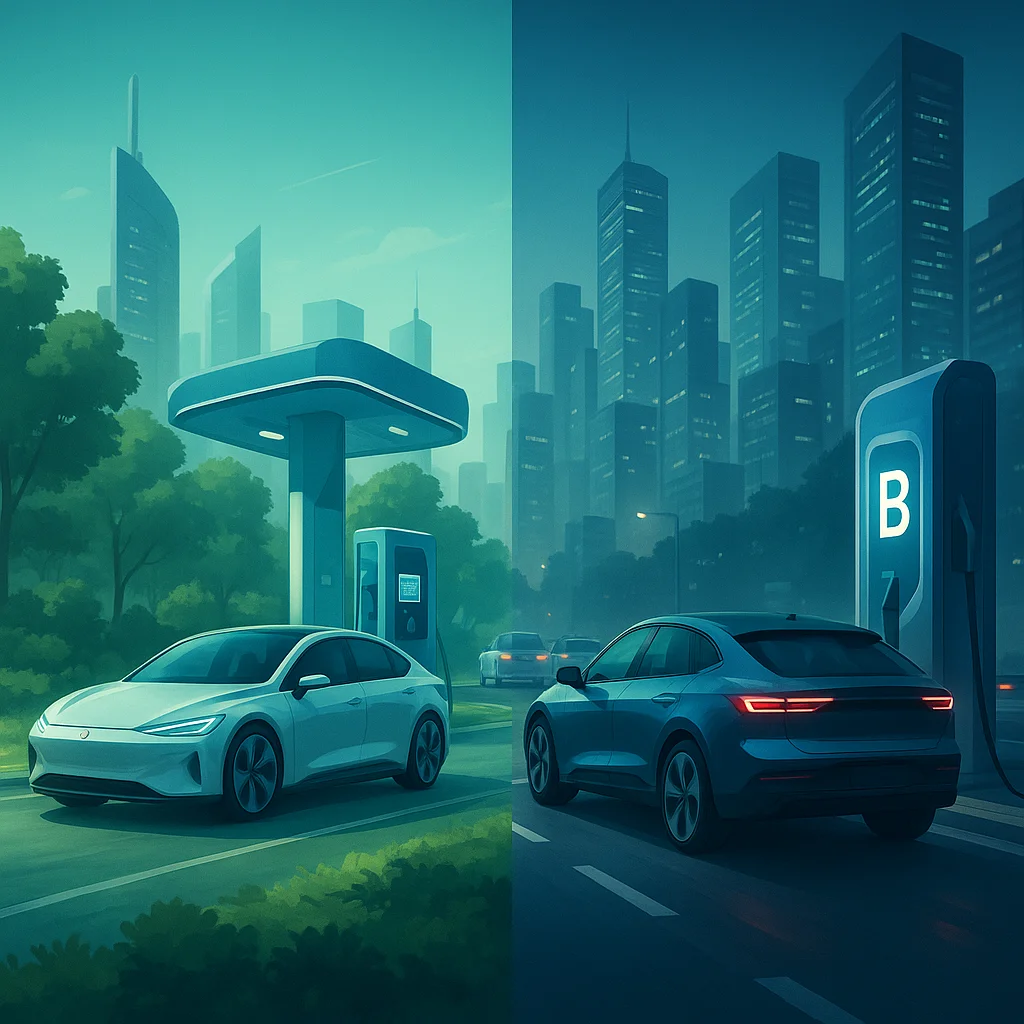

Introduction: A Tale of Two Electrons
Hydrogen fuel cell vehicles (FCEVs) and battery electric vehicles (BEVs) have been pitched as the twin pillars of a cleaner transportation future. But before you uncritically buy into the promise of "zero emissions," it's worth unpacking the inconvenient truths both technologies carry. For starters, BEVs still wrestle with raw material extraction nightmares, while FCEVs battle against an infrastructure desert and efficiency losses that make your smartphone battery look like a powerhouse. Yet, despite their flaws, both have forged ahead, backed by governments, automakers, and investors hungry to claim green bragging rights.
In 2026, the competition between hydrogen and battery electric vehicles is no longer theoretical; it's a full-blown market skirmish shaping global energy and automotive strategies. This article sifts through the hype, the tech specs, and the evolving industry landscape to give you a no-nonsense comparison of FCEVs and BEVs. For deeper insights, see our 2026 Trends in Hydrogen Fuel Cell Vehicles vs Battery Electric Cars and Complete Guide to Hydrogen Fuel Cell Vehicles vs Battery Electric in 2026.
Historical Context: How Did We Get Here?
The journey to electrified transport is littered with dead ends and half-baked solutions. The first fuel cell vehicle dates back to the 1960s, but it took until the early 2000s for commercial FCEVs like the Toyota Mirai to hit roads, albeit in limited numbers. Meanwhile, battery electric vehicles, although conceptually older, gained momentum only after Tesla’s Model S debuted in 2012, proving there was a market for long-range BEVs.
The 2010s saw governments betting heavily on BEVs, driven by falling lithium-ion battery costs and growing climate urgency. Hydrogen, by contrast, was relegated to niche applications—buses and forklifts—due to infrastructure scarcity and energy inefficiency. Still, hydrogen’s advocates argued it held the key for long-haul and heavy-duty transport, where batteries were too heavy or slow to recharge.
Entering the 2020s, massive subsidies and technological advances pushed battery electric vehicles into the mainstream. Yet hydrogen's promise lingered, buoyed by breakthroughs in green hydrogen production and renewed industrial interest. Now in 2026, the field is less about "if" and more about "which technology suits which purpose." The historical rivalry has evolved into a nuanced battle for dominance across different transport segments.
Technical Comparison: Efficiency, Range, and Infrastructure
The core of the hydrogen vs battery debate is efficiency and practical usability. BEVs convert around 77–82% of electrical energy from the grid into motion, according to data from the U.S. Department of Energy. Hydrogen fuel cell vehicles, on the other hand, face a cascade of energy conversions—from electricity to hydrogen via electrolysis, compression or liquefaction, transport, and finally conversion back to electricity in the fuel cell—resulting in an overall efficiency of roughly 30–40%.
Range is another battleground. Hydrogen vehicles typically offer longer range and faster refueling, with some models exceeding 400 miles and refueling times under 5 minutes. BEVs often require 20–40 minutes for a rapid charge to 80%, although improvements in solid-state batteries and ultra-fast charging tech are closing this gap.
Infrastructure starkly divides the contenders. Battery charging stations have proliferated globally, with over 2 million public chargers reported in 2026 by the International Energy Agency. Hydrogen refueling stations remain scarce—about 1,200 worldwide, mostly concentrated in California, Japan, and parts of Europe. This infrastructure gap restricts FCEV adoption primarily to select regions and fleets.
“Hydrogen’s energy losses in production and distribution make it a tough sell for passenger vehicles, but its quick refueling and energy density keep it relevant for trucks and buses.” – Energy analyst, CleanTech Insights
- Energy Efficiency: BEVs ~80%, FCEVs ~35%
- Refueling Time: BEVs 20-40 min fast charge, FCEVs <5 min
- Driving Range: BEVs 250-350 miles typical, FCEVs 300-400+ miles
- Infrastructure Availability: BEVs 2 million+ charging points, FCEVs ~1,200 hydrogen stations
Current Industry Landscape and 2026 Developments
Fuel cell technology is experiencing a renaissance in commercial and heavy-duty sectors. In May 2026, Toyota announced a strategic partnership with Nikola to expand hydrogen refueling infrastructure and heavy truck fuel cell tech, signaling renewed confidence in hydrogen’s commercial potential (Electrek).
Meanwhile, battery electric vehicles continue to dominate consumer markets, with Tesla, Volkswagen, and Hyundai pushing battery innovations and affordability. The 2026 ACT Expo underscored a hybrid approach, showcasing hydrogen trucks alongside advanced electric fleets and next-gen charging solutions (FleetOwner).
Europe remains a battleground, with countries like Germany investing heavily in green hydrogen production plants and hydrogen corridors for freight, while Norway and the Netherlands accelerate battery charging infrastructure. Public transit authorities are also testing the waters: Solaris secured a deal to deploy hydrogen fuel cell buses in Krefeld, Germany, highlighting hydrogen’s niche in public transport (Hydrogen Fuel News).
Hydrogen racing championships, too, are back on the scene, using motorsport as a high-profile testbed for fuel cell advancements, as seen in Saudi Arabia’s recent events (gasworld).
“The 2026 industry pivot is clear: BEVs for the mass market, hydrogen for heavy transport and specialized applications.” – Automotive strategist, WriteUpCafe
- Toyota & Nikola collaboration to expand hydrogen fueling
- ACT Expo highlights mix of hydrogen trucks and BEVs
- Solaris deploys hydrogen buses in Germany
- Hydrogen racing returns as tech showcase
- Charging infrastructure growth outpaces hydrogen stations
Expert Perspectives and Industry Impact
Industry insiders are split but pragmatic. Battery advocates highlight BEVs’ superior efficiency and lower total cost of ownership, especially as battery prices have plummeted below $100/kWh in 2026. Critics argue that raw material sourcing—lithium, cobalt, nickel—still poses environmental and ethical challenges, stirring a demand for battery recycling and alternative chemistries.
Hydrogen proponents counter that fuel cells enable zero-emission heavy transport and can leverage existing industrial hydrogen supply chains. The hurdles are mainly infrastructural and economic. Experts suggest hydrogen’s role will be complementary rather than competitive, focused on sectors where batteries struggle: freight, aviation, and maritime.
Automakers are hedging bets. Hyundai and Toyota continue investing in fuel cell R&D, while also scaling BEV production. European and Asian governments are cautiously balancing subsidies, funding hydrogen hubs alongside battery infrastructure. The World Economic Forum’s 2026 mobility report notes this dual-track approach as essential for rapid decarbonization.
As one senior analyst put it:
“Hydrogen fuel cell vehicles aren’t the enemy of battery electrics; they’re the reluctant sibling who does the heavy lifting when the road gets tough.” – Senior analyst, Clean Energy Futures
Looking Ahead: What to Watch in Hydrogen and Battery Electric Markets
Predicting the future is risky, but some trends are crystal clear. Battery technology will continue improving, with solid-state batteries promising higher energy density and faster charging. Yet, raw material constraints will drive innovation in battery chemistries and recycling. Meanwhile, green hydrogen production costs, linked to renewable electricity prices, are expected to drop, potentially making hydrogen more competitive, especially for commercial transport.
Key questions remain about infrastructure expansion. Will governments and private players scale hydrogen refueling stations fast enough to make FCEVs viable beyond niche markets? Can battery charging networks keep pace with growing BEV demand without overloading grids? Integration with smart grids and renewable energy sources will be decisive.
Consumers will also influence market trajectories. Early adopters of BEVs are now mainstream buyers, but hydrogen’s acceptance depends on visibility and convenience. Fleet operators, logistics companies, and public transit agencies are the likely early hydrogen adopters, setting the stage for broader acceptance.
In the near term, expect a segmented market where BEVs dominate personal and light-duty transport, and hydrogen powers heavy-duty, long-range, and specialized vehicles. For a comprehensive forecast, consult WriteUpCafe’s analysis on Hydrogen Fuel Cell Vehicles vs Battery Electric: A 2026 Comparative Analysis.
- Advances in solid-state battery tech improve BEV range and charging
- Green hydrogen production cost declines improve FCEV economics
- Expansion of hydrogen refueling stations remains critical bottleneck
- Fleet and heavy-duty segments likely first to adopt hydrogen at scale
- Consumer acceptance favors BEVs for personal transport




























Sign in to leave a comment.