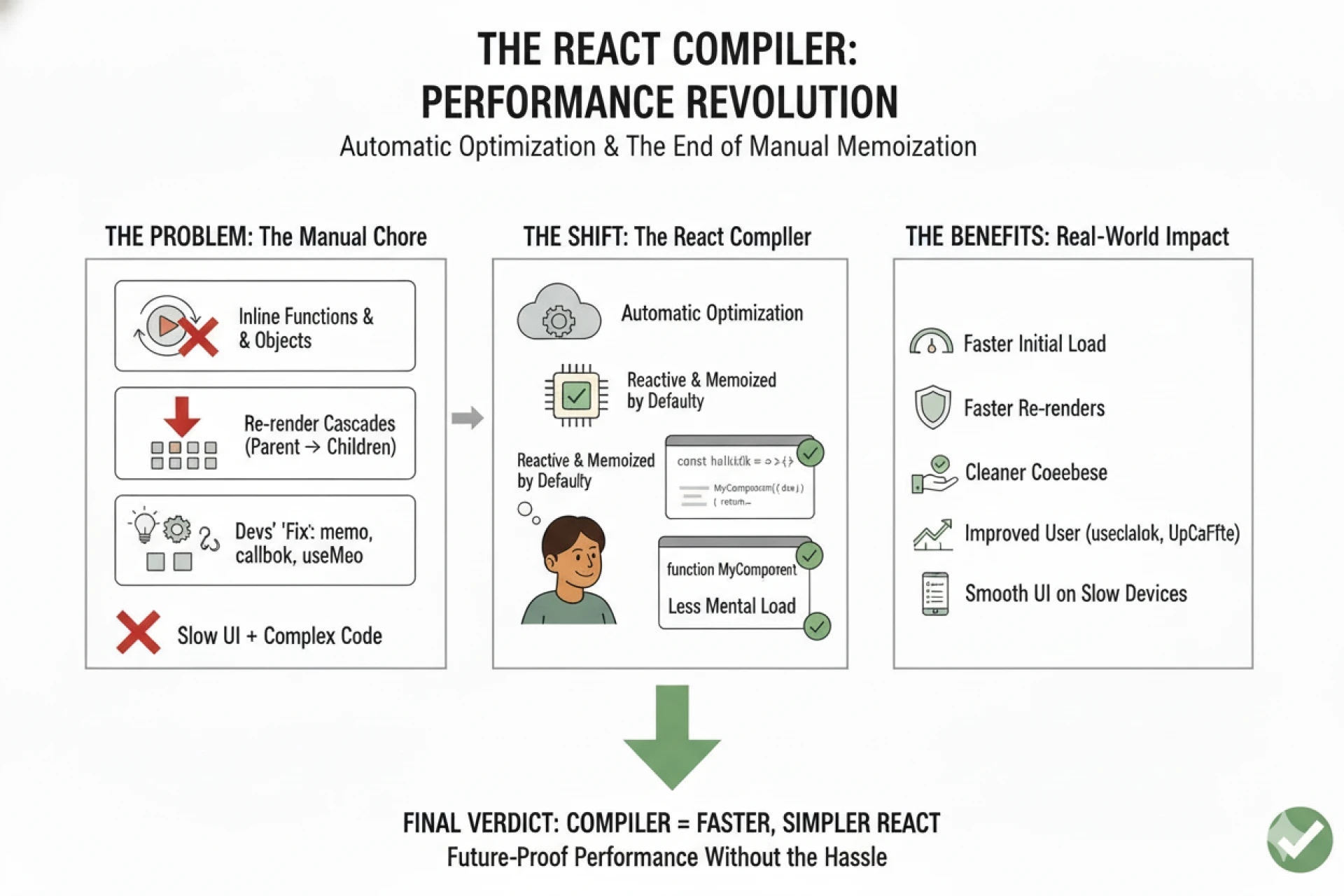

The React compiler boasts of automatic performance optimization and no memoization, but does it live up to the marketing? With no code changes, there are 25-40 fewer re-renders in complex applications, according to early adopters, but real-world testing shows a more subtle picture. The compiler has already been delivered in applications such as the Meta Quest Store, with first loads and cross-page navigations up to 12 percent faster, and some interactions are over 2.5 times faster.
Understanding whether the React compiler truly represents a performance miracle requires examining both its impressive achievements and practical limitations. Professional ReactJS development company teams evaluating compiler adoption must separate marketing promises from measurable, real-world results.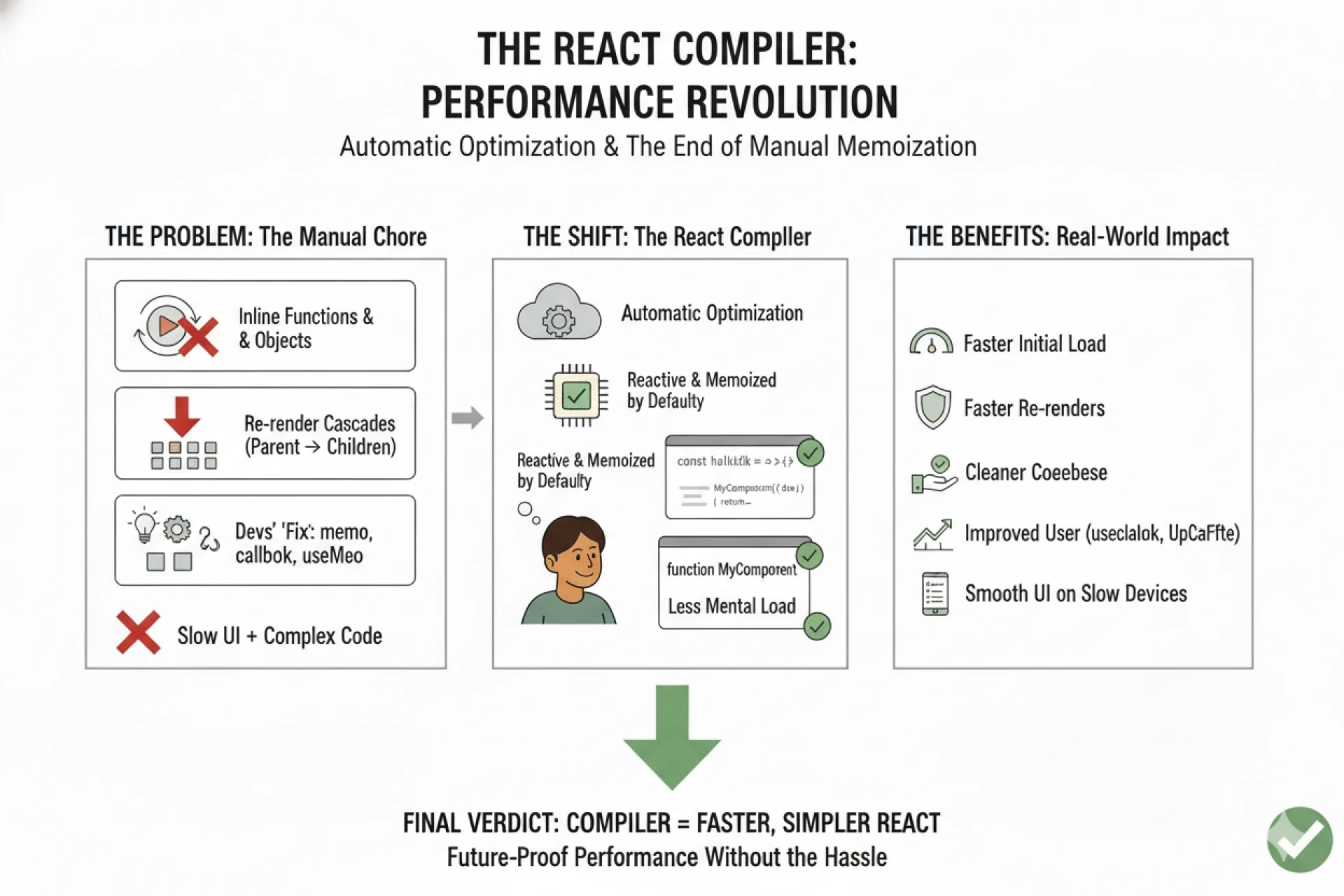
Why React Needed a Compiler in the First Place
For years, React developers have struggled with a very familiar problem: Unnecessary re-renders.
Even well-structured React apps often slow down because:
- Inline functions trigger re-renders
- Objects get re-created on each render.
- Deep trees re-render when parent props change.
- Expensive components re-run computation unnecessarily
- Missing memoization leads to slow UI updates.
The community’s solution?
React.memo, useMemo, useCallback, and countless hours profiling the component tree.
React knew this wasn’t scalable—especially as apps grew more interactive and data-heavy.
The new React Compiler exists to solve these problems automatically.
No more manual memoization.
No more obsessing over dependency arrays.
No more performance micro-management.
Sounds magical, right?
But does it work?
What the React Compiler Actually Does
Unlike previous versions, the new React Compiler is reactive and memoizes by default.
Here’s what it can automatically detect:
1. Which parts of your component depend on which variables
This means it can avoid re-running logic when nothing has changed.
2. When a component is pure
If the output only depends on inputs, the compiler memoizes it automatically.
3. When to skip running effects
If dependencies are unchanged, the compiler avoids unnecessary effect executions.
4. How to prevent needless re-render cascades
It stops child components from updating unless required—similar to React.memo, but smarter.
Instead of developers manually optimizing each component, the compiler takes over.
This is where companies using professional ReactJS development services see the real impact: fewer bugs, cleaner code, and predictable performance.
Why the React Compiler Feels Like a “Performance Miracle”
Let’s look at the practical benefits you actually feel in a production app.
1. No More useCallback and useMemo Everywhere
These hooks were meant as optimization tools, but developers used them for survival.
With the new compiler, many of these hooks become unnecessary because the compiler handles purity and memoization internally.
Your code becomes cleaner and easier to read, which is a massive win for large teams.
2. Massive Reduction in Re-render Count
Real-world apps with:
- complex dashboards
- tables with hundreds of items
- nested components
- frequent data updates
…have seen dramatic performance boosts.
Apps that were laggy even on strong devices become responsive on mid-range phones.
3. Smaller Mental Load for Developers
One of the most underrated benefits:
You don’t have to think about re-renders as much.
Junior developers write cleaner components.
Senior developers focus on architecture instead of micro-optimizing everything.
Teams that hire ReactJS developers get on board faster.
4. Consistent Performance Wins Without Hacks
No more patching performance issues with:
- unstable callbacks
- deep comparison utilities
- custom memo wrappers
- tricky dependency arrays
- handcrafted selectors
The compiler does what developers have been forced to do manually for years.
But… Is It Truly Perfect?
Not yet.
There are limitations you need to understand—especially if you’re building enterprise applications or working with a ReactJS web development company.
1. It only works on React code that follows the rules of React
Impure components, mutated props, or side-effect-heavy logic confuse the compiler.
2. It doesn’t eliminate the need for good architecture
A poorly separated state will still cause issues.
3. It’s young
There will be edge cases, bugs, and libraries that require updating.
4. Some optimizations still require developer decisions
You have the choice of what to exist on the server, what to run on the client, and how to design data flows.
The compiler is intelligent—though not mystical.
Imagine it is a co-pilot and not an autopilot.
So… Is It a Performance Miracle?
Yes—and no.
Yes, because:
- It removes 80% of the manual work that React developers used to do
- It eliminates many common performance mistakes.
- It significantly reduces re-renders in large apps.
- It cleans up codebases dramatically.
- It enables smoother UI on slower devices.
- It unlocks better performance without developer sacrifice.
No, because:
- It won’t fix architecture problems
- Some patterns still need optimization.
- It has limitations and learning curves.
- It isn’t fully mature yet.
But here’s the essential truth:
The largest step taken by React in the past decade is the React Compiler.
It also supports React, making it faster, more predictable, and more easily scaled, particularly when working with teams having large apps or those with an organization using a ReactJS development firm to modernize their current codebase.
The Future of React Will Be Compiler-Driven
We’re entering a new era of React development where:
- Components are optimized automatically
- Re-renders are predictable
- Performance is built in.
- Developers write fewer hooks and simpler code.
- Complex apps remain smooth even at scale.
Suppose that the old React was a mighty engine that had to be fiddled with manually all the time; the new React, which is taking the place of the compiler, seems to be an automatic-transmission engine.
React does the heavy lifting, although it is developers who drive.
Conclusion
So, is the new React Compiler a miracle?
It is not magic, but it manages to resolve actual issues that React teams have fought for decades. It minimizes re-renders, fixes codebases, enhances performance, and improves developer experience to improve significantly.
You are about to either upgrade an existing application or embark on a new application, and this is the best opportunity to engage already tried and tested ReactJS development services or hire specialists to lead you through the migration. The compiler is not a mere addition; it is the future of React.






















Sign in to leave a comment.