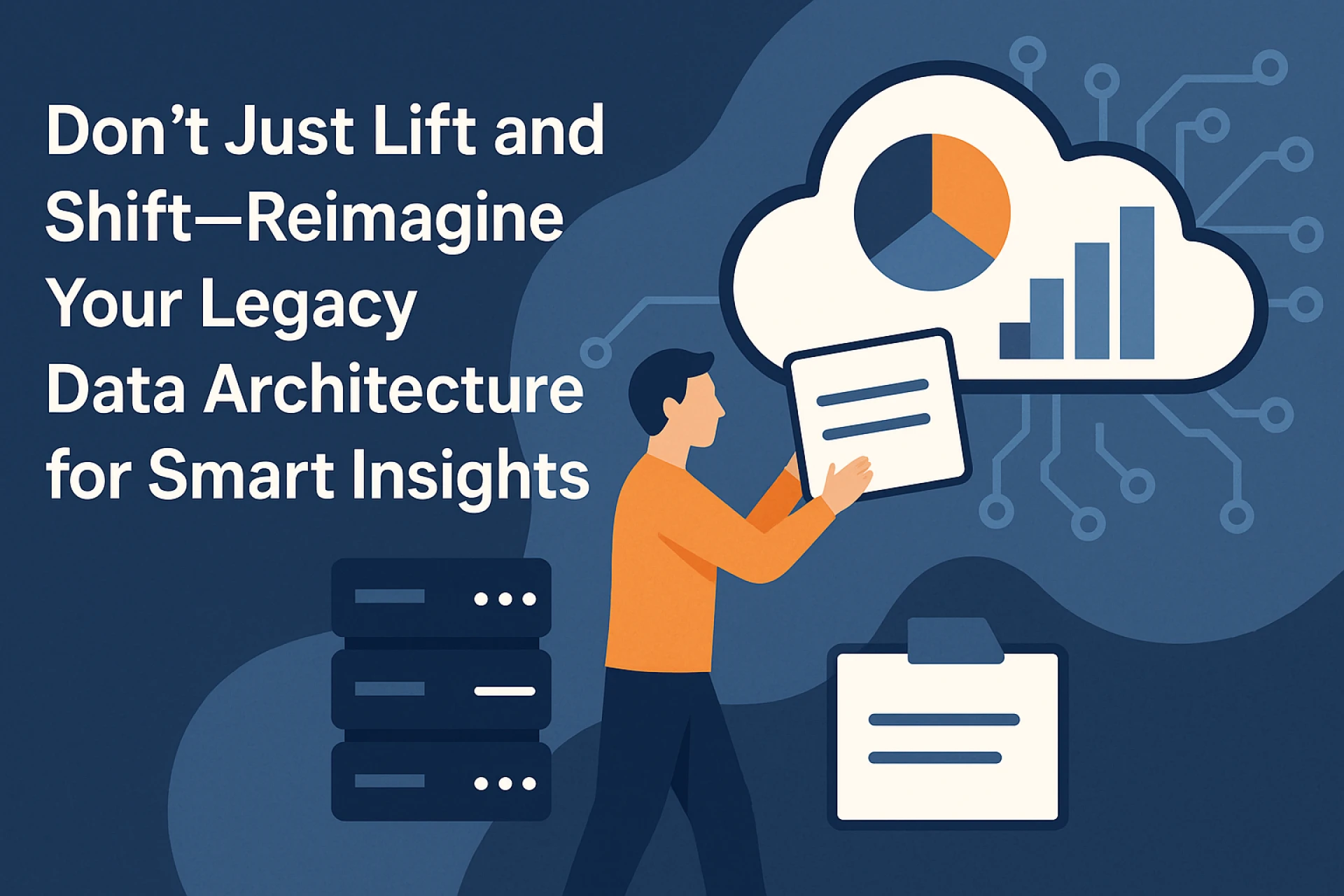

Nowadays, the digital world is so fast that businesses are literally overwhelmed with data. Legacy systems that were once the hallmark of reliability now often struggle to meet today's demands. Just by transferring these traditional systems to the cloud by a "lift and shift" process, it may be considered a simple way to solve the issue, but it practically never reveals the data's latent potential. Data architecture consulting is the next step that should be considered. By just changing the physical location of data, agencies will not be able to get the same level of efficiency as with well-planned data architecture restructuring. Along with the competitive advantage, the organization will also become capable of extracting quicker and smarter insights.
The Problem with Lift and Shift
A lot of companies think that the solution to all issues is just a click away, and that is by moving the current data structure to the cloud. They might imagine that all performance and scalability problems will be solved right after the data is moved to this new environment. But in reality, this is not it. Legacy data models, data silos, and inadequately structured data pipelines are the root causes of the slow pace of analytics and decision-making. Simply put, without an overhaul of the fundamental architecture, firms are essentially handing over cash to the cloud in return for limited rewards.
Also read: 6 Approaches to Modernize Legacy Applications
Why Reimagining Data Architecture Matters
The act of rethinking one's legacy data architecture is equivalent to starting from scratch, but this time with a focus on flexibility, scalability, and intelligence. Instead of just duplicating the old systems, this approach can help organizations enjoy a seamless flow of their data, easy access to analytics, and support of advanced technologies like AI and machine learning.
The proper design can help you:
Unlock real-time insight: Old systems often deliver data that are days late. Modern data architectures make it feasible to do a quick analysis, which can, in turn, lead to businesses taking immediate actions on critical information.
Simplify the situation: By integrating data from varied sources into one unified platform, the overall efficiency goes up, thus also the chances of errors decrease.
Make predictive analytics possible: A remodeled architecture enables organizations to predict the trends, speculating the needs of the customers, and taking proactive measures.
How Data Engineering Services Can Help
Data engineering services are very helpful when it comes to redesigning data architecture, which is a major challenge. Engineers handle tasks that involve data transportation, data cleansing, and data modification for the easy use of data by the analysts. As part of these, they may carry out cloud platform integrations, storage optimization activities, and even take up the responsibility of automation. In this way, a data network system that is both sustainable and efficient would be at your disposal.
The main rewards of professional data engineering services are:
- Better data quality: Fully automated pipelines reduce the frequency of both errors and inconsistencies.
- Quicker discovery of data: With flows made to be efficient, reporting and analytics can go on, almost, real-time.
- A future-proof infrastructure: Engineers can be in charge of coming up with systems that are easily adaptable, be it for new data sources or technologies.
Steps to Reimagine Your Legacy Data Architecture
Step 1. Analyze the current situation: Know your strengths and limitations of your existing systems. Identify data silos, outdated processes, and bottlenecks.
Step 2. Clarify a vision that is ready for the future: Determine the way your data architecture, staff, and structure will operate to help the business achieve its set goals. Think about solutions that are cloud-native, hybrid architectures, or data lakehouse models.
Step 3. Collaborate with the pros: Get help from data architecture consulting and data engineering groups to implement a plan that you can scale and that works well practically.
Step 4. Start implementation step by step: The process of modernization should be gradual. Make a start with the areas of high value to see quick wins, and then slowly extend the whole enterprise.
Step 5. Keep track of the situation and work on it: Measure the performance consistently and make your pipelines, storage, and data models efficient and up to date by adjusting them.
The Bottom Line
Just moving and transferring your old data systems to the cloud may be a quick solution to the problem of data management, but it will not give you the necessary insights to compete with other companies in a data-driven world. When you rebuild your data architecture with the help of data architecture consulting and the support of Data Engineering Services, you can turn your data into a business advantage.
The new and modern data architecture that is properly designed not only keeps data, but also allows the organization to make decisions more intelligently and quickly. It is already time to get rid of the lift-and-shift mindset. The real value of your data can be unleashed only by rethinking the data flow, management, and analysis.
























Sign in to leave a comment.