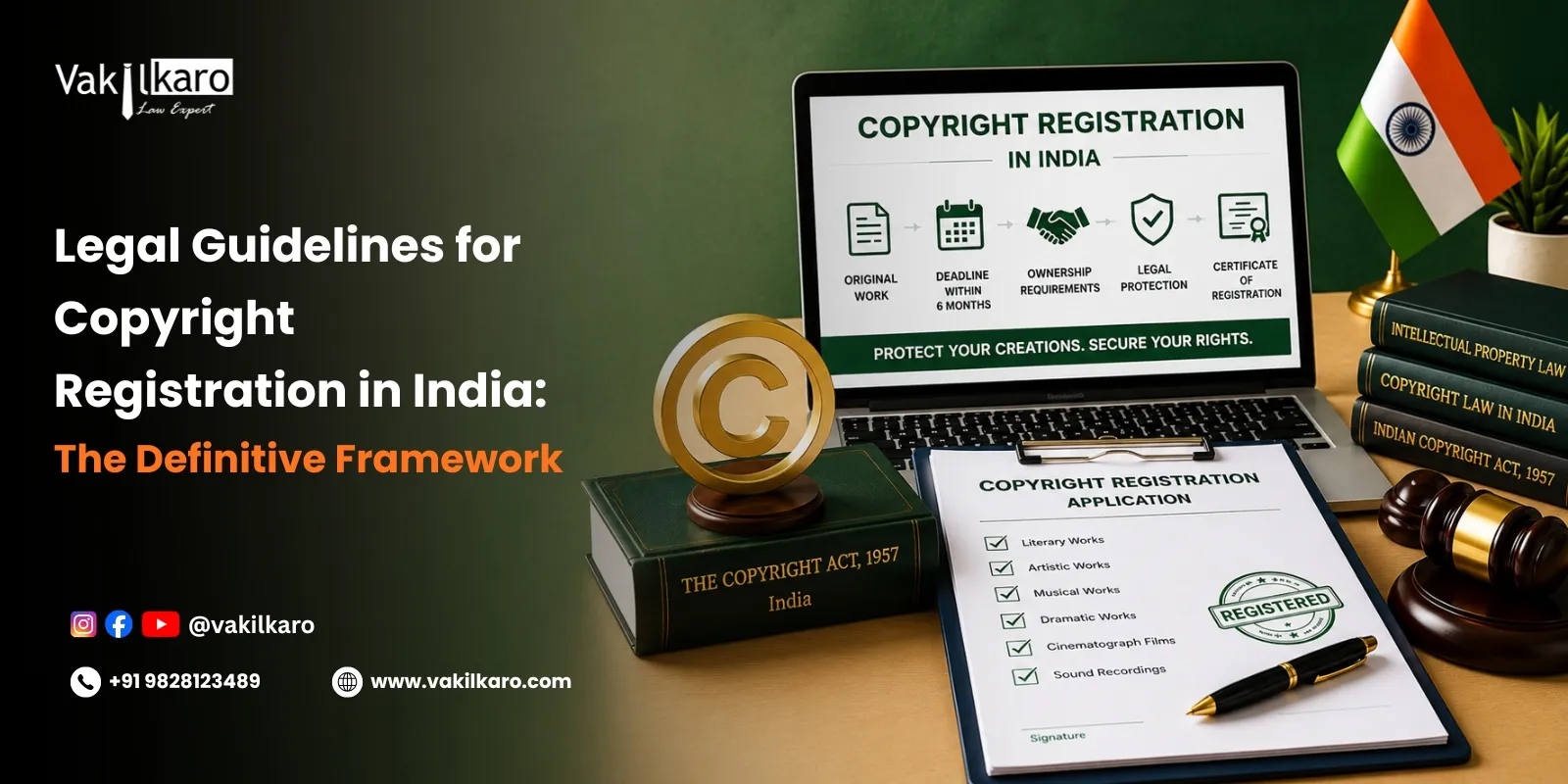

Navigating institutional enforcement is a completely different matter, even though copyright protection under Indian jurisprudence is born automatically the instant an original work is fixed in a tangible medium. Moving past the fundamental belief that creation is sufficient to shield you in a significant legal dispute is necessary when operating within the federal registry. Asserting your rights during an infringement crisis can easily result in expensive operational delays if there isn't a formal public record.
Guidelines for Copyright Registration under the Indian Copyright Act, 1957
In India, the corporate and creative asset registration is strictly governed under the Copyright Act, 1957, when read in conjunction with the Copyright Rules. Thereby, according to Section 48 of the Act, a registration certificate is considered prima facie that is at the first sight evidence in a court of law. Therefore, even though a registration is optional, having an official certificate clearly establishes a legal presumption of ownership, immediately shifting the burden of proof to any actor who breaks the law or behaves dishonestly.
- The Separate Application Rule: For each individual work you want to protect, you must submit a separate application under Rule 70 along with the unique prescribed fee.
- The 30-Day Static Window: Before an examiner reviews the file, all applications must go through a mandatory 30-day public notice period during which third parties may submit objections.
- The Trademark Cross-Check: A cleared Search Certificate from the Trademark Registry is required for any application pertaining to a Copyright Registration of a logo or an artistic creation used for commercial goods.
1. Eligible Subject Matter: Categorizing Your Corporate Assets
Making sure your asset clearly falls into one of the legally recognized categories of protected works is the first and most important rule under Section 13 of the Copyright Act. If you submit an asset under the incorrect category, the examiner will reject it, requiring you to reapply and pay additional fees.
Text, data compilations, and written expressions are all included in literary works. Computer programs, software source code, object code, and corporate databases are specifically registered as literary works under Indian law. When obtaining exclusive corporate designs, artistic works—which include paintings, drawings, architectural blueprints, photographs, and commercial illustrations—are the main category. Lastly, regardless of the underlying scripts or musical scores, Cinematograph Films and Sound Recordings protect all visual and audio recordings, including corporate commercials, training podcasts, and promotional videos.
2. Step-by-Step Execution: Navigating Online Copyright Registration
All modern applications must be processed electronically, according to the Copyright Office. A precise multi-stage pipeline is required to carry out an online copyright registration. Form XIV that is the Application for Registration of Copyright must be filled out by the applicant or their designated attorney. The title of the work, the language used, the publication status, and full identifiers for the author and the copyright owner are all required disclosures on this form.
Furthermore, a required attachment known as the Statement of Particulars (SOP) outlines the chain of title, including who created the work, where it was first published, and who currently owns the economic rights. Lastly, you have to use the portal to upload clear, underacted soft copies of the work. Software programs, for example, demand that a PDF containing at least the first ten and last ten pages of the source code with no redactions be uploaded.
3. Special Prerequisites: Mandatory Clearances and Consents
The guidelines mandate that an application should include a clear documentation that will be proving the chain of title, especially when the applicant is not the sole author of the same. The Trademark Clearance Requirement is crucial: that is before submitting an artistic work that can be used on goods or services, Section 45(1) mandates that you should conduct a copyright certificate search and obtain a Clear Search Certificate that is TM-C from the Trademark Registry. This proves that your design and an already-registered brand don't conflict with each other.
Additionally, you need to upload a formal No-Objection Certificate (NOC) or an Assignment Agreement signed by the creator if the asset was created by an outside software company, independent contractor, or vendor. In the absence of this, the individual contractor—rather than the hiring organization—retains the legal presumption of first ownership under Section 17 of the Act.
4. The Examination Pipeline: Handling Objections and Discrepancies
After your application is submitted and a unique Diary Number is generated for the same, it is then subjected to a strict statutory evaluation process. The public ownership objections may be raised during the required 30-day waiting period for the filing. If no objections are voiced by that time, a senior examiner reviews the file to search for any discrepancies in the data.
The office sends out a formal discrepancy notice if mistakes are found. After the notice date, you have 30 days to submit a formal response. The Registrar enters the work into the official Register of Copyrights after all objections and inconsistencies have been resolved. The Registrar will notify both parties in the event that a third party files an objection, and the parties may be summoned to a formal hearing to ascertain true ownership.
Conclusion and Strategic Portfolio Management
A dependable method of transforming your digital and creative assets into safe, legally protected business property is to adhere to the official copyright registration guidelines. Accurately submitting your application avoids administrative delays and protects your business from expensive intellectual property disputes because the registration process is open to public opposition. You can shield your business from legacy legal liabilities by carefully managing your public filings and maintaining accurate records of creation.
Strategy is Key:
- Verify Categories Before Filing: Even before submitting, you should make sure your software, documentation, or creative files are listed under the appropriate statutory category by comparing your digital assets to the Section 13 requirements.
- Clear Trademark Checks Early: Before beginning your copyright application, you should obtain your TM-C search certificate from the Trademark Registry if you are registering a logo or commercial design.
Keeping your intellectual property portfolio organized helps to keep your company safe and strong. For insightful, forward-thinking information on asset management and corporate compliance, stay tuned to the Vakilkaro Brief. To turn your innovations into a safe, defendable market position, Vakilkaro offers comprehensive portfolio engineering, sophisticated asset search systems, and specialized corporate advisory.






















Sign in to leave a comment.