
For commercial property owners, long-term savings are calculated not just in lower utility bills, but in the total cost of owning and operating a building over decades. Commercial spray foam in Sioux Falls, SD delivers these savings by fundamentally transforming a building's performance. It drastically cuts energy consumption by creating a seamless air and thermal barrier, but the financial benefits go much further. This high-performance envelope allows for smaller, more efficient HVAC systems, reduces maintenance costs by preventing moisture damage, and enhances the building's structural durability, extending its service life. In a climate like Sioux Falls, with its punishing winters and hot summers, these combined savings make spray foam a powerful long-term financial strategy. This investment yields substantial benefits across critical areas such as energy consumption, HVAC system efficiency, building maintenance, and overall structural integrity, which this guide will explore.
This guide will break down the specific ways that an investment in commercial spray foam pays dividends for years to come, moving beyond the monthly energy bill to the bigger picture of asset management. The information is based on the practical realities of commercial construction and building science, offering a clear view for business owners and facility managers.
A Direct and Drastic Reduction in Energy Costs
Energy is one of the largest operating expenses for any commercial building, especially large, open structures like warehouses, manufacturing plants, or agricultural buildings. These buildings are notoriously difficult and expensive to heat and cool.
Sealing the Leaky Box
Most commercial buildings, particularly those made of steel, are full of air leaks. Gaps in the metal panels, around doors, and at the roofline allow for a massive amount of uncontrolled air exchange. In the winter in Sioux Falls, this means the heating system is essentially trying to heat the entire outdoors. In the summer, it is fighting a constant influx of hot, humid air.
Spray foam’s primary advantage is its ability to create a complete air seal. It is applied as a liquid and expands to fill every single gap, crack, and seam, creating a monolithic barrier that stops air leakage. This alone can reduce a building's heating and cooling costs by 30% to 50%. By stopping the leaks, the HVAC system no longer has to fight a constant battle against the outside elements.
The Power of Continuous High R-Value
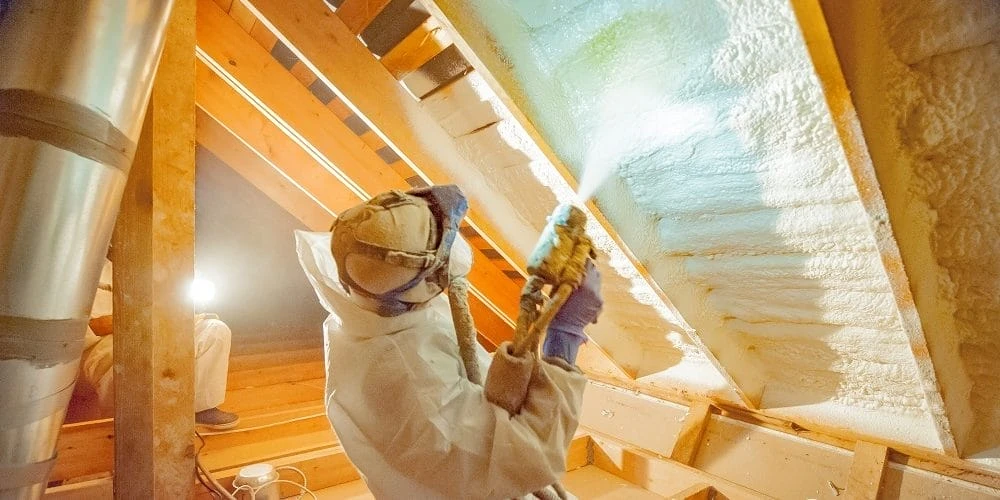
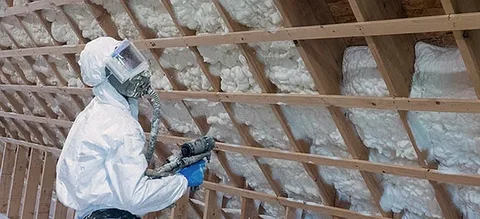
In addition to being an air barrier, spray foam insulation in Sioux Falls offers a high R-value of around R-7 per inch. It is applied in a continuous layer, which eliminates the problem of "thermal bridging," where heat can conduct through the steel studs or purlins, a major source of energy loss in metal buildings. This continuous thermal blanket ensures the entire building is protected, maximizing the efficiency of the heating and cooling systems. The visual below depicts a professional team applying closed-cell spray foam to a commercial building's interior, showcasing this transformative process firsthand.

Smaller HVAC Systems and Lower Maintenance
The single biggest factor in determining the size and cost of a commercial HVAC system is the building's heating and cooling "load," which is the amount of energy required to maintain a comfortable temperature inside.
Right-Sizing Your Equipment
By dramatically improving the building envelope's performance with spray foam, the heating and cooling load is significantly reduced. For new construction, this means a much smaller, less expensive HVAC unit can be specified and installed. The savings on the initial capital cost of the HVAC equipment can be substantial, in some cases enough to offset a significant portion of the insulation cost.
For a retrofit project, the existing HVAC system will now be oversized for the building's needs. This means it will run in shorter, more efficient cycles, drastically reducing wear and tear. This leads to fewer breakdowns, lower repair bills, and a much longer operational lifespan for the equipment, which is a major long-term saving.
Enhanced Building Durability and a Longer Lifespan
Moisture is the enemy of a commercial building, especially one made of steel. Condensation is a common and destructive problem.
Preventing Condensation and Corrosion
In the winter, the warm, moist air inside a heated building comes into contact with the cold surface of the metal roof and walls. This causes condensation to form, which then drips down, damaging inventory, creating slip hazards, and, most importantly, causing the steel structure to rust and corrode over time.
Closed cell spray foam is a vapor barrier. When applied directly to the interior of the metal panels, it keeps the warm, moist indoor air from ever touching the cold metal surface. This completely eliminates condensation, protecting the building's steel structure from rust and degradation. This preventative measure saves a huge amount of money in future maintenance and repair costs and significantly extends the life of the building itself. Additionally, the closed cell foam's rigid structure and adhesive properties also add a significant amount of racking strength to a building, making it more resistant to high winds, a common concern on the plains of South Dakota.
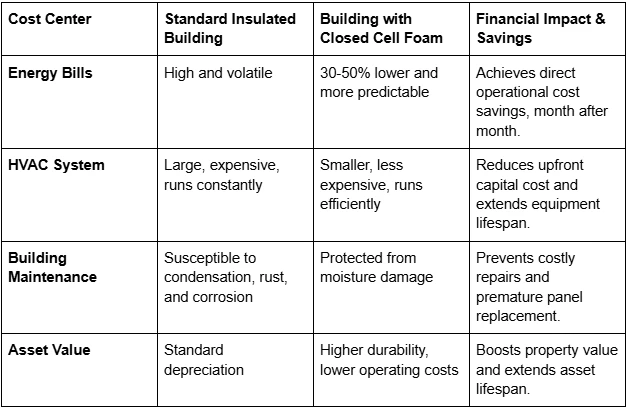
Here is a summary of the long-term financial impact:
Things to Consider Before Investing
Before committing to an investment, it's vital to consider several key factors to ensure optimal returns:
- Upfront Cost vs. Total Cost of Ownership: Spray foam is a premium product with a higher initial cost than materials like fiberglass blankets. However, business owners should evaluate the investment based on the total cost of ownership over 10, 20, or 30 years. The savings in energy, HVAC, and maintenance often provide a rapid return on investment.
- Choosing the Right Contractor: Commercial spray foam installation is a large-scale, technical job. It is essential to hire a contractor with proven experience in commercial buildings. They need to have the right equipment and safety protocols to handle a project of this size.
- The Building's Use: The specific use of the building will determine the required R-value and other considerations. A climate-controlled warehouse will have different needs than a livestock barn or a manufacturing facility. A professional contractor can help engineer the right solution.
Questions Business Owners Ask
What is the typical ROI on a commercial spray foam project?
While it varies depending on the building and its use, many businesses see a return on their investment in as little as 3 to 5 years through energy savings alone. When the savings from lower maintenance and HVAC longevity are factored in, the ROI becomes even more compelling.
Can spray foam be applied to an existing, operational building?
Yes. Experienced contractors can work in sections and schedule the work to minimize disruption to business operations. Proper ventilation and site containment are key to ensuring a safe process.
Does applying spray foam to the roof deck help with leaks?
While spray foam is not considered a primary roofing material, its seamless, monolithic, and waterproof nature can seal small existing leaks and add a secondary layer of water protection, further protecting the building and its contents.
Bonus Tip: For existing commercial buildings, a professional energy audit that includes thermographic imaging can be a powerful tool. It can visually show exactly where the building is losing the most heat, helping to build a clear business case for an insulation upgrade.
Final Thoughts on a Strategic Investment
For business owners in Sioux Falls, commercial spray foam insulation is not merely a building material; it represents a powerful long-term financial tool. It transforms a major liability, energy consumption, into a controlled and reduced expense. It also protects the physical asset of the building from degradation, thereby lowering future capital expenditures. This is a strategic investment that pays for itself through multiple streams of savings, making a business more profitable, sustainable, and resilient for years to come.
Get a Professional Commercial Building Assessment
To understand the specific long-term savings potential for your commercial property, a detailed evaluation by an experienced professional is the first step. A qualified contractor can provide a comprehensive energy analysis and a clear, data-driven proposal. For business owners in the Sioux Falls area, the team at Foam Worx Spray Foam Insulation offers specialized expertise in commercial applications. They can be reached for a consultation by email at [email protected] or by phone at (507) 407-0678.
Reviewer: Jacob Wright has 6 years of experience in spray foam insulation. He reviewed this content and made sure it focused on the real decisions small business owners deal with every day.

























Sign in to leave a comment.