

Machine Learning (ML), a branch of artificial intelligence (AI), is significantly transforming numerous sectors, with its impact on healthcare being both deep and extensive. By improving diagnostics, personalizing treatment plans, forecasting epidemics, and streamlining clinical processes, ML is fundamentally changing the delivery and experience of healthcare. As this technology progresses, it promises to enhance healthcare's predictive, preventive, and personalized capabilities.
What is Machine Learning in Healthcare?
Machine learning entails training algorithms to identify patterns and make decisions based on data. Unlike conventional programming, where rules are explicitly defined, ML systems learn from extensive datasets to enhance their performance over time. Within the healthcare context, these systems evaluate various data types—including electronic health records (EHRs), medical imaging, genomics, and information from wearable devices—to extract valuable insights that can aid clinicians in diagnosing conditions, choosing treatments, and managing patient outcomes.
This data-centric approach is especially beneficial in a field as intricate and variable as healthcare, where tailored treatment and prompt intervention can significantly influence the difference between recovery and decline.
Key Applications of Machine Learning in Healthcare
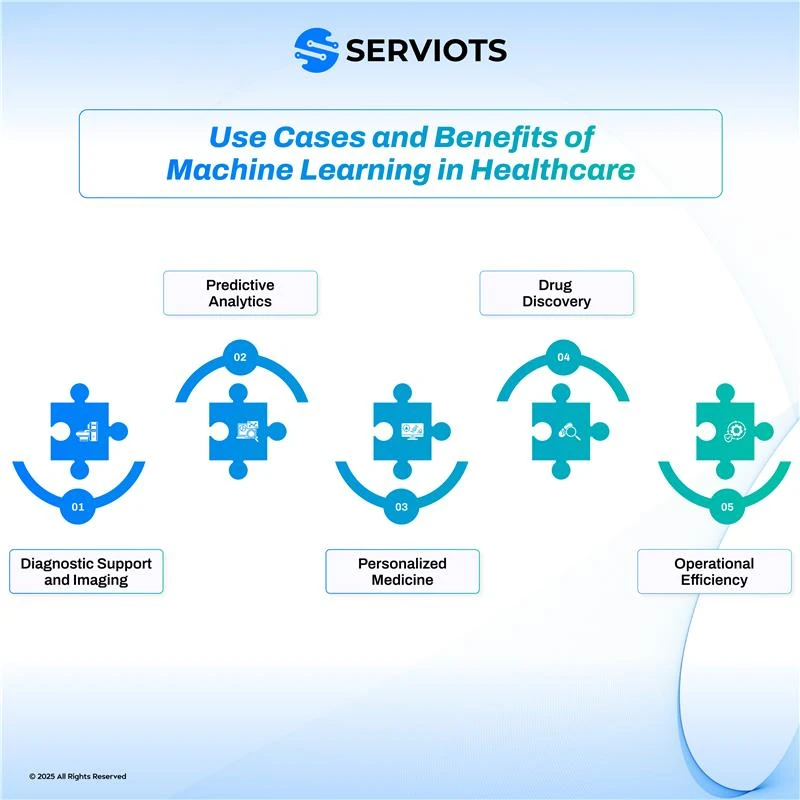
1. Medical Imaging and Diagnostics
One of the earliest and most effective uses of machine learning in the healthcare sector is in the realm of medical imaging. Sophisticated machine learning models, especially those employing deep learning techniques, are capable of analyzing medical images such as X-rays, CT scans, and MRIs to identify abnormalities with exceptional accuracy.
Google’s DeepMind has created algorithms that can diagnose more than 50 eye conditions from retinal scans, achieving accuracy comparable to that of top ophthalmologists.
Machine learning tools are utilized for the early identification of various cancers, including breast, skin, and lung cancers, frequently detecting signs that may elude human observation.
Radiologists now leverage machine learning to highlight anomalies, prioritize cases, and even track the progression of diseases over time.
2. Predictive Analytics
Machine learning is particularly proficient in predictive analytics, which involves forecasting future health outcomes based on historical data.
Machine learning models assist hospitals in predicting readmission risks, enabling them to take preventive actions.
Predictive tools evaluate a patient’s likelihood of developing chronic illnesses such as hypertension, diabetes, and cardiovascular diseases.
Public health officials employ machine learning to predict flu outbreaks and other epidemiological patterns, thereby enhancing resource distribution and intervention strategies.
3. Personalized Medicine
A notable transformation in contemporary healthcare is the transition towards personalized medicine. Machine Learning (ML) plays an essential role in this area by examining genetic information, lifestyle factors, and treatment histories to customize therapies for individual patients.
In the field of oncology, personalized treatment strategies are formulated using ML algorithms that analyze genomic profiles and pinpoint biomarkers.
ML can assess the probable effectiveness of a medication for a particular patient, thereby decreasing trial-and-error prescribing and lessening adverse reactions.
With the advent of wearable devices and mobile health applications, continuous monitoring data can be utilized to modify treatments in real time.
4. Drug Discovery and Development
The process of drug development has traditionally been slow and expensive. ML enhances this process by:
Identifying potential drug candidates through the analysis of biomedical literature and compound databases.
Predicting drug-target interactions and potential side effects through simulation and modeling.
Repositioning existing drugs for new uses, thus shortening development timelines and lowering costs.
Organizations such as BenevolentAI and Atomwise are at the forefront of employing ML in drug discovery, significantly expediting the transition from research to clinical application.
5. Clinical Decision Support Systems (CDSS)
ML-driven CDSS offer clinicians evidence-based recommendations by synthesizing patient data, clinical guidelines, and real-time analytics.
These systems can notify healthcare providers of potential diagnoses, suggest treatment plans, and highlight possible medication interactions.
ML-based tools are increasingly utilized in emergency departments and intensive care units, where swift and precise decisions are crucial.
By minimizing diagnostic errors and enhancing clinical judgment, these tools play a significant role in improving patient outcomes.
6. Operational Efficiency in Healthcare
In addition to patient care, machine learning (ML) significantly improves the administrative and operational efficiency of healthcare organizations.
ML algorithms enhance the allocation of resources, scheduling of staff, and management of beds within hospitals.
Predictive models anticipate patient admissions and discharges, aiding in effective capacity planning.
Automation of billing, coding, and claims processing minimizes human error and alleviates administrative burdens.
These advancements result in cost savings and enable healthcare professionals to concentrate more on tasks centered around patient care.
Challenges and Considerations
Despite its significant potential, the implementation of machine learning in the healthcare sector is accompanied by various challenges. These obstacles must be meticulously addressed to guarantee ethical, effective, and equitable application.
1. Data Privacy and Security
Healthcare data is extremely sensitive, and its utilization is regulated by strict laws such as HIPAA (Health Insurance Portability and Accountability Act) and GDPR (General Data Protection Regulation). Balancing data privacy and protection with the need for access during model training presents a complicated dilemma.
Anonymization and de-identification of patient information are widely used methods, yet they require careful execution to avoid the risk of re-identification.
Emerging solutions like secure data-sharing frameworks and federated learning approaches aim to uphold privacy while facilitating collaborative learning.
2. Algorithmic Bias and Fairness
Machine learning models are only as effective as the data on which they are trained. If this data is biased or not representative, the resulting models may reinforce or even worsen health disparities.
For instance, a diagnostic model that is primarily trained on data from a single demographic group may yield poor performance for other groups.
Continuous auditing and validation across varied populations are crucial to ensure fairness and equity in machine learning outcomes.
3. Model Interpretability
In order for machine learning to gain widespread acceptance in clinical practice, it is essential for healthcare professionals to comprehend and have confidence in the recommendations provided by the system.
Although black-box models are highly effective, they frequently lack the necessary transparency.
There are ongoing initiatives aimed at creating interpretable machine learning models and visualization tools that clarify the processes behind predictions.
4. Regulatory Approval and Compliance
Prior to the implementation of machine learning-based tools in clinical environments, it is imperative that they obtain approval from regulatory authorities such as the U.S. FDA or the European Medicines Agency.
This approval process demands thorough validation, reproducibility, and comprehensive documentation.
Regulatory agencies are modifying their frameworks to accommodate the evolving nature of machine learning, including models that adapt and improve after deployment.
5. Integration with Existing Systems
The deployment of machine learning solutions necessitates integration with existing health IT infrastructures, which can present significant technical challenges.
Key factors include compatibility with electronic health record (EHR) systems, data interoperability, and alignment with current workflows.
Additionally, it is vital to train clinicians and staff to utilize machine learning tools effectively to ensure successful implementation.
The Path Forward: Enhancing, Not Displacing Human Care
The prospects of machine learning in the healthcare sector are undeniably bright. As data becomes increasingly available and computational techniques advance, machine learning will persist in revealing new opportunities within medical science and patient care.
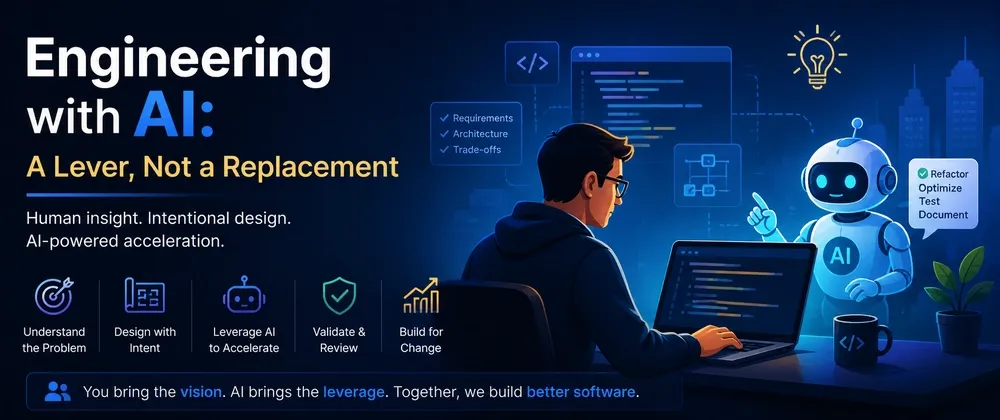
Nonetheless, it is crucial to acknowledge that machine learning serves as a tool rather than a substitute for human insight. Empathy, ethical judgment, and clinical expertise are irreplaceable components of healthcare.
The responsible development, validation, and implementation of machine learning technologies can foster a more proactive, accurate, and personalized healthcare system. Cooperation among technologists, healthcare professionals, regulators, and patients will be essential to achieving this potential.
In summary, machine learning represents not merely an innovation but a driving force for a transformation in healthcare. When applied judiciously, it has the capacity to empower healthcare practitioners, improve patient outcomes, and create a more intelligent, compassionate healthcare ecosystem for the future.
























Sign in to leave a comment.