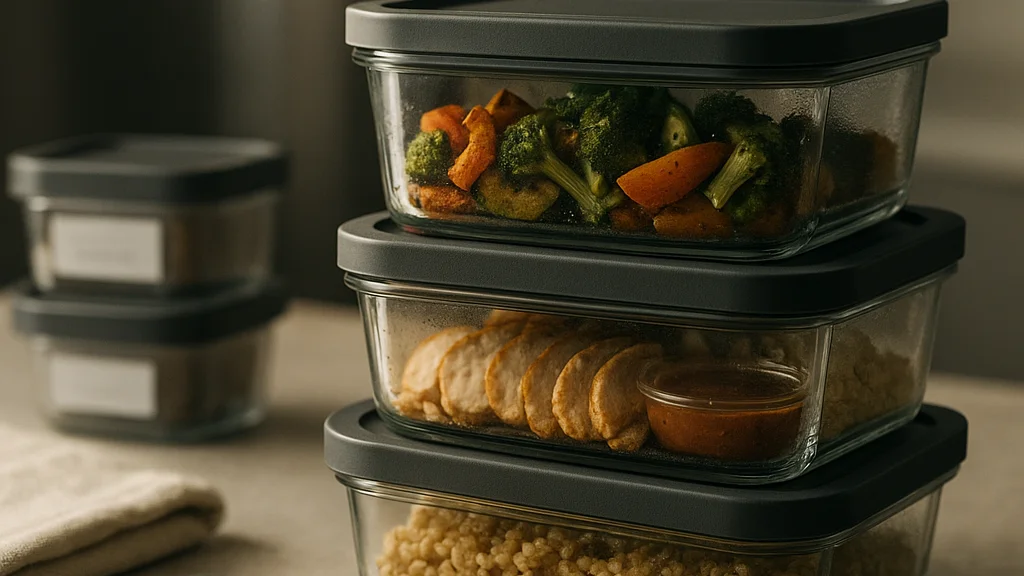

The most effective meal prep strategy for a busy professional is not cooking more. It is reducing daily decision-making. That distinction matters because most failed meal-prep systems are built like weekend projects rather than repeatable operating models. By Wednesday, the polished glass containers are half-empty, the salad greens are limp, and takeout has quietly reclaimed the calendar. The problem is rarely motivation. It is system design.
That conclusion is echoed across consumer coverage and practical guides. A recent MSN roundup on healthy meal prep for busy professionals emphasized speed, modular recipes, and low-friction assembly over elaborate Sunday cooking marathons. The framing is useful because time scarcity, not culinary ambition, is the binding constraint for most office workers, founders, consultants, clinicians, and hybrid employees. If your workday regularly runs from early meetings into late email triage, the right question is not what looks impressive on Instagram. It is what survives a real week.
Professionals are also contending with a changed food environment in 2026. Grocery prices remain a live concern for many households, restaurant delivery fees are still materially higher than pre-pandemic norms in many cities, and return-to-office policies have pushed more workers back into commuting routines that compress breakfast and lunch. In that context, meal prep has become less of a wellness hobby and more of a practical response to time, cost, and energy volatility.
This is where a disciplined approach helps. Think in terms familiar to anyone who has worked with OKRs or postmortems: identify failure points, standardize what can be standardized, and reserve creativity for the parts that actually benefit from it. Readers who want a companion perspective can compare this framework with Effective Meal Prep Strategies for Busy Professionals and Meal Prep Strategies for Busy Professionals That Actually Work, both of which underline the value of repeatable habits over aspirational overhauls.
Meal prep works best when it behaves like infrastructure: mostly invisible, highly reliable, and designed to remove friction before the workweek begins.
Why conventional meal prep fails by midweek
Many professionals approach meal prep with the wrong unit of analysis. They prep dishes, not workflows. A finished tray of baked pasta may solve Monday dinner, but it does not automatically solve Tuesday lunch, Wednesday appetite fatigue, or Thursday's late train home. The result is a common pattern: strong start, diminishing compliance, then a complete break in the system.
There are four recurring reasons this happens. First, people overestimate available prep time on weekends. A two-hour block often turns into shopping, cleaning, chopping, cooking, cooling, and packing, which is closer to a half-day operation than a quick reset. Second, they make too few interchangeable components. If every container is a completed meal, there is little room to adapt when schedules shift. Third, they ignore shelf-life realities. Cooked seafood, dressed greens, sliced avocados, and some roasted vegetables degrade quickly. Fourth, they optimize for health theater rather than adherence, choosing meals that look virtuous but do not satisfy hunger or fit the workday.
That last point is underappreciated. A lunch that is technically balanced but leaves you hungry by 3 p.m. is not efficient. It simply delays spending. Busy professionals need meals that travel well, reheat predictably, and provide enough protein, fiber, and volume to reduce opportunistic snacking. This is especially true for workers with irregular schedules, such as nurses, sales teams, attorneys in trial preparation, or managers moving between meetings without a real lunch break.
Industry reporting over the past several years has repeatedly shown that convenience is a primary purchase driver in food decisions. That should shape home prep too. The best systems do not demand ideal conditions. They assume interruptions. A useful diagnostic is simple: if your meal-prep plan collapses after one late meeting, one grocery substitution, or one dinner out, it was too brittle.
- Overproduction: cooking seven distinct lunches at once increases labor and boredom.
- Under-seasoning: food meant to last three or four days needs stronger flavor architecture to remain appealing.
- Poor container logic: using the wrong sizes leads to sogginess, leaks, and portion drift.
- No backup layer: without freezer meals, canned proteins, or shelf-stable staples, one disruption triggers takeout.
For a useful counterpoint on avoidable errors, Common Meal Prep Mistakes Busy Professionals Make in 2026 is worth reading alongside this article. The underlying lesson is consistent: successful prep is less about intensity and more about resilience.
The modular method: prep components, not just meals
The strongest strategy for busy professionals is a modular system built around components that can be recombined in five to ten minutes. This is how restaurant kitchens and efficient home cooks preserve speed without sacrificing variety. Instead of making five complete lunches and five complete dinners, you prepare a short list of building blocks: one or two proteins, one grain or starch, two vegetables, one sauce, one crunch element, and one emergency freezer option.
That architecture creates optionality. Roasted chicken can become a grain bowl on Monday, a wrap on Tuesday, a soup addition on Wednesday, and a quick fried rice on Thursday. Cooked lentils can anchor a salad, bulk up a pasta sauce, or fill a grain bowl. A yogurt-herb sauce can work across chicken, salmon, roasted vegetables, or chickpeas. The point is not culinary novelty for its own sake. It is reducing the number of steps between hunger and a decent meal.
Professionals often ask how much to prep. A practical answer is to prep for 60 to 70 percent of the week's meals, not 100 percent. Full coverage sounds disciplined but tends to generate waste and fatigue. Partial coverage is more realistic and leaves room for social dinners, office lunches, or spontaneous schedule changes. In operations terms, this is capacity planning with buffer.
A strong modular prep session might include:
- One high-protein anchor such as chicken thighs, baked tofu, turkey meatballs, or hard-boiled eggs.
- One secondary protein or legume such as black beans, edamame, or canned tuna for variety and speed.
- One grain or starch such as rice, quinoa, farro, potatoes, or whole-wheat pasta.
- Two vegetables with different textures, for example roasted broccoli and sliced cucumbers.
- One sauce or dressing that can transform repeated ingredients.
- One breakfast component such as overnight oats, egg bites, or Greek yogurt packs.
- One freezer-ready fallback meal for the night everything goes sideways.
This approach also aligns with practical advice found in Inside Meal Prep Strategies for Busy Professionals, which emphasizes the value of structure over complexity. The professionals who stick with meal prep are rarely the ones cooking the fanciest food. They are the ones who can assemble a satisfying lunch in under three minutes before a commute.
If a prepared component cannot serve at least two different meals, it may be too specialized for a high-pressure workweek.
There is a nutritional upside too. Modular systems make it easier to distribute protein and fiber consistently across the day. That matters for satiety, energy stability, and the simple ability to avoid making expensive decisions while hungry.
Time, cost, and nutrition: the numbers that matter
Meal prep is often sold as a wellness tactic, but for busy professionals the economics are just as persuasive. Consider the arithmetic. A purchased weekday lunch in a major U.S. city can easily run from $12 to $20 before taxes, delivery fees, or coffee add-ons. Even conservative assumptions put a five-day lunch habit at $60 to $100 a week. Over a month, that becomes a meaningful line item. Home-prepped lunches vary widely by ingredient choice, but grain bowls, pasta-based meals, soups, bean dishes, and roasted protein combinations usually come in far lower on a per-serving basis.
The same logic applies to breakfast. A coffee shop breakfast sandwich and drink can push past $10 in many business districts. By contrast, overnight oats, egg muffins, yogurt with fruit, or freezer burritos can be made in batches at a fraction of that cost. For professionals managing student loans, childcare, rent, or travel, the cumulative savings are not abstract. They are budgetary breathing room.
Time is more nuanced. Meal prep does not eliminate cooking time; it redistributes it. The gain comes from collapsing multiple decisions and cleanup cycles into one coordinated block. If you cook dinner from scratch four separate weeknights, you repeat setup, chopping, cooking, and cleaning four times. A 90-minute prep session that yields lunches, breakfasts, and dinner components can reduce total active labor over the week, even if the weekend block feels concentrated.
Nutrition is the third leg of the stool. According to federal dietary guidance in the United States, many adults still underconsume vegetables, whole grains, and fiber while overconsuming sodium and added sugars. Home prep does not automatically fix that, but it improves control. You choose the oil level, the salt, the portion size, and the protein source. You can also engineer meals for satiety rather than simply for calorie minimization, which tends to be more sustainable for working adults.
- Best cost performers: beans, lentils, eggs, oats, rice, potatoes, frozen vegetables, canned fish.
- Best time performers: rotisserie chicken, pre-washed greens, microwave grains, frozen edamame, jarred sauces used strategically.
- Best satiety performers: meals combining protein, fiber, and a moderate amount of fat.
- Worst value traps: aspirational ingredients bought for one recipe and never reused.
The MSN guide linked earlier leans into this same logic by centering recipes that can be assembled quickly and repeated without much friction. That is the right instinct. Busy professionals do not need culinary maximalism. They need dependable throughput.
What changed recently: meal prep in 2026 is more hybrid
The meal-prep conversation in 2026 looks different from the early pandemic years, when many workers had more home-based routines and broader windows for cooking. A large share of professionals now operate in hybrid schedules, which creates a split reality: some meals happen at home, others in transit, and others at the office with limited refrigeration, microwave access, or social predictability. This has pushed meal prep toward portability and flexibility.
One visible shift is the rise of the “assembly-first” lunch. Instead of fully dressed salads or mixed bowls that degrade by noon, professionals are packing compartmentalized meals with sauces on the side, crunchy toppings separate, and proteins portioned independently. The method is not glamorous, but it preserves texture and extends shelf life. Another shift is increased reliance on freezer support. More workers are keeping frozen breakfast burritos, soups, dumplings, or cooked grains in reserve as insurance against schedule volatility.
Grocery retail has adapted too. Across major chains, shoppers now find more pre-cut vegetables, ready-cooked grains, marinated proteins, and family-size convenience packs aimed at reducing prep labor. Purists sometimes dismiss these products, but for time-poor professionals they can be rational purchases. If a slightly higher unit cost on pre-chopped vegetables prevents three restaurant meals, the net economics may still be favorable.
There is also more awareness of food safety and storage discipline. Professionals have become more sophisticated about cooling cooked food promptly, labeling containers, and sequencing meals by perishability. Seafood and leafy salads are often front-loaded earlier in the week; sturdier grain bowls, chilis, curries, and frozen meals are reserved for later. That sequencing is one of the simplest upgrades a household can make.
Current guidance circulating in practical meal-prep media, including the MSN feature on quick healthy meal prep ideas, also reflects a broader move toward shorter prep windows. Thirty- to forty-five-minute sessions are increasingly favored over all-day Sunday efforts. The reason is behavioral, not ideological: shorter systems are easier to repeat. And repeatability is what turns meal prep from a burst of enthusiasm into a durable habit.
A practical weekly system busy professionals can actually sustain
If you want a meal-prep strategy that survives real workweeks, build it around three checkpoints: plan, produce, and protect. Plan means deciding in advance which meals truly need coverage. Produce means cooking only the components that generate the most leverage. Protect means creating backups for the moments when the week stops cooperating.
Start with calendar mapping. Look at the next five to seven days and identify pressure points: commute days, late meetings, gym sessions, client dinners, school pickups, or travel. Then assign meal-prep intensity accordingly. A work-from-home day may need only breakfast support. A full office day may require breakfast, portable lunch, and a fast dinner. This prevents overproduction and keeps the system tethered to reality.
Next, create a fixed shopping template. Repetition here is a feature, not a flaw. Many professionals benefit from a standard list they can adjust seasonally:
- Two proteins
- One grain or starch
- Three vegetables
- Two fruits
- One breakfast base
- One sauce or dressing
- One emergency freezer item
Then use a two-track cooking block. Track one is hands-off cooking: roast a sheet pan of vegetables, bake protein, cook rice, boil eggs. Track two is assembly: portion yogurt, wash fruit, mix a dressing, pack snack boxes, label containers. This parallel workflow cuts dead time and makes a 60- to 90-minute session far more productive.
Protection is the most overlooked step. Keep shelf-stable and freezer options that require almost no thought: canned beans, tuna, tomato soup, frozen vegetables, microwave rice, whole-wheat tortillas, and dumplings. These are not signs of failure. They are continuity planning. Teams do not run production systems without redundancies; households should not either.
For readers who want more scenario-based tactics, Top Meal Prep Strategies for Busy Professionals 2026 expands on how current routines are adapting to hybrid work and compressed schedules. The central idea is the same one any good postmortem would surface: design for the week you actually have, not the week you wish you had.
Real-world meal frameworks for breakfast, lunch, and dinner
Abstract advice is useful only up to a point. The test is whether a strategy translates into actual meals that hold up in a bag, in an office fridge, or after a late return home. The most reliable breakfast options are those that can be eaten cold, carried one-handed, or reheated in under two minutes. Overnight oats with chia and fruit, Greek yogurt with nuts, egg muffins, cottage cheese bowls, and freezer breakfast burritos all perform well because they require little to no morning cognition.
Lunch is where portability and satiety matter most. Good office lunches usually share three traits: they survive transport, they avoid texture collapse, and they contain enough protein and fiber to prevent the afternoon vending-machine spiral. Grain bowls built from rice or farro, a protein, roasted vegetables, fresh vegetables, and a side sauce are highly durable. Pasta salads with beans or chicken can work if dressing is controlled. Wraps are efficient when moisture is managed with barrier ingredients such as lettuce or hummus.
Dinner needs a different standard. Weeknight dinners for busy professionals should optimize for low active time, not zero effort at all costs. A prepped protein plus bagged salad and microwaved potatoes can be enough. So can soup from the freezer with toast and fruit. The mistake many people make is assuming dinner must be a fully original event each night. On hard days, adequacy beats novelty.
- Fast breakfast: overnight oats, egg bites, yogurt bowls, freezer burritos.
- Reliable lunch: grain bowls, wraps, pasta salad with protein, lentil soup with sides.
- Low-friction dinner: sheet-pan leftovers, stir-fry from prepped components, soup-and-salad combinations, loaded baked potatoes.
- Emergency snacks: nuts, fruit, cheese sticks, roasted chickpeas, hummus cups.
One final note on flavor: repetition becomes sustainable when sauces, acids, herbs, and textures do more work. Lemon, pickled onions, chili crisp, tahini dressings, salsas, pesto, yogurt sauces, and toasted seeds can make the same core ingredients feel different across several days without requiring a second cooking session.
Busy professionals do not need endless recipe variety. They need enough variation to prevent boredom and enough structure to stay out of the takeout trap.
What to watch next and the habits that matter most
Meal prep is likely to become even more personalized over the next few years, but the fundamentals are already clear. The winning systems will be shorter, more modular, and more integrated with hybrid work patterns. Expect continued growth in products that reduce labor without pretending to replace cooking entirely: pre-cooked grains, high-quality frozen vegetables, portioned proteins, and versatile sauces. Expect, too, a stronger emphasis on food waste reduction, since consumers are increasingly sensitive to both grocery costs and sustainability.
Technology may help at the margins. Grocery apps, shared household lists, and AI-assisted meal planning tools can reduce planning friction. But no app can compensate for an unrealistic system. The professionals who do well with meal prep are not necessarily more disciplined than everyone else. They are better at simplifying choices, standardizing a few defaults, and building in backup capacity.
If there is one principle to keep, it is this: aim for strategic consistency, not culinary perfection. Build a base menu of ten to twelve meals you genuinely like, rotate them, and adjust by season. Use your busiest weeks as design feedback. If a meal keeps coming home uneaten, rewrite the system. If a prep session feels too long, cut complexity before you cut the habit. If produce keeps spoiling, buy sturdier vegetables or more frozen options. Those are not compromises. They are optimizations.
The best meal prep strategy for busy professionals is the one that continues working after the novelty fades. That usually means fewer recipes, better containers, stronger sequencing, and a clear-eyed view of your calendar. It means treating food less like a daily improvisation and more like quiet infrastructure. Once you do that, the reward is not just healthier eating or lower spending. It is recovered mental space, which may be the scarcest resource of all.


























Sign in to leave a comment.