
Today’s web apps are orders of magnitude more complex than they were just a few years ago. Businesses today need applications that can scale quickly, support continuous feature releases, and deliver great user experiences across multiple devices. These growing demands often exceed the capacities of classic front-end architectures. Many companies are searching for more modular approaches to development.
One architectural pattern that is gaining traction rapidly is micro-frontend architecture. Inspired by the microservices trend, micro-frontends decompose large front-end applications into smaller, independently deployable modules that can be developed by different teams. This allows for faster innovation, better scalability and easier maintenance.
With enterprises accelerating their digital transformation initiatives, every full stack development company is looking to build more agile and future-ready applications. Micro frontends are one of the most successful ways to achieve that goal, as well as improve cooperation between development teams and reduce project complexity.
What is Micro Frontend Architecture?
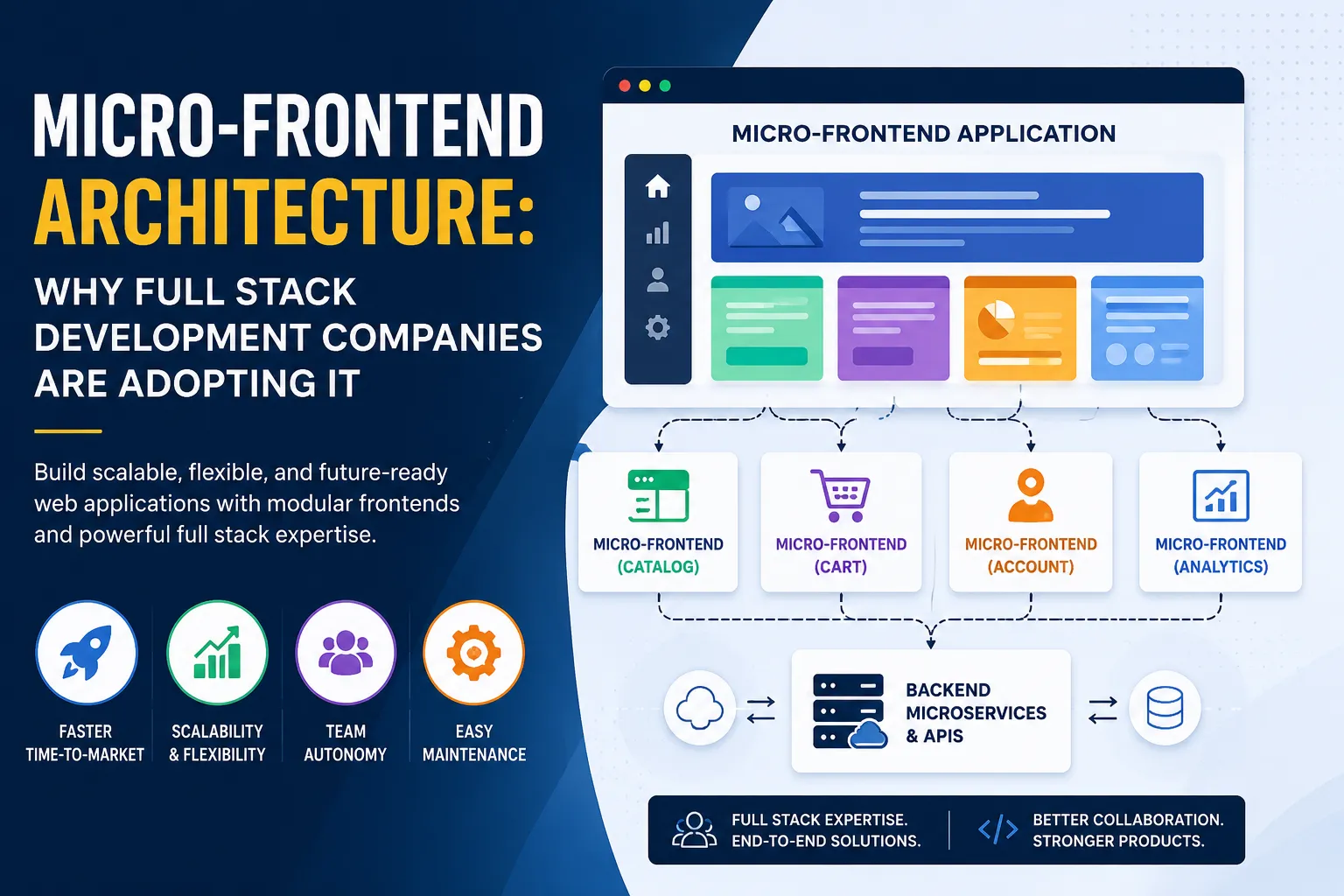
A micro-frontend architecture is a design pattern that splits a frontend application into multiple smaller applications that operate independently but appear as a single user interface.
Rather than having one huge code base for the frontend, each part of an application can be developed, tested, deployed and updated independently. Different modules belong to different teams and this does not impact the rest of the application.
Monolithic frontend applications typically bundle all features into a single codebase, slowing down deployments and increasing the chances of system failure. Any change requires the whole application to be rebuilt and tested.
Micro-frontends use the same philosophy as backend microservices. Microservices break down backend functionalities into independent services . Micro-frontends break down the user interface . Organizations can improve the efficiency of scaling frontend development .
This architectural model has gained more attraction for enterprises looking for modern full stack development services that facilitate continuous innovation.
Why Micro Frontends Are Gaining Traction In Full Stack Development Companies
Enterprise software development is becoming more about flexibility, speed and scalability. These factors have made micro-frontends a preferred choice of many development organizations.
No Complexity, Scalability
Large enterprise applications usually have hundreds of features and each of them is for a different user group. Single frontend codebase is hard to maintain eventually.
Micro-frontends offer the ability to scale each business function independently without affecting the rest of the application. This architecture allows teams to add new features and still keep the system stable, which is ideal for enterprise growth.
Shorter development timelines
Independent modules enable multiple teams to work in parallel without interfering with each other’s code.
Teams can deploy updates individually and not wait for a single centralized deployment. This accelerates development timelines dramatically and enables agile delivery models.
Increased Team Autonomy
Development teams are responsible for specific business domains.
Maybe one team works on user authentication and another on payment processing or analytics dashboards. Each team does their own thing, but contributes to one application.
Such ownership improves accountability, speeds decision making and increases productivity across projects.
Flexibility in Technology
Technology is developing quickly and many companies find themselves with legacy frontend frameworks.
Micro-frontends enable teams to use different technologies when they make sense, without having to re-write the entire application. Organizations can modernize their applications incrementally and still retain their current investments.
Low maintenance
Smaller codebases are easier to debug, update and maintain.
Developers only need to look at one isolated module in case of problems, instead of the whole application, which reduces downtime and maintenance costs.
Micro-Frontends: Full Stack Development Services That Make a Difference
Micro-frontends are the backend architectures of today. This will lead to a more flexible software ecosystem.
A biggest benefit is the modular UI development. Teams can add dashboards, customer portals, checkout pages, reporting tools, or admin interfaces without breaking the consistency of the app.
Agility from independent deployment. New capabilities are deployed independent of full system releases, reducing operational disruption and enabling continuous delivery.
And collaboration is much better. Designers, frontend developers, backend engineers, DevOps teams and QA specialists can work on different modules in parallel, reducing bottlenecks and accelerating the project.
Modern full stack development services today combine backend microservices, API gateways, cloud-native infrastructure & containerized deployments with micro-frontends. This means you can build very scalable enterprise applications that can evolve over time without big rewrites.
Benefits for Employers
But micro-frontends have the benefits for the businesses adopting them beyond just the technical.
One of the biggest benefits is it can speed time to market. Different development teams can release features independently and continuously, making it possible for organizations to respond quickly to customer needs and changes in the market.
The risk of development is also reduced because changes are made in isolated modules. If something goes wrong with deployment it only takes down one feature, but not the entire app.
Long term upgrades are a lot easier to do. This allows companies to change one module at a time instead of rebuilding the whole system. This decreases technical debt and keeps the system up and running.
The software becomes easier to maintain and the teams working on it become more productive over time, which improves the cost efficiency. Organizations develop applications in small increments, not costly rewrites of the entire platform.
The benefits entail big savings in the long run for the companies that have been working with digital goods for some time now.
The Importance of Full Stack Developers for Micro-Frontend Projects
Micro-frontends are not only frontend skills. It takes a wonderful choreography of frontend modules, backend services, APIs, firewalls, cloud infrastructure, deployment pipelines, etc. to make it work.
When an organization hires a full stack developer, it gets the benefit of people who know the whole application lifecycle, not just the parts. - Full stack developers create a common ground for front-end and back-end teams by maintaining architecture and ensuring more seamless integration across systems.
The companies, which decide to hire full stack programmer resources, also benefit from an easier project management. Cross-functional developers have a better understanding of the front end modules and back end microservices, which reduces integration issues and speeds up delivery.
With deep technical expertise, organizations are better positioned to make architectural choices that support long term scalability and maintainability.
Challenges and How Full Stack Web Development Services Can Assist
Micro-frontend architecture has advantages, but also challenges to implement.
The more front-end applications that need to talk to common services and APIs, the more complex integration becomes. Coordination requires proper planning as without it, inconsistencies are introduced across modules.
Also, performance optimization needs to be considered. The more frontend bundles you have, the more your page load times can suffer without lazy loading optimized asset delivery and caching strategies.
Another challenge is the challenge of keeping a consistent UI and UX across modules developed independently. When there’s no cohesive design system and governance, applications can feel disjointed.
The solution to these problems is professional full stack web development services. Design of centralized architecture, common component libraries, API management strategies, DevOps automation, containerization and continuous integration pipelines.
Development teams experienced in designing governance structures that achieve the right balance between consistency and individual team autonomy, so that companies can realize the full benefits of micro-frontends while maintaining quality and performance.
Conclusion
Micro Frontend Architecture is changing the way enterprise applications are designed, developed and maintained. It offers organisations a practical way to develop future-ready digital platforms that allow modular development, independent deployments, greater scalability and faster innovation.
Companies are increasingly adopting cloud-native technologies and agile delivery models, and thus working with an experienced full stack development company is a valuable asset. Modern full stack development services assist organizations to build scalable applications that are flexible to changing business needs and reduce long-term maintenance costs.
If you’re building a large enterprise platform, a SaaS product or a modern e-commerce solution, hiring full stack developers with the expertise of micro-frontend architecture can be a great improvement to project success. Hiring full stack programmer talent with both frontend and backend expertise ensures seamless integration, faster delivery and long term scalability.
Investing in expert full stack web development services today will set your business up for sustainable digital growth and a stronger competitive advantage for years to come.




























Sign in to leave a comment.