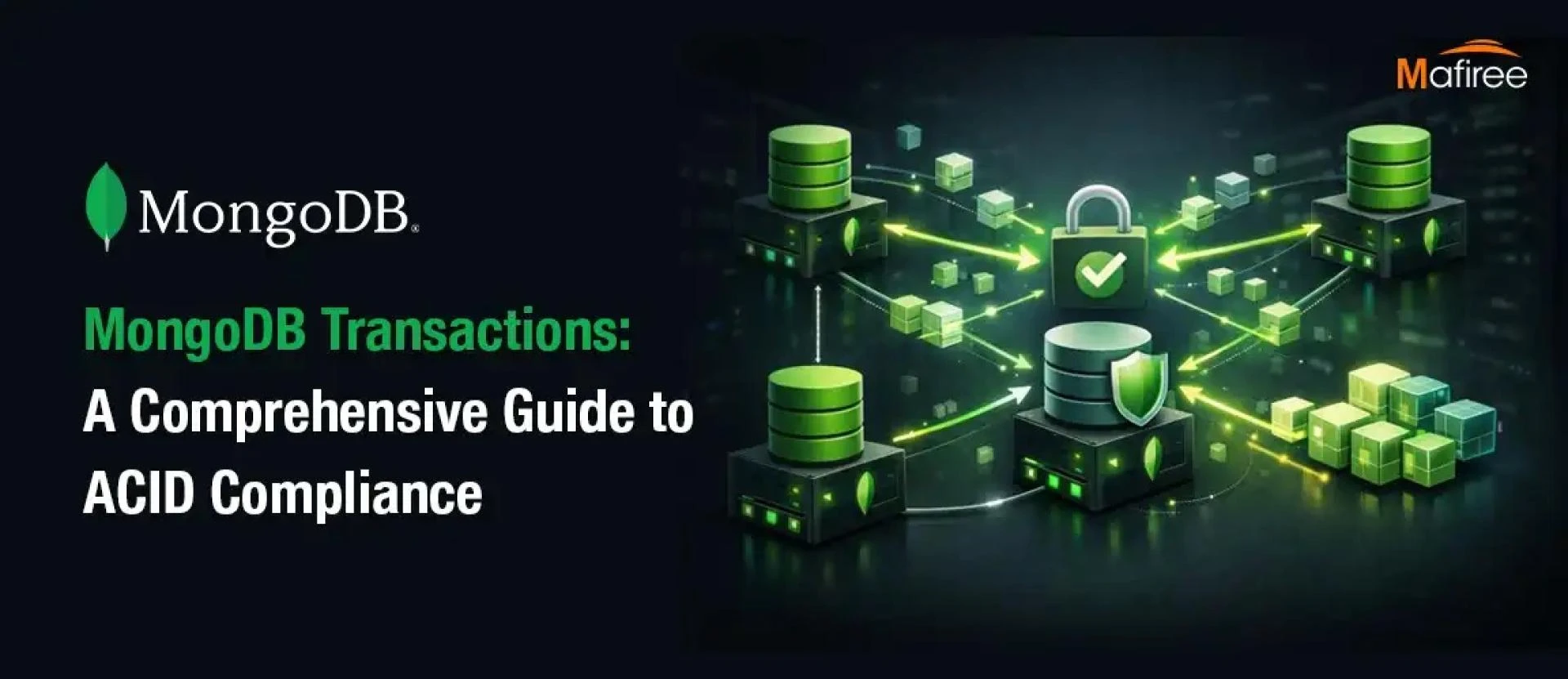

MongoDB has long been celebrated for its flexibility and performance, and since version 4.0, it also supports full ACID transactions — giving developers both NoSQL scalability and the data consistency guarantees traditionally associated with relational databases.
What Are MongoDB Transactions?
A MongoDB transaction groups multiple read and write operations into a single atomic unit. It adheres to all four ACID principles: Atomicity ensures all operations either fully succeed or are entirely rolled back; Consistency keeps data valid at every stage; Isolation hides in-progress changes from other operations until committed; and Durability guarantees that committed data survives system failures. It's worth noting that MongoDB has always been ACID-compliant for single-document writes — multi-document transactions simply extend that guarantee.
Single-Document vs. Multi-Document
Single-document operations remain MongoDB's performance benchmark. When related data is stored within one document — including nested arrays and sub-documents — writes are automatically atomic, with no overhead or deadlock risk. Multi-document transactions become necessary only when updates must span multiple collections simultaneously, such as modifying both an Orders and an Inventory collection at once. This capability was introduced for replica sets in version 4.0 and expanded to sharded clusters in 4.2. Frequent reliance on multi-document transactions may signal a schema design issue worth addressing.
How They Work
Transactions are session-bound. The typical flow involves starting a session, initiating the transaction, executing operations, and either committing to success or aborting to roll back changes on failure.
Key Constraints
Multi-document transactions cannot write to capped collections, cannot access system databases, and do not support the explain() command. Critically, standalone MongoDB servers don't support transactions at all — they require the Oplog available only in replica sets or sharded clusters. From version 4.4 onward, creating collections and indexes within transactions is permitted.
Performance Best Practices
Transactions carry overhead, so keeping them short — ideally under one second — is essential. MongoDB enforces a default 60-second limit before terminating long-running transactions. Poorly managed transactions can cause WiredTiger cache pressure, lock contention, and "Cache Full" errors. Write conflicts between concurrent transactions require retry logic using exponential backoff via the TransientTransactionError label. Monitoring commit latency, abort rates, and cache pressure is critical in production.
Sharded Clusters
Transactions on sharded clusters use a two-phase commit protocol, adding latency. Cross-shard transactions can be affected by chunk migrations, and certain replica set configurations with arbiters may restrict multi-shard support.
Transactions vs. Document Embedding
Use transactions when atomicity across multiple documents is genuinely required, such as financial transfers. Favor document embedding when data is queried together frequently, relationships are simple, or performance is the priority.
Used thoughtfully, MongoDB transactions deliver enterprise-grade reliability — without sacrificing the flexibility the document model provides.

































Sign in to leave a comment.