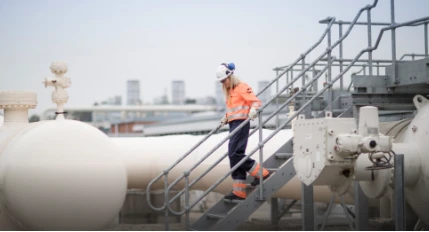
The United Kingdom continues to rapidly move towards a low-carbon future, and Ofgem's recent finance decision represents a key milestone in that journey. The announcement of an additional £107 million grant for National Gas's Project Union demonstrates that we are transitioning from ambitions for a dedicated hydrogen transmission network to implementation.

Source: www.energyvoice.com
This investment represents a total of £164 million that Ofgem has invested in Project Union, and it highlights the Regulator's clear commitment to support the establishment of hydrogen infrastructure on a national scale. For the UK energy sector, this funding decision is not simply another funding update for an exciting new project. It represents the long-awaited pivot to build the foundation for a competitive and resilient hydrogen economy.
Building the Core of Britain’s Hydrogen Network
Project Union aims to repurpose parts of the existing natural gas transmission system and construct new pipelines where needed, ultimately creating a 1,500-mile hydrogen transmission backbone that links major industrial clusters across the country.
The newly allocated investment has two major components:
The St Fergus–Teesside Link (£67m)
This is an essential pipeline connection from St Fergus in north-east Scotland to Teesside, with an important connection to the Grangemouth industrial cluster. This area contains some of the UK’s most energy-intensive industries and presents high-impact decarbonisation hydrogen opportunities. Routeing these areas through a dedicated hydrogen pipeline will further de-risk significant decarbonisation of refineries, chemicals, manufacturing and heavy industrial activity.
Project Union: North West (£40m)
The North West is developing as a hydrogen hub with the established partnership of the Geographical HyNet Cluster. The funding will support hydrogen production, distribution and storage in the region and help industries in Liverpool, Manchester, and Chester undertake decarbonisation activity with greater urgency. The proposal also progresses geological hydrogen storage, which is required to moderate reliable and flexible supply as part of growth.
Combined, these expansions push more than half of Project Union into the detailed engineering and design phase, an encouraging sign of momentum for the UK’s broader hydrogen infrastructure ambitions.
Transitioning from Discussion to Delivery
According to Ian Radley, Chief Commercial Officer at National Gas, this milestone is “a hugely significant moment for Britain’s hydrogen journey”. His comments underscore a real shift taking place within the sector: hydrogen is no longer theoretical or experimental. It is becoming an active, material part of the UK’s future energy system.
Project Union is expected to:
- Unlock substantial private and public investment.
- Provide heavy industries with a viable route to decarbonisation.
- Strengthen the UK’s long-term energy security.
- Support around 3,100 jobs at peak construction.
- Deliver an estimated £300 million in annual GVA.
These findings illustrate how investments made into infrastructure strategically can help strengthen economic development and still create environmental value.
Industry Support Continues to Strengthen
The announcement received a remarkable reaction from the energy industry.
RWE, a key power generator in Europe, noted that combining production centres and demand hubs with storage through a national hydrogen pipeline network was essential to hydrogen development, being inclusive and flexible and that any size of offtaker could become part of the hydrogen economy anywhere. Statera Energy, developing a 3GW green hydrogen project at Kintore, echoed this, expressing appreciation for the clarity Project Union provides.
For producers looking to deliver clean hydrogen to industrial clusters and flexible generation sites, having a dedicated transmission network significantly enhances project viability and helps maximise the value of renewable energy resources by reducing wind curtailment.
A Strong Signal for the UK’s Clean Energy Future
Ofgem's recent funding pledge delivers a definitive, confident message: hydrogen is a cornerstone of the UK’s long-term decarbonisation plans. Through funding the infrastructure to move hydrogen at scale, the UK is establishing its competitive advantage in low-carbon technologies in a way that also allows industries to decarbonise more effectively.
As hydrogen infrastructure develops, industrial clusters will have access to cleaner, flexible and increasingly affordable energy alternatives. Project Union’s advancement shows that the UK is not just planning its hydrogen future, it is developing it.














Sign in to leave a comment.