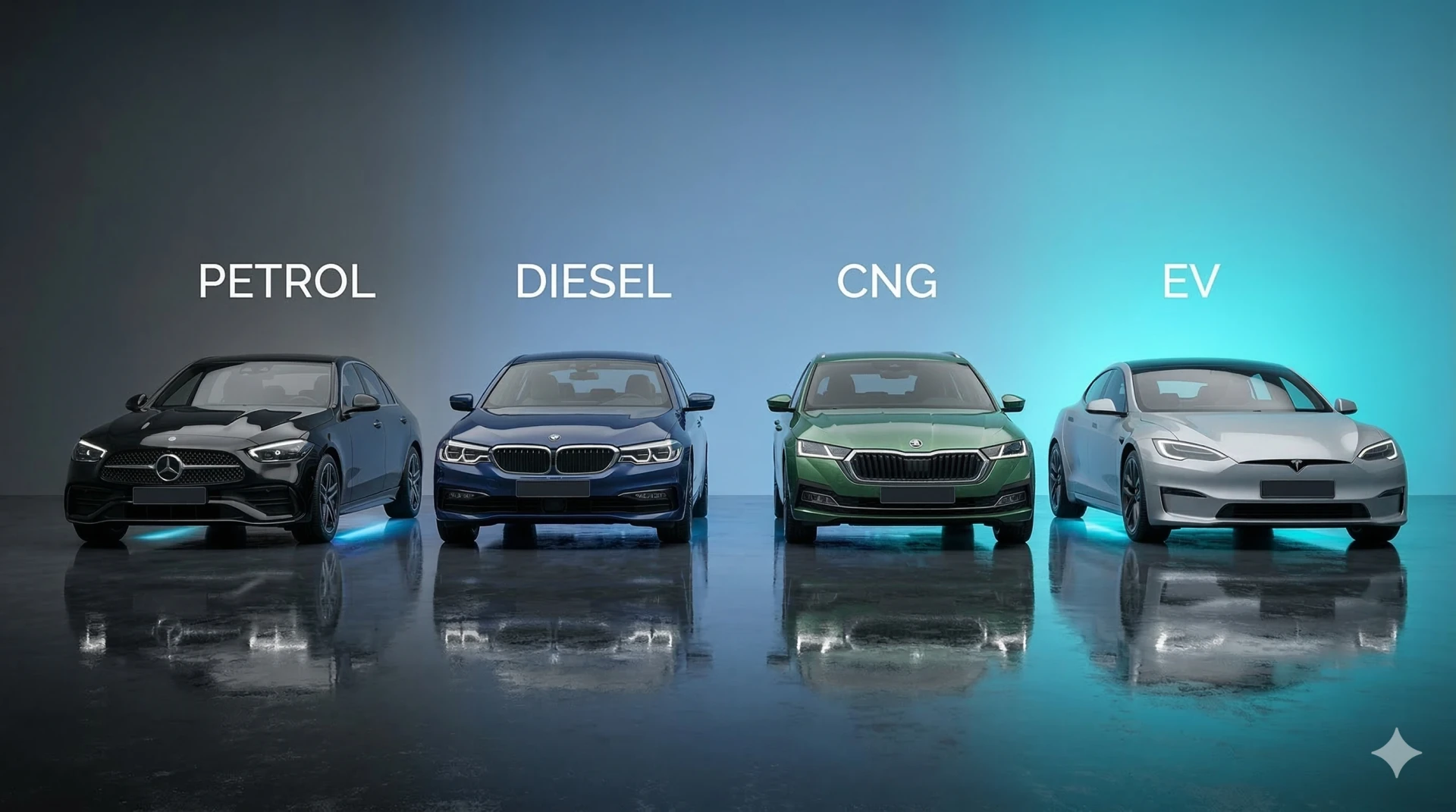

Picking a fuel type used to be a non-decision. Petrol for cities, diesel for highways, done. That logic no longer holds up. With CNG expanding its footprint and EVs steadily lowering their cost barriers, the question of which fuel makes financial sense over the long run is genuinely complex. And the answer changes depending on who you are, how much you drive, and where you live.
This isn't a ranking. It's a breakdown.
The Purchase Price Problem
Every cost comparison starts here, and it's where most people get tripped up. Petrol cars carry the lowest sticker prices. Diesel adds a modest premium, historically justified by fuel savings on long hauls. CNG variants typically cost slightly more than their petrol equivalents due to the factory-fitted kit and cylinder infrastructure. EVs sit at the top of the upfront cost ladder.
In a direct comparison, a CNG variant can cost approximately one lakh rupees more than an equivalent petrol car, while a diesel variant adds around two lakh, and an entry-level EV can carry a premium of over four lakh compared to petrol. In European and US markets, that gap is starker. In the UK, the average EV retails around £48,000 to £50,000, compared to roughly £22,000 for the average petrol car.
But purchase price alone is a misleading metric. What matters is the total cost of owning and running the vehicle over five, seven, or ten years.
Running Costs: Where the Real Divergence Happens
This is where fuel types start separating themselves clearly.
Petrol has always been the baseline. It's widely available, reliable, and costs per kilometre are predictable. The problem is they don't go down. Petrol prices are tied to crude oil, which means geopolitical events, refinery issues, or currency shifts can send your monthly fuel bill in unexpected directions.
Diesel delivers better fuel efficiency, particularly on highways, and its higher torque makes it the natural pick for hauling heavy loads or frequent long-distance travel. Diesel engines are known for lasting longer than petrol engines if properly maintained, and their efficiency advantage is most evident in high-mileage use cases. The downside is tightening regulations in many markets. Diesel bans in city zones across Europe, strict emissions standards, and the diesel particulate filter maintenance costs all chip into the economic advantage over time.
CNG occupies an interesting middle ground. CNG cars carry a 25 to 40 percent efficiency advantage over petrol, and the fuel itself costs considerably less per kilogram than petrol does per litre in markets like India. Running costs for CNG vehicles can drop to as low as one to two rupees per kilometre in city conditions. The trade-off is infrastructure. Outside of major urban centres, CNG pumps remain sparse, which limits range flexibility and makes highway travel a calculated exercise.
EVs have the lowest cost per kilometre of all four fuel types, and it isn't close. When charged at home, an EV's per-kilometre cost can be less than half of what a CNG vehicle costs to run. However, if you rely on DC fast chargers, the gap narrows significantly, and the cost per kilometre approaches that of CNG. That distinction matters enormously. Home charging is the scenario that makes EVs financially compelling. Public fast charging erodes much of that advantage.
Break-Even Points and Who Actually Benefits
The concept of break-even is central to understanding which fuel type makes sense for which person.
Based on savings per kilometre, a CNG vehicle breaks even against its petrol counterpart at around 38,000 km. A diesel car takes closer to 74,600 km to recover its higher upfront cost through fuel savings. An EV, despite its larger price premium, breaks even at approximately 71,700 km due to the much larger per-kilometre savings it generates.
What this tells you is straightforward. High-mileage drivers win with diesel and EVs. Low-mileage drivers, say under 8,000 km a year, rarely benefit from switching away from petrol. CNG is the fastest to break even, which makes it particularly attractive for daily city commuters who put in steady kilometres but can't justify an EV's upfront cost.
A 2025 analysis covering 28 European countries found that EVs in the compact segment already have a lower total cost of ownership than petrol or diesel in 18 of those countries, assuming a corporate lease structure and moderate annual mileage. In the US, studies comparing EVs to their closest petrol equivalents over a seven-year ownership period show similar trends. The Chevrolet Equinox EV costs nearly 20 percent less to own than the petrol Equinox over seven years, with 56 percent savings on fuel and 39 percent savings on maintenance.
Maintenance: The Silent Long-Term Cost
Fewer moving parts mean lower maintenance bills. This is one of the clearest advantages EVs hold. No oil changes, no timing belts, no exhaust systems to worry about. Fuel costs represent just 15 percent of an EV's total cost of ownership, while the figure is 23 percent for petrol and 28 percent for diesel drivers.
Diesel maintenance is the most expensive of the four, particularly in models with diesel particulate filters that require specific driving patterns to regenerate properly. In stop-start city driving, this becomes an active cost issue, not just a theoretical one.
CNG vehicles sit between petrol and diesel on maintenance. The CNG kit requires periodic inspection and cylinder testing, and spark plugs wear faster due to the higher combustion temperature. Over five years, though, these added costs are marginal and don't significantly offset CNG's running cost advantage.
Use Cases: Matching Fuel to Lifestyle
For urban daily commuters covering 15,000 to 20,000 km per year: CNG and EVs are the clear winners. CNG gets you to break-even faster. EVs give you lower costs over the full ownership cycle, assuming home charging is available.
For intercity and highway-heavy drivers: Diesel still makes a strong case. The fuel efficiency at higher speeds, combined with the engine's durability, means that over 100,000+ km, diesel can be more economical than petrol in markets where diesel prices remain reasonable. EVs are catching up on highway range but charging infrastructure on long routes remains inconsistent in many countries.
For fleet operators and commercial use: Battery electric heavy-duty trucks already have a lower total cost of ownership than diesel equivalents in China, and by 2030, they are expected to reach parity in Europe and the United States as well, particularly for high-utilisation routes where the fuel savings compound quickly.
For low-mileage or occasional drivers: Petrol remains the most practical and financially sound choice. The infrastructure is universal, the upfront cost is lowest, and the fuel savings from switching simply don't add up when annual mileage is modest.
The Geography Factor
Where you live shapes this entire equation. Electricity grids powered largely by renewables make EVs dramatically cheaper and cleaner. In markets with expensive electricity or cheap petrol, the calculus shifts. In the United States, which has the lowest gasoline prices and fewest EV subsidies among major markets, the total cost of ownership advantage for EVs is less pronounced than in Europe or Asia.
Government policy is the other wildcard. Subsidies, tax credits, congestion exemptions, and emissions regulations all move the numbers. The UK, for instance, has congestion charge exemptions for EVs in London. Several Indian states offer reduced road tax on EVs. These incentives don't show up in a simple fuel cost calculation, but they add up over years of ownership.
The Honest Conclusion
There is no universally correct answer here. Anyone who tells you otherwise is ignoring the variables that make each person's situation unique. What the data does tell us clearly is this: if you drive a lot and have reliable home charging, an EV wins on total cost over a five to seven year period in most markets. If you drive a lot but can't charge at home, diesel or CNG is the smarter bet. If you drive occasionally, keep your petrol car and stop second-guessing it.
Electric cars today often have a lower total cost of ownership than internal combustion engine cars over the vehicle lifetime due to reduced fuel and maintenance expenses, but the purchase price gap remains the primary adoption barrier in most regions.
That gap is closing. The decision, right now, comes down to your mileage, your charging access, and your patience with infrastructure limitations. Run the numbers for your specific situation. The winner isn't the same for everyone.
For more such informative blogs, visit AutoVoB blogs.

























Sign in to leave a comment.